
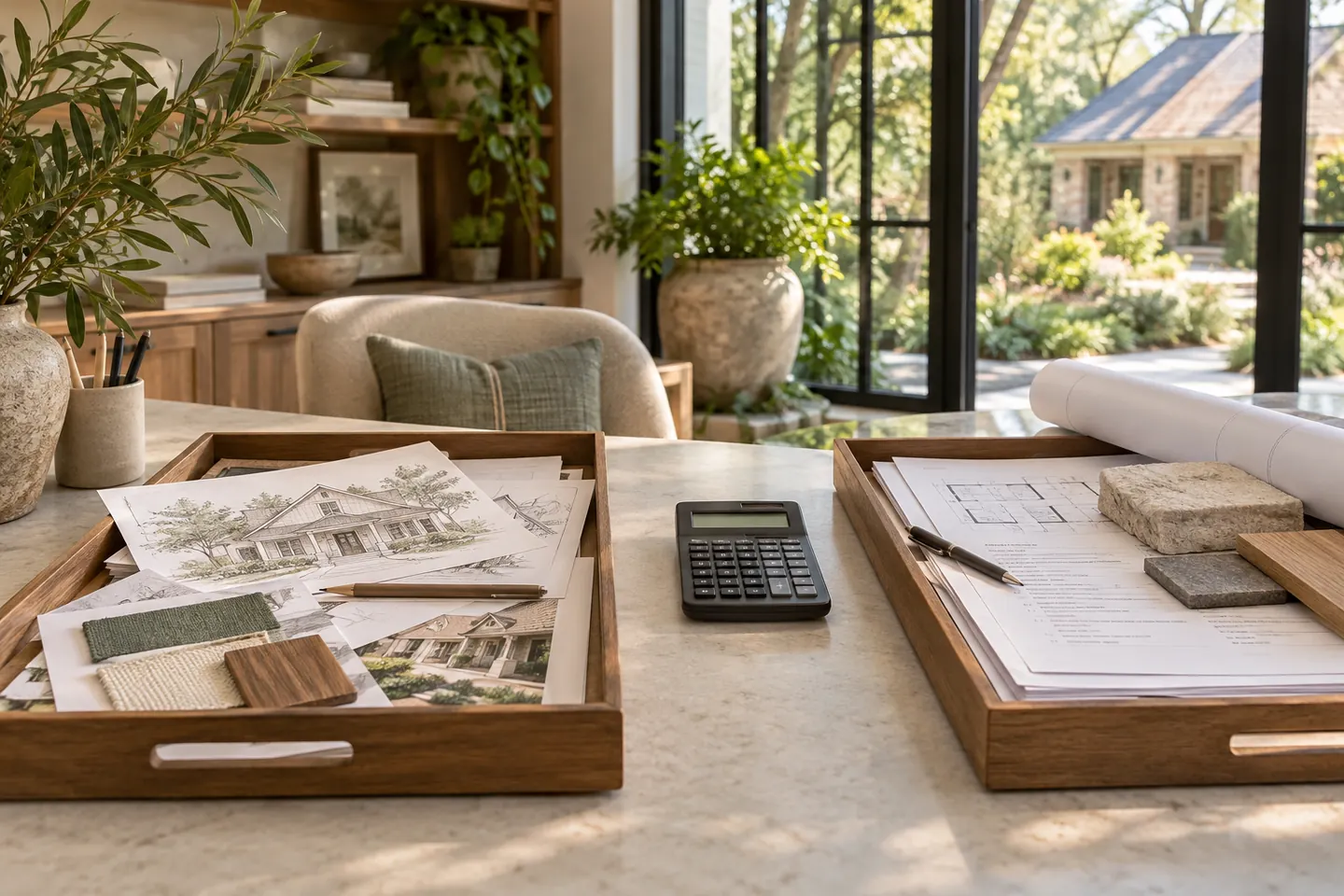
Your design fee and your construction budget are related, but they pay for different work. A homeowner may have a complete outdoor-project spending target and still need to understand which parts cover planning, design, construction, separate professional services and purchases made directly.
If a patio installer offers a construction quote and a designer provides a planning proposal, adding the two numbers may still leave important items unpriced. The better question is not just “What is the total?” but “What does each amount buy, and what is still unknown?”
Give the overall target a clear boundary
Write down the amount you are willing to consider for the complete project, if you have one. Label it as your target.
Then describe what you intend that target to cover. Include the phases and features you are considering, along with purchases you expect to make separately. If the target is not yet decided, write that instead of using a placeholder that looks like an approved amount.
This is a planning exercise, not a statement of what the project will cost. Actual proposals and unresolved scope will need to be reviewed as information becomes available.
Use five separate budget categories
Start with the scope you are considering and create a simple record. Not every category will apply to every project, and the provider's written scope—not its job title—determines where an item belongs.
- 1. Planning and design: Consultation or paid site-and-scope services, layout, 3D design development, agreed revisions, estimating support and bidding preparation where included in the signed engagement. For LANDOVA, later paid stages begin after the scope, approval and payment requirements for those stages are satisfied.
- 2. Outside technical and approval services: Surveying, engineering, specialist assessments, permits, plan review or other professional work when required or not included elsewhere. The actual project and location determine what applies.
- 3. Construction and installation: The actual work described by each trade's proposal, such as pool, patio, drainage, electrical, planting, structures or outdoor kitchens. Break these down by contractor and by scope—not just by one total.
- 4. Direct homeowner purchases: Furniture, décor or other selected items you are buying separately rather than through a construction proposal. Confirm who supplies and installs them.
- 5. Unresolved items and changes: Work awaiting quotes, selections still covered by allowances, and potential scope changes. Keep these visible as unknown or provisional instead of hiding them inside a confident total.
One contractor may supply several kinds of work, and another may use subcontractors. Separate the work by scope even when the same business appears on multiple lines. Also check for double counting before adding line items together.
Keep planning and design in its own category
A design proposal should explain the services and deliverables being offered. Ask about the review process, included revisions, exclusions and any additional work that may be proposed separately.
Do not assume two design proposals describe the same work because both use the word design. One may define a different scope or set of deliverables from another.
For LANDOVA DESIGN + PLANNING, rely on the actual engagement offered for your project. A general article cannot establish its fee, included services or terms. Keep that agreed scope beside the amount in your budget record.
Describe construction by scope
A construction amount should stay attached to the work it describes. Keep the proposal, its date, assumptions and exclusions rather than copying only the total into a spreadsheet.
If multiple trades are involved, identify how their scopes meet. Ask who includes the connection between related work and whether any item appears in more than one proposal.
Do not assign an unpriced item a zero merely to make the worksheet add up. Use a visible status such as not yet priced. The total of known amounts is useful, but it is not automatically the complete project cost.
Account for purchases outside the construction proposal
Furniture, decorative items or other owner-selected purchases may be handled separately from construction. Whether that is true for your project depends on the actual proposals.
Create a category for the items you expect to buy directly and check it against the contractor's scope. This helps avoid both omission and double counting.
Also ask about other project-specific services or charges that may need separate consideration. The goal is a complete question list, not a universal list of fees that every backyard must carry.
A fictional worksheet without invented prices
Imagine a fictional homeowner with a design proposal and a preliminary patio quote. The homeowner also plans to buy dining furniture but has not selected it.
The worksheet has separate rows for agreed design scope, the quoted patio scope, furniture not yet priced and unresolved site work. The known quoted amounts can be added, while the open rows remain visible.
This is more informative than presenting one total labeled backyard cost. It shows exactly what the current number represents and what still needs an answer.
Try this mini budget worksheet
For every line, use the same five questions:
- Item: What specifically are we purchasing or planning?
- Source: Which proposal, document or conversation supports the amount?
- Status: Is it a household target, preliminary estimate, formal quote, allowance, accepted price or still unpriced?
- Boundary: What is clearly included, excluded or not stated?
- Next action: Who will clarify the remaining question, and by when?
For a fictional project, the rows could read: “LANDOVA agreed layout and design scope — fee shown in engagement”; “Patio installation — dated trade quote”; “Dining furniture — homeowner purchase not selected”; and “Future outdoor kitchen utility provisions — scope not yet confirmed.” Each row has its own status. The worksheet does not invent a price for the unconfirmed work.
Useful check: Keep “known quoted amounts” separate from “complete project spending target.” A total of known figures should never be labeled the final all-in cost if open items remain.
Track changes without losing the starting point
If the design changes, record which budget rows may be affected. A moved feature might prompt a revised construction proposal. An added deliverable might prompt a separate design discussion. The actual provider should explain the implications.
Keep the earlier version instead of overwriting it without a note. Record the date, change and status of the new amount: requested, quoted or accepted. A figure should not look approved merely because it is the newest one.
Ask how proposed changes are handled under the relevant agreement. Keep that contractual question with the appropriate provider rather than assuming the same process applies to every part of the project.
Review the complete picture before the next commitment
Read each row and ask four questions: what does it cover, where did the amount come from, what is excluded and what remains unknown?
Then check the categories against your original overall target. If the scope and target no longer align, the next conversation can address priorities or phases using visible information.
Separating design fees from construction does not make the project less connected. It makes the responsibilities and numbers easier to understand as the plan develops.
Use LANDOVA's free Outdoor Project Planning tools to describe what you want to build, or request a free initial consultation. Your project-specific design proposal will identify the actual services and fee; it should not be assumed to be part of a future contractor's construction price unless the relevant agreements expressly say so.
Keep learning
- How LANDOVA estimates outdoor projects — Learn what the estimating stage provides.
- How planning can reduce project costs — Understand how a well-defined scope helps trades communicate.
- Compare construction quotes on equal scope — Understand how to read the work behind each proposal.
