
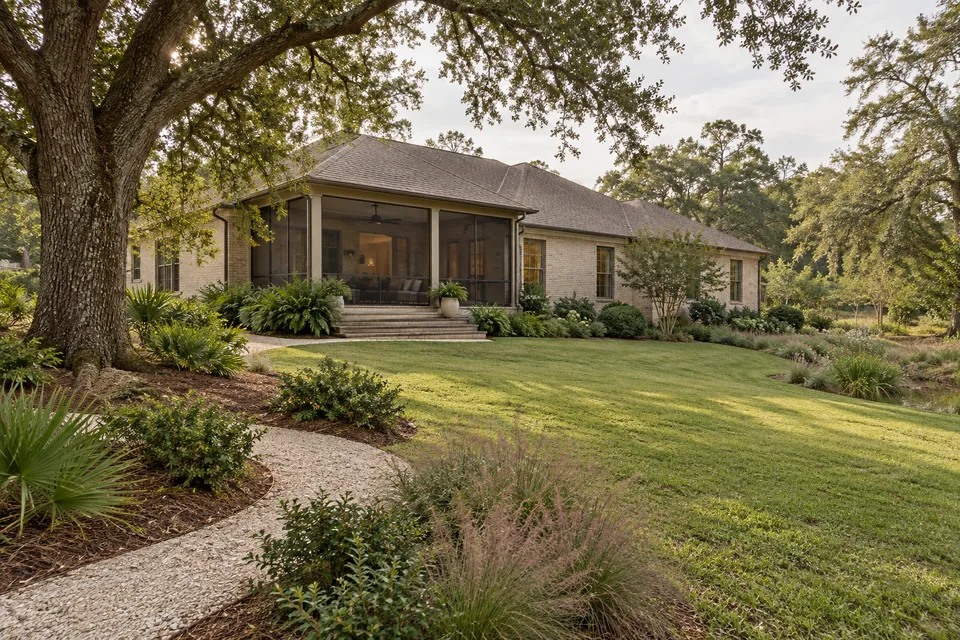
Choose sod, groundcover or artificial turf by the job the area must do—not by which option looks greenest in a photograph. A place for regular play, a planted foreground and a small pet-use area are different briefs. They deserve a comparison of specific plants or products, the installed system and the work of owning it.
Start with the current backyard layout. Mark the activities you want to preserve, then evaluate each candidate against the same conditions. There is no single surface that wins every comparison on every property.
Decide whether people will use the area or look across it
Trace the routes people and pets actually repeat. Identify where someone will play, sit or move furniture, and which parts are mainly seen from the house. Separate those needs from a leftover patch that has no clear purpose.
EPA WaterSense recommends placing turf where it has a practical function. That does not mean eliminating every lawn. It means explaining why an open surface belongs in that part of the design before selecting its material.
Compare living grass by its actual identity
Sod is a way of establishing living grass, not a universal specification. Ask which species or cultivar is proposed, why it fits the light and use, and what regional care guidance supports the choice. Keep the site assessment with the selection.
If grass has struggled there before, ask what needs investigation rather than assuming replacement sod fixes the underlying issue. Record observed shade, repeated traffic, known soil disturbance and water concerns without diagnosing them yourself.
Include establishment and later care in the discussion. Ask who supplies the instructions, performs the work and reassesses the routine when conditions change. Compare that responsibility with the amount of gardening your household actually wants.
Do not assume every groundcover is a walking surface
Groundcover describes many plants with different forms and requirements. Ask whether the exact candidate is intended for the traffic you expect. A low-growing planting beside a path is not necessarily an alternative to a lawn used for games.
Consider a separate path through a planted view when most movement follows one route. Review the actual mature spread, containment, seasonal appearance and maintenance. Do not choose a plant simply because its photograph resembles a uniform green carpet.
Evaluate artificial turf as a complete installation
Request the exact product and a written description of preparation, base, drainage, seams, edges and any infill. Ask who evaluates the site and which assumptions still need confirmation. A sample of the visible fibers does not explain the whole installed system.
University of California Agriculture and Natural Resources identifies ongoing artificial-turf cleaning needs, including plant debris, spills and pet waste. Treat maintenance-free claims cautiously and request the actual manufacturer's care instructions.
Ask separately about sun-exposure comfort, the intended activity, repair, warranty exclusions and eventual removal. Require evidence for environmental or health claims tied to the product and use being proposed; a general label cannot settle them.
Use the same six questions for all three options
- Use: Which household activity is the option intended to support?
- Site: What light, soil, water and traffic information supports the proposal?
- Identity: Which exact plant, cultivar or manufactured system is included?
- Installation: What preparation, drainage, edges and restoration are in the price?
- Ownership: What routine care, equipment, supplies and professional service are expected?
- Change: How would repair, replacement or a later backyard phase affect this area?
Write not provided beside an unanswered item. Do not fill the space with a guessed annual cost, an assumed water saving or a promise that the category performs a certain way.
Test the comparison on two fictional areas
Imagine a family that wants an open play area beside a garden walk. The play space needs a surface evaluated for the actual activity. The planted edge mainly provides a view and should not be treated as though it has the same requirements.
The family could compare a locally appropriate grass for the activity area, a specific groundcover along the walk and a defined synthetic installation as an alternative where its product information supports the intended use. The final plan might contain more than one system, or reject a candidate after site review.
The purpose is not to make three different areas look identical. It is to explain how each supports the household without creating an ownership routine nobody accepts.
Keep the decision tied to its evidence
Before purchase, retain the selected identity, installation scope, care instructions and unresolved conditions. Review substitutions against those same requirements, not only against color. A different grass or synthetic product may need its own evaluation.
LANDOVA helps place these choices within the complete outdoor design. Request a free initial consultation to discuss the activities and care expectations behind your landscape. Technical site capture begins after the applicable paid Site + Scope commitment.
