
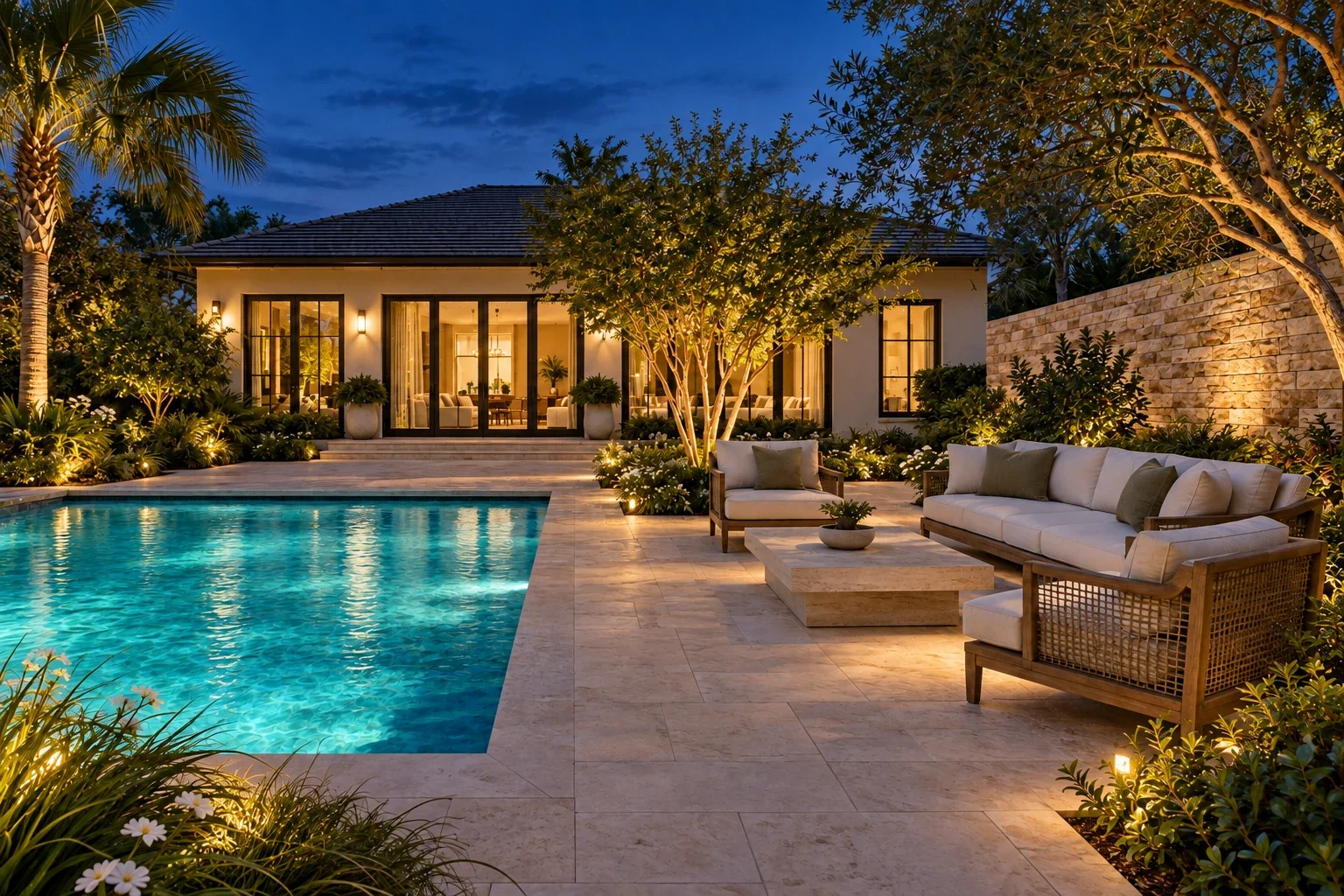
A glowing pool can be the center of an evening backyard. It can also compete with the dining area, leave the route back to the house unresolved or look very different from the photograph that inspired the purchase.
Plan the evening experience before selecting a light package. Start with where you will be, what you will be doing and which parts of the yard you want to notice.
Describe two evenings, not one dramatic image
Write a scene for an ordinary evening and another for a gathering. In the first, perhaps two people sit outside after dinner while the pool provides a quiet backdrop. In the second, people move between the house, dining area and poolside seating.
List what each scene needs. You may want a restrained view from inside the house, enough appropriate lighting for the intended outdoor activities and simple controls. These goals are more useful to the design team than “make it bright” or “make it look like a resort.”
Include the people who do not want to swim. A backyard lighting concept should still make sense when the water is a visual feature and everyone is on the patio.
Use a two-scene evening lighting brief
Give the design team two practical descriptions using the same pool and backyard:
- Quiet evening: A couple is seated after dinner while the water becomes a visual background. Identify where guests sit, what indoor window they look through, and what should remain gently illuminated rather than distracting.
- Active gathering: People move between the house, poolside seating and dining. Identify which paths and transitions must be evaluated for safe, functional lighting, independently of the underwater effects.
For each scene, write activity | important viewpoint | intended atmosphere | safety or visibility question | desired control action. A spectacular color image doesn't answer all five.
Review the views you actually have
Identify the main indoor view, the dining position, the lounge seats and the approach from the house. Ask the lighting professional to review the proposed arrangement from those positions, including potential glare and reflections.
A manufacturer's image is an example, not a forecast. Pentair's lighting documentation notes that perceived lighting varies with the light model, its installation, pool finish and geometry, and surrounding light. A design visualization should therefore be labeled as a concept, not proof of exact color or illumination.
If you visit a completed example, record the conditions. What other lights were on? Was the pool finish similar to yours? Were you viewing it from the same kind of position? Those observations can guide a conversation without becoming a promise that your yard will look identical.
Coordinate the water with the dry spaces
Put the pool, patio, steps, paths and house lighting into one discussion. Different professionals may be responsible for different parts, but someone should explain how the overall plan fits together.
Ask which areas require functional lighting and which are intended primarily as visual accents. Do not assume underwater lighting will adequately serve a walking route or a separate seating area. Request a professional review of the whole arrangement and applicable requirements.
Also consider the views beyond the property. Discuss where light is directed and whether nearby windows or neighboring spaces need consideration. The goal is a pleasant evening environment, not simply more illuminated objects.
Match fixture performance to the actual pool
Pentair's IntelliBrite Architectural Series specifications explicitly caution that the appearance of light can vary with fixture model, position, depth, pool finish and surrounding illumination. That is a reason to request the exact quoted models, intended locations and any documented limitations from your pool-lighting professional—not to expect a marketing photo to reproduce itself on your property.
Ask whether the proposed system is intended to emphasize the water, reveal pool edges or support other specific design goals. Lighting in nearby patios, steps and paths must be coordinated and professionally evaluated for the intended activity. Underwater light does not substitute for adequate site lighting, supervision or required barriers.
Choose controls around ordinary actions
Describe a few actions in plain language: turn on the everyday evening setting, select a different pool-light setting, return to the usual arrangement, and turn the relevant systems off. Ask the provider to demonstrate how the proposed controls support them.
Confirm which functions require optional equipment or a particular automation configuration. If several lighting systems are involved, ask whether they are controlled together or separately. A single concept image should not imply a single control when the proposal includes several unrelated products.
Discuss who will set up the system and teach you to use it. Request the exact model names and current documentation, including any limitations relevant to the desired lighting effects.
Plan a clear homeowner handoff
Before accepting the package, have the installer identify the exact fixtures, controls, compatibility assumptions, switching or scenes, electrical responsibilities, warranty contacts and demonstration plan. If the project uses separate pool and landscape lighting systems, ask which functions operate together and which require independent controls or extra components.
Electrical work in and around pools carries special safety considerations. Installation, bonding, grounding, applicable protective devices and code compliance belong to qualified pool and electrical professionals—not a homeowner experiment based on a product tutorial.
Review before installation locks in the choices
Ask for an evening concept tied to the current pool and landscape plan. The review should identify the fixture selections, the intended experience and the items that still require technical confirmation. Keep electrical design, installation and servicing with qualified professionals; lighting around water is not a homeowner trial-and-error project.
For a fictional comparison, imagine one concept that emphasizes dramatic color throughout the water and another that supports a quieter pool view beside an active dining area. Compare both against your two evening descriptions. The right answer may be different settings for different occasions, if the actual system supports them.
Record why you chose the arrangement and what the provider will demonstrate at handoff. Thoughtful lighting begins with the life you want after sunset, then turns that intention into a coordinated, professionally reviewed design.
Start with the free Outdoor Project Planning tools to describe the evenings you want to enjoy, or request a free initial consultation. Detailed lighting design and electrical requirements are addressed by the relevant qualified professionals as the approved project develops.
Related homeowner guides
- Sun, shade and evening use — Plan the hours when your outdoor spaces matter most.
- Before hiring a landscape lighting contractor — Clarify lighting-trade responsibilities.
- Pool automation questions — Understand whether the desired scenes and controls are supported.
- Backyard level changes — Review paths and transitions alongside lighting.
