

Published by LANDOVA Design & Planning. Updated October 6, 2026.
Plan the backyard around the hours you expect to use it. A lounge that looks inviting in a rendering may not match your preference for morning sun or afternoon shade. An outdoor dining area should also be considered after sunset if that is when your household gathers.
At LANDOVA, those preferences belong in the early layout conversation. The day and night design review then gives homeowners another way to evaluate the same arrangement as detail develops.
Begin with your actual schedule
Write down a few ordinary uses and their likely times. Perhaps breakfast outside matters on weekends, the pool gets used after school, and dinner is usually late. Be specific about the experience you want: direct sun, a shaded place to read, a sheltered gathering area or a comfortable view from the living room.
Household preferences may differ. Instead of trying to make one seat satisfy every person, ask whether the arrangement can offer a choice. The design can test how sun-oriented and shade-oriented spaces relate to the pool, house and gathering areas.
Observe the property before deciding
Where it is safe and practical, photograph the same parts of the yard at several times on an ordinary day. Note which areas you currently enjoy and which you avoid. Existing trees, roofs and neighboring structures are relevant to the conversation.
Treat those observations as a starting record, not a full-year sun analysis. Ask what changes with the season and what the proposed design might change. A future structure or growing tree may alter the conditions around seating and planting. Any visual study should identify its assumptions rather than suggesting one image represents every day.
Compare shade choices as design decisions
Different approaches bring different questions. With a structure, discuss its location, proportion, relationship to the house and required technical review. With planting, discuss the conditions and mature space the selected plants need. With a flexible shade element, check how it will be used, stored and maintained against the actual product guidance.
UF/IFAS advises matching planting to the site’s light and water conditions and checking mature height and width. Those criteria help keep a shade or screening idea connected to the space it will occupy. Read UF/IFAS planting guidance.
Review the evening as a sequence
Imagine bringing dinner outside, finding a seat, walking back into the house and looking out at the yard afterward. Which routes, changes in level, cooking tasks and gathering spaces need attention? What should feel visually quiet?
A night visualization can start this discussion, but it does not establish measured illumination or equipment performance. Ask what is illustrative, what fixtures are proposed and what still requires a qualified lighting or electrical review. Consider glare, views from nearby properties and the actual task at each location.
DarkSky and the Illuminating Engineering Society recommend lighting that has a purpose, is directed where needed and uses appropriate controls. Use those principles to frame the conversation with the lighting professional. Read the responsible-lighting principles.
Use one property to compare the options
In an illustrative example, a family prefers afternoon shade for dining but wants a sunny place to lounge. Compare those two zones within the same backyard plan. Keep the house, pool and furniture scale consistent so the choice concerns location and use, rather than a different-looking scene.
Review matching daytime and evening views when possible. If a proposed change moves the kitchen or dining area, return to the routes between them. Comfort decisions remain connected to circulation and entertaining.
Record priorities before approving finishes
Summarize the decisions in plain language: which space serves which routine, what exposure is preferred and what remains to be checked. Identify any future phase that changes the arrangement or conditions. Confirm that the priorities appear in the agreed layout before the project becomes focused on colors and surface selections.
The aim is a backyard designed around the life you expect to live outside. Video reviews, household feedback and project-specific technical checks each contribute a different part of that decision.
Bring these questions to your design review
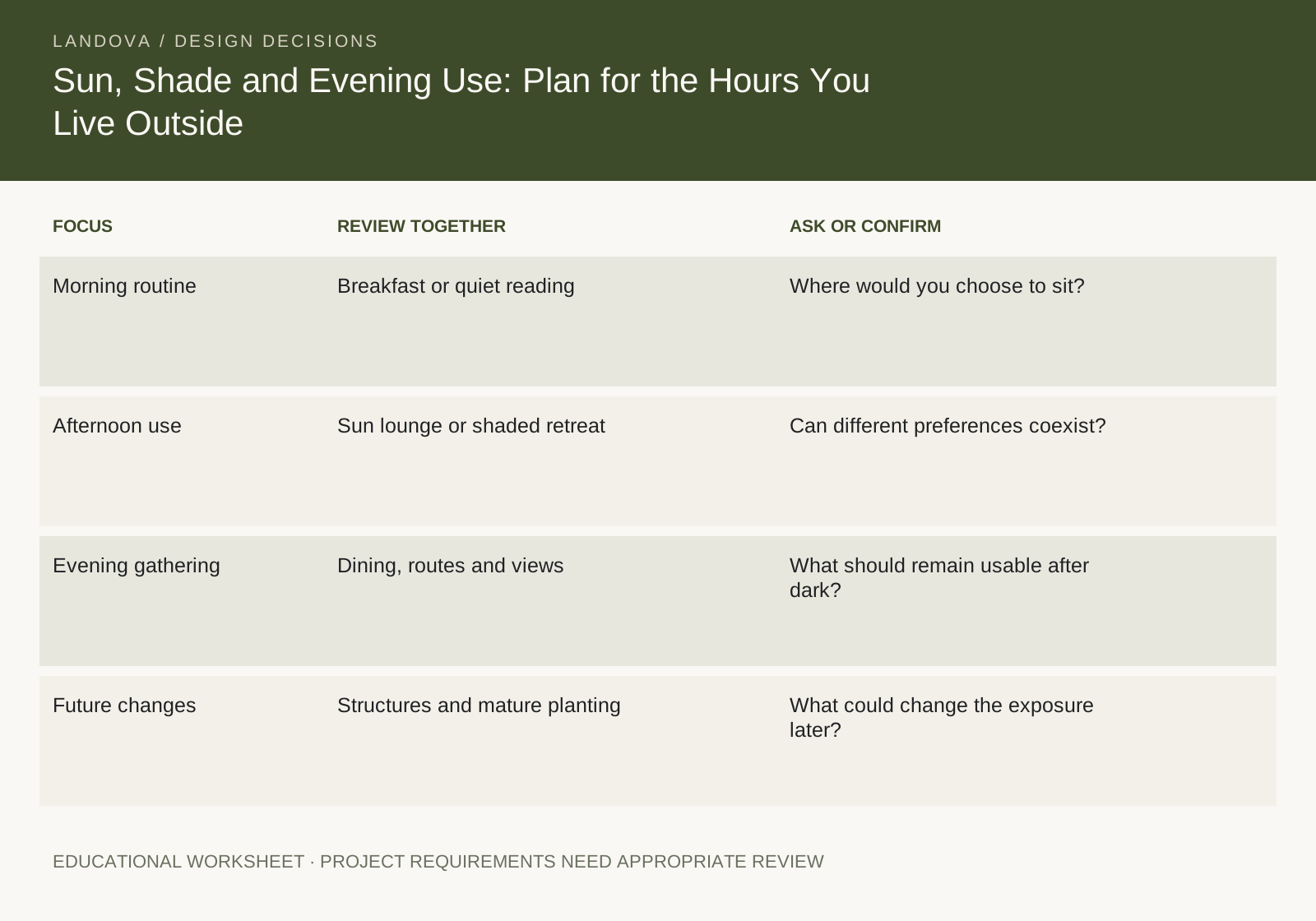
- Morning routine · Breakfast or quiet readingWhere would you choose to sit?
- Afternoon use · Sun lounge or shaded retreatCan different preferences coexist?
- Evening gathering · Dining, routes and viewsWhat should remain usable after dark?
- Future changes · Structures and mature plantingWhat could change the exposure later?
Keep planning the whole project
These decisions connect to other parts of the yard. Continue with:
