
Published by LANDOVA Design & Planning. Updated October 6, 2026.
Choose poolside landscaping by what it needs, how it grows and how you want to maintain it. Color and texture matter, but the design should also consider mature space, plant litter, access and the relationship between planting and the pool.
LANDOVA uses these questions to connect the landscape to the whole outdoor plan. The goal is a planting direction that supports your priorities, with actual plant selections checked against the property rather than chosen solely because they look attractive in a rendering.
Give each planting area a job
Decide what the landscape should accomplish. One area may provide privacy, another may soften a view of paving, and another may bring seasonal interest near a seating area. Those are different roles. A dense screen is not automatically the right treatment for every edge of the yard.
Also identify views you want to retain, including views from indoors. Discuss how the landscape relates to gathering areas, circulation and the pool. The planting should be reviewed as part of the arrangement, not added after every other space has consumed the available room.
Match the selection to the conditions
UF/IFAS recommends considering sun and shade, water availability and mature height and width when choosing plants. It also advises against crowding plants together simply to create a mature appearance sooner. Those checks are useful foundations for a poolside selection discussion. Read UF/IFAS’s right-plant, right-place guidance.
For a Gulf Coast property, ask which exposures are relevant to the actual location. Do not assume every coastal address experiences the same conditions or that a plant labeled “coastal” will suit every bed. Any named species or cultivar should be verified using reliable horticultural information and project-specific assessment.
Review the mature arrangement
A young plant in a nursery container is not a permanent space requirement. Ask what the planting could occupy as it develops and how the plan handles that space. Where might pruning become a regular task? Which routes, service areas or views need to remain available?
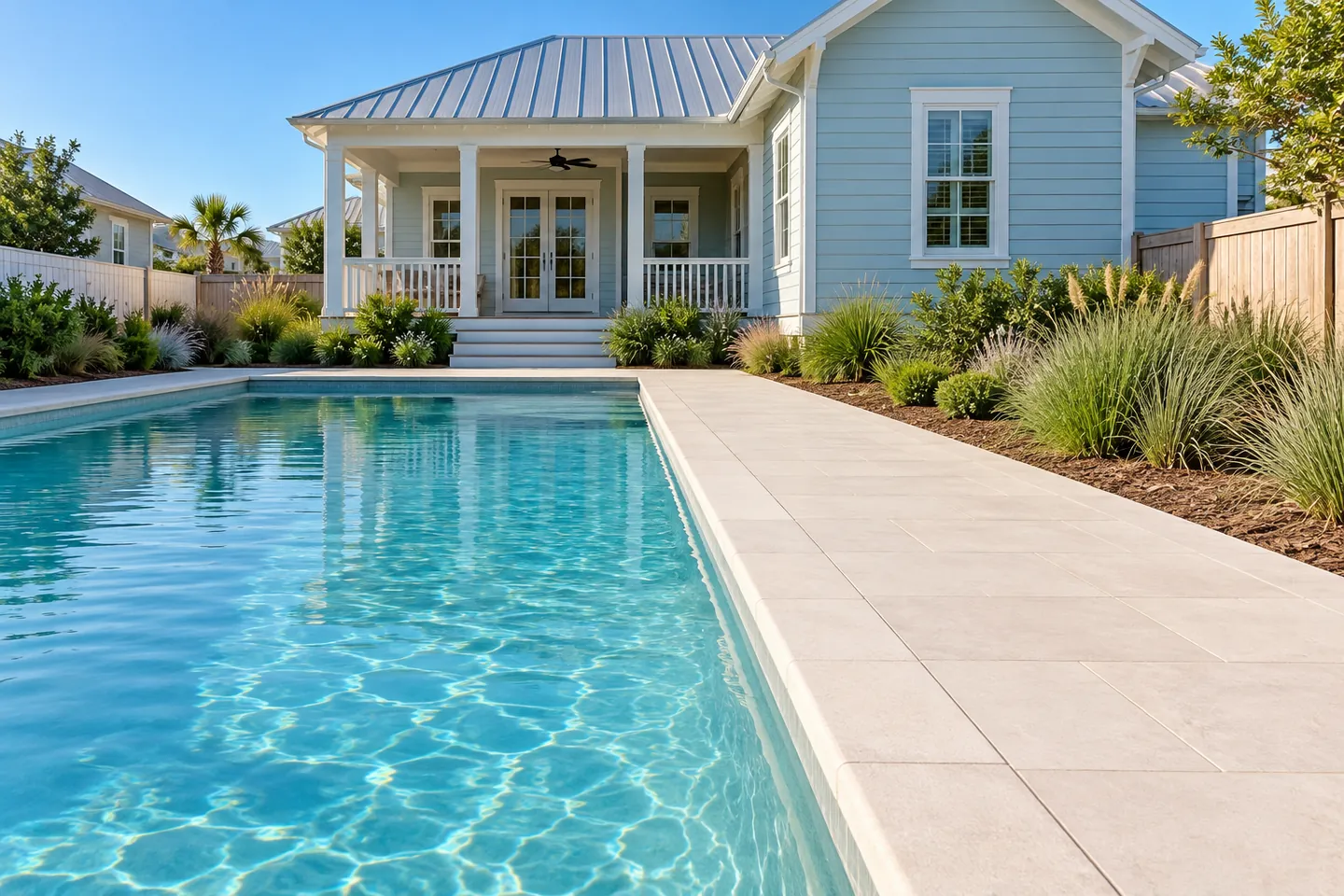
Consider an illustrative poolside bed that is attractive when shown as a row of small shrubs. The useful follow-up is to compare the intended mature arrangement, the desired privacy and the available access. If those goals conflict, revisit the selection or placement before treating the image as a finished answer.
Talk honestly about cleanup
Discuss leaves, flowers, fruit and other plant litter with the designer and the professionals who will care for the property. Ask what the proposed plants are likely to contribute and whether that matches your tolerance for cleanup around the pool and seating areas. A preference for abundant seasonal flowers may come with a different care expectation than a restrained planting scheme.
Avoid treating “low maintenance” as “no maintenance.” Identify who will do the work, what tasks they are comfortable handling and which areas they need to reach. If an important selection has not been researched, leave it as an open item rather than promising an easy-care result.
Keep equipment and service areas usable
Landscaping can help integrate practical equipment into the view, but screening should be coordinated with the equipment’s actual requirements. Ask the appropriate installer or service professional what access must remain. Do not prescribe a planting distance from a decorative image.
Discuss roots and the relationship to nearby structures, paving and utilities with qualified professionals as needed. The right response depends on the proposed plant and property conditions. Check the actual selection before treating root behavior or plant suitability as settled.
Put a care plan beside the plant list
For each candidate, record its exact identity, intended role, expected mature dimensions, local suitability and principal care tasks. Ask what it sheds, when cleanup is likely and who will reach the back of the bed. UF/IFAS poolside guidance makes clear that its suggested plants still need care and cannot tolerate a deluge of chlorine or salt water.
Compare two arrangements using the same view and furniture: planting directly beside the lounge, and planting in a separate accessible bed. Which route does each require for cleanup and pruning? Which view does each screen? Record the task and the person expected to perform it before calling either option easier to maintain.
Have the responsible professionals review planting around pool barriers, visibility needs, equipment and utilities. Where existing trees may be affected, seek an appropriate arborist assessment. The planting image does not establish barrier compliance or show that roots and future construction are compatible.
Review the future yard as well as the first installation
If a pavilion or kitchen is planned for later, ask how that phase affects light, access and the planting areas around it. A landscape installed now may need to accommodate that future work. Coordinate the sequence before new planting fills a route that another phase will need.
During the design update, review planting roles first, then actual selections, mature space and care expectations as detail develops. Record what has been verified and what remains to be checked. The result should be a landscape conversation that respects both the desired look and the work of living with it.
Bring these questions to your design review
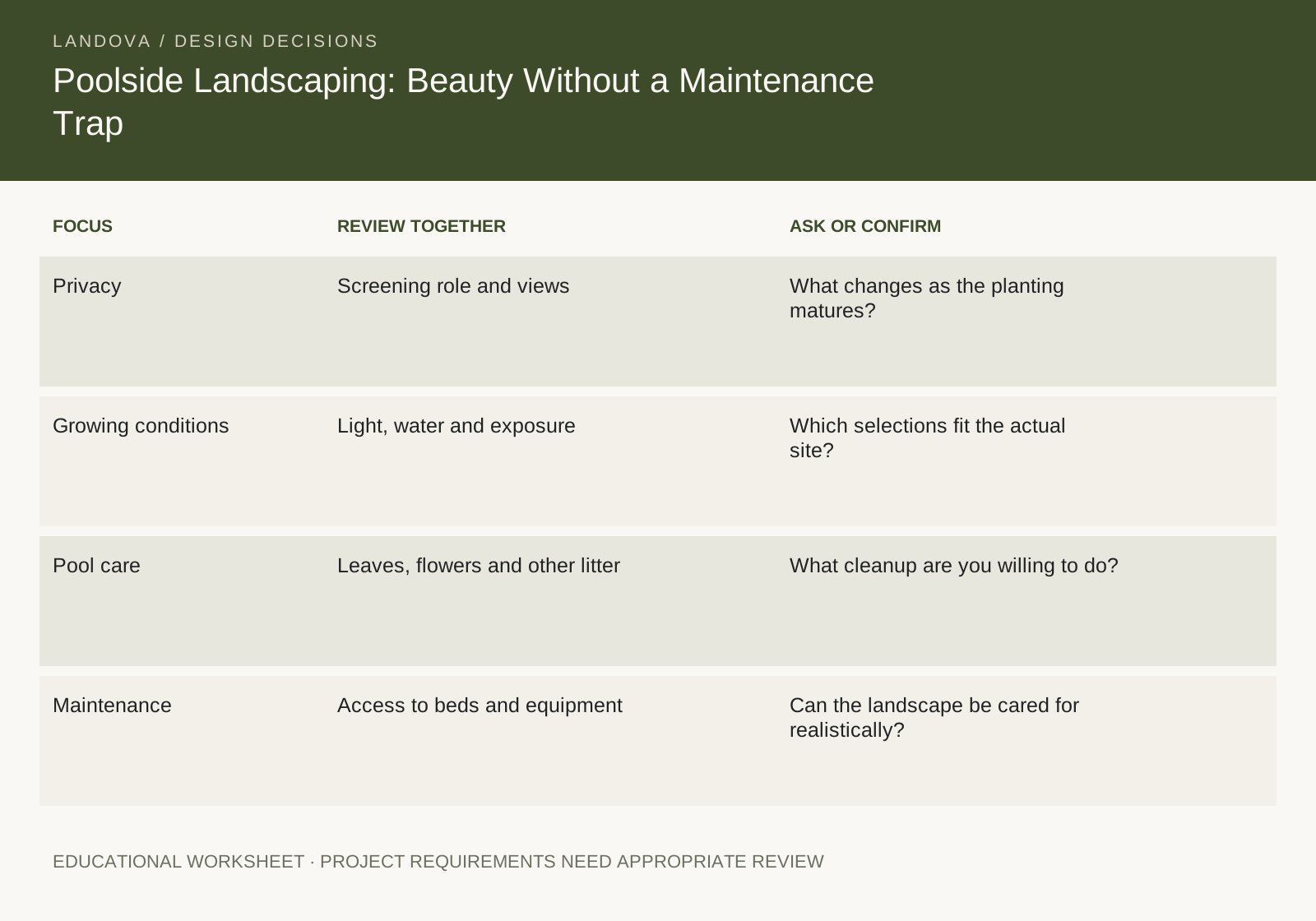
- Privacy · Screening role and viewsWhat changes as the planting matures?
- Growing conditions · Light, water and exposureWhich selections fit the actual site?
- Pool care · Leaves, flowers and other litterWhat cleanup are you willing to do?
- Maintenance · Access to beds and equipmentCan the landscape be cared for realistically?
Keep planning the whole project
These decisions connect to other parts of the yard. Continue with:
