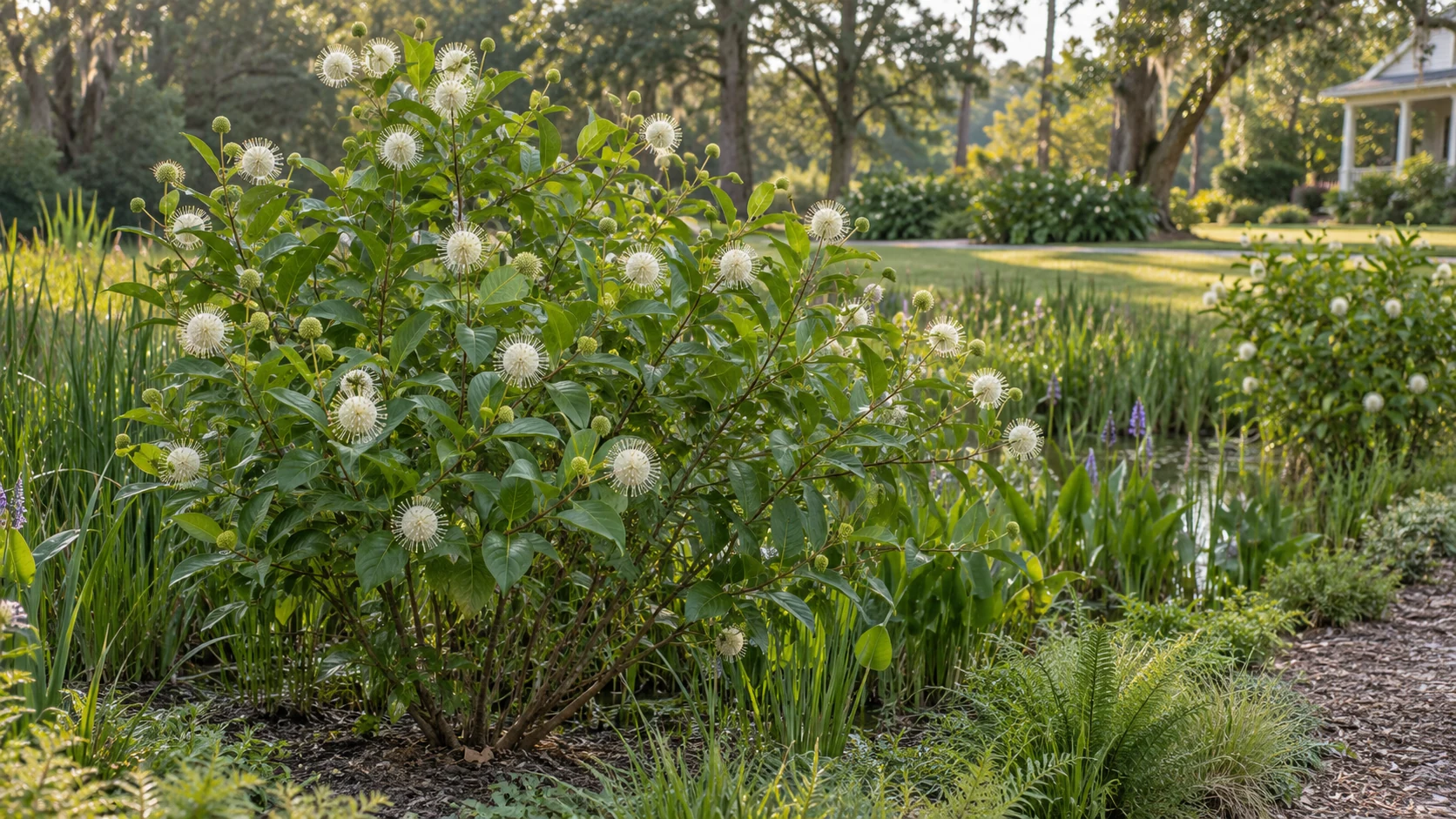
Round white flower heads bring an unexpected detail to a large, leafy native shrub. Buttonbush is an option for a genuinely moist setting, with enough space for its broad form. Choosing it starts with understanding water, not just liking the flower.
Illustrative planting concept
Size and space
Mature range: 6–12 ft high × 6–10 ft wide.
UF/IFAS lists 6–12 ft high by 6–10 ft wide and notes older plants may spread beyond 12 ft. Keep a generous growth allowance in the plan. This is the full-sized species, not a named dwarf selection.
Compare with a six-foot person: installed example 2 ft high by 1.5 ft wide. This example is not a fixed pot size or a growth timeline.
Full sun to part sun · Consistently moist to wet freshwater conditions; poor fit for dry beds. · Deciduous; white spherical spring-to-summer flowers and later seed heads.
Where it works around Pensacola
Consider Buttonbush for an appropriate moist planting area in Pensacola or coastal Alabama. UF/IFAS identifies it as a Florida native suited to wet sites. It is not a fix for a drainage defect, and poor salt tolerance rules out a brackish flood zone.
Moist native garden
Freshwater pond-side planting
Large pollinator border
Roomy rain-garden concept
Naturalistic background shrub
Why is the area wet?
Identify the source, depth and duration of water before choosing plants. A wet-tolerant shrub does not resolve water entering a building or crossing a property boundary.
Where is the dry access route?
Leave a reliable route for garden care and keep people out of the wet planting area. Draw the route outside the eventual branch spread.
Will this be the main privacy screen?
Allow for winter leaf loss. If year-round screening matters, plan a separate evergreen layer in conditions appropriate to that plant.
Does the whole garden stay moist?
Keep dry-bed plants out of the wet center. A single composition can have different planting zones, each matched to the actual water pattern.
Before it goes on the plan
Can planting it repair drainage?
No. It can suit an appropriate wet garden once the water plan is understood. Drainage and construction decisions still need their own review.
Is it suitable immediately beside the pool?
A broad seasonal shrub with leaves, flowers and seed heads needs a deliberate setback. A moist native bed elsewhere may be a better starting point.
Are the plant parts edible?
No. Buttonbush can be harmful if eaten. Keep that in mind when choosing locations around children, pets and edible gardens.
Pairing ideas
Summersweet Clethra: Summersweet Clethra can bridge to a moist acidic outer bed. Match the exact wetness; do not assume both plants tolerate the same depth or duration of water.
Henry’s Garnet Sweetspire: Henry’s Garnet Sweetspire offers a lower arching layer in compatible moist soil. Keep it clear of the buttonbush’s eventual canopy.
{"key":"button","id":"PLT-CEPH-OCCIDENTALIS","slug":"buttonbush","name":"Buttonbush","botanical":"Cephalanthus occidentalis","eyebrow":"Start with the wetter part of the property","benefit":"Give a damp garden a deliberate purpose.","intro":"Round white flower heads bring an unexpected detail to a large, leafy native shrub. Buttonbush is an option for a genuinely moist setting, with enough space for its broad form. Choosing it starts with understanding water, not just liking the flower.","h":[6,12],"w":[6,10],"install":[2,1.5],"color":"#6f8859","habit":"round","light":"Full sun to part sun","lightTags":["sun","part"],"water":"Consistently moist to wet freshwater conditions; poor fit for dry beds.","season":"Deciduous; white spherical spring-to-summer flowers and later seed heads.","care":"Allow a loose multi-stemmed form; manage spread and access as it grows.","site":"Consider Buttonbush for an appropriate moist planting area in Pensacola or coastal Alabama. UF/IFAS identifies it as a Florida native suited to wet sites. It is not a fix for a drainage defect, and poor salt tolerance rules out a brackish flood zone.","sizeNote":"UF/IFAS lists 6–12 ft high by 6–10 ft wide and notes older plants may spread beyond 12 ft. Keep a generous growth allowance in the plan. This is the full-sized species, not a named dwarf selection.","uses":["Moist native garden","Freshwater pond-side planting","Large pollinator border","Roomy rain-garden concept","Naturalistic background shrub"],"checks":[["Why is the area wet?","Identify the source, depth and duration of water before choosing plants. A wet-tolerant shrub does not resolve water entering a building or crossing a property boundary."],["Where is the dry access route?","Leave a reliable route for garden care and keep people out of the wet planting area. Draw the route outside the eventual branch spread."],["Will this be the main privacy screen?","Allow for winter leaf loss. If year-round screening matters, plan a separate evergreen layer in conditions appropriate to that plant."],["Does the whole garden stay moist?","Keep dry-bed plants out of the wet center. A single composition can have different planting zones, each matched to the actual water pattern."]],"faq":[["Can planting it repair drainage?","No. It can suit an appropriate wet garden once the water plan is understood. Drainage and construction decisions still need their own review."],["Is it suitable immediately beside the pool?","A broad seasonal shrub with leaves, flowers and seed heads needs a deliberate setback. A moist native bed elsewhere may be a better starting point."],["Are the plant parts edible?","No. Buttonbush can be harmful if eaten. Keep that in mind when choosing locations around children, pets and edible gardens."]],"sources":[["UF/IFAS Buttonbush","https://ask.ifas.ufl.edu/publication/FP117"],["Florida Native Plant Society","https://www.fnps.org/plant/cephalanthus-occidentalis"],["USDA NRCS plant guide","https://plants.sc.egov.usda.gov/DocumentLibrary/plantguide/pdf/pg_ceoc2.pdf"]],"companions":[{"slug":"summersweet-clethra","name":"Summersweet Clethra","title":"Step toward the moist edge","reason":"Summersweet Clethra can bridge to a moist acidic outer bed. Match the exact wetness; do not assume both plants tolerate the same depth or duration of water.","image":{"id":"6a9f6fc61b4de4ff5d4dfb69","url":"https://cdn.prod.website-files.com/6a975baac0f352647862d847/6a9f6fc61b4de4ff5d4dfb69_landova-clethra-context-r06.webp","alt":"Illustrative planting concept with Summersweet Clethra"}},{"slug":"henrys-garnet-sweetspire","name":"Henry’s Garnet Sweetspire","title":"Build a lower transition","reason":"Henry’s Garnet Sweetspire offers a lower arching layer in compatible moist soil. Keep it clear of the buttonbush’s eventual canopy.","image":{"id":"6a9f5cd7d7f880ff25110b61","url":"https://cdn.prod.website-files.com/6a975baac0f352647862d847/6a9f5cd7d7f880ff25110b61_landova-henry-context-r05.webp","alt":"Illustrative planting concept with Henry’s Garnet Sweetspire"}}],"wholeCaption":"Illustrative leafy-season vase-shaped form; this shrub loses its leaves in winter.","detailCaption":"Illustrative spherical white flower heads; bloom timing and density vary.","wholeFit":"contain","native":true,"guideKind":"Native species guide","aliases":["common buttonbush","button bush"],"images":{"context":{"id":"6a9fefd510a56c43d4c56ee0","url":"https://cdn.prod.website-files.com/6a975baac0f352647862d847/6a9fefd510a56c43d4c56ee0_landova-button-context-r07.webp","alt":"Illustrative planting concept with Buttonbush"},"whole":{"id":"6a9fefd5e2004ee023e03bc0","url":"https://cdn.prod.website-files.com/6a975baac0f352647862d847/6a9fefd5e2004ee023e03bc0_landova-button-whole-r07.webp","alt":"Illustrative view of Buttonbush overall form","fit":"contain"},"detail":{"id":"6a9fefd5bc55594ead64ba39","url":"https://cdn.prod.website-files.com/6a975baac0f352647862d847/6a9fefd5bc55594ead64ba39_landova-button-detail-r07.webp","alt":"Illustrative view of Buttonbush foliage and seasonal detail"}},"caution":"A large deciduous shrub for freshwater wet sites. It cannot repair drainage and is harmful if eaten."}
LANDOVA / PLANTING DECISIONS
Choose plants with the whole space in mind.
Explore a planting goal, then compare the growing needs and mature size of individual plants.
LANDOVA is in beta
Join the launch waitlist.
We are not accepting paying clients yet. We expect to launch around January 2027 and may open sooner. Explore our free tools now, and sign up for launch updates and educational planning emails.
Thank you. Your waitlist signup has been received. We will email you with launch updates. No purchase or project booking has been made.
We could not save your signup. Please try again or email info@landovadesign.com.