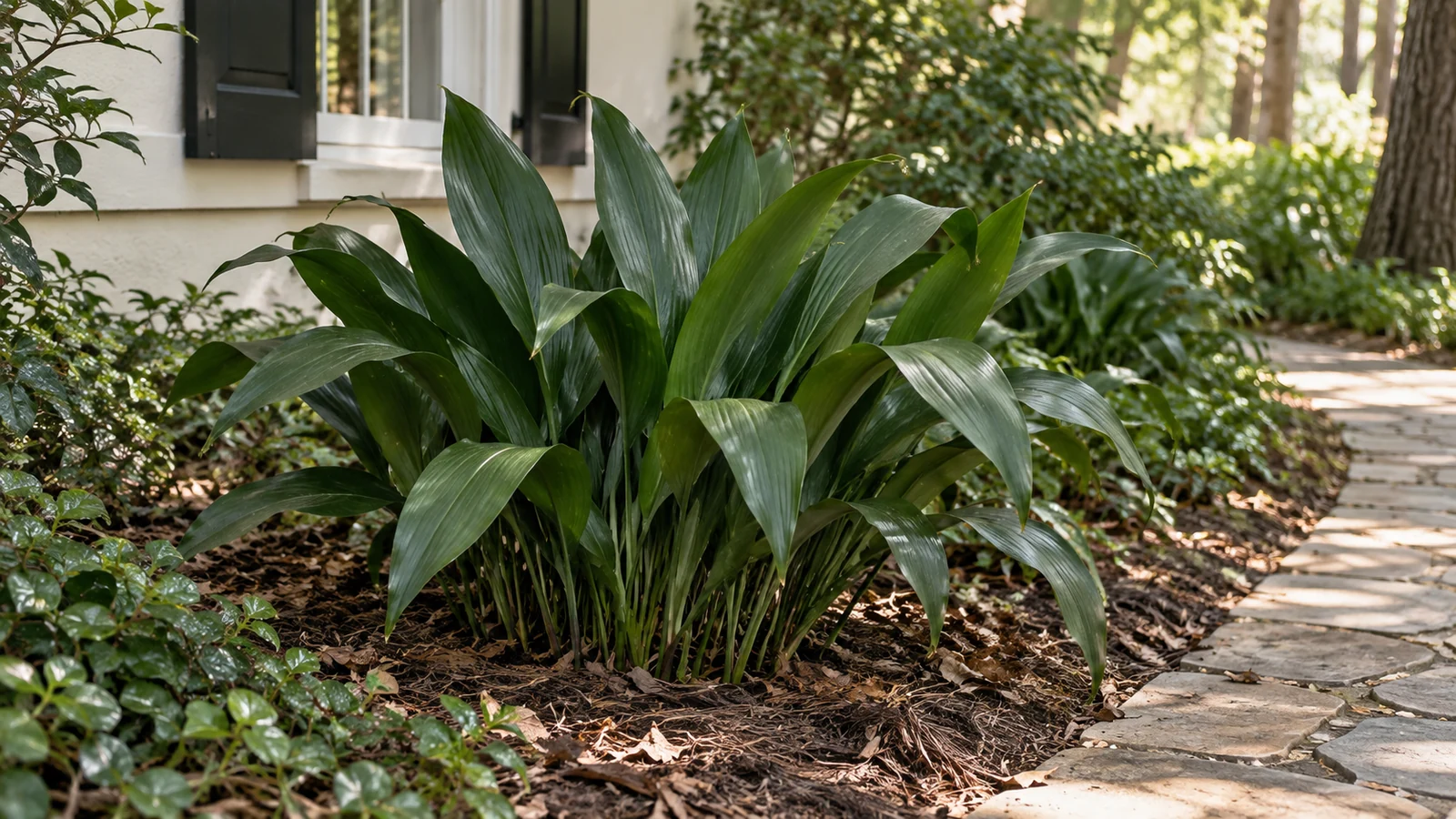
Give a shaded bed a broad, calm evergreen texture.
Cast Iron Plant forms upright clumps of broad, arching leaves. It offers a stronger leaf shape than fine-textured mondo grass or liriope and can make a shaded bed feel full without a shrub canopy. The plain green form in this guide is especially useful as a repeated foliage layer beneath taller planting.
Before you choose: The name describes toughness, not immunity to poor placement. Direct sun can scorch the leaves, persistent wetness is unsuitable, and exposed winter wind can mark the foliage. It is a taller clumping ground layer, not a low carpet or a walking surface.
Illustrative planting concept
Size and space
Typical height: 12–36 in. Mature spread: 1–3 ft wide.
NC State lists a broad 12–36 in height and 1–3 ft width range; many plain green plants are nearer two feet tall. Confirm the nursery form when height matters. Rhizomes gradually enlarge the planting, and clumps can be divided when needed. The measured diagram shows an individual clump; repeated planting still needs a layout based on the actual bed and nursery stock.
Installed example: 8 in high × 8 in wide. This is an illustrative size, not a pot-size or growth-timeline promise.
Part shade to deep shade; protect from direct sun · Water to establish; well-drained soil, with drought tolerance once rooted · Broad glossy green foliage; flowers are small and near the soil
Care: Remove damaged leaves at the base; divide expanding clumps when needed
Know the whole plant
Illustrative overall form of Cast Iron Plant; the nursery plant, season and growing conditions will affect its appearance.Illustrative foliage and seasonal detail of Cast Iron Plant. Confirm the botanical name on the nursery label.
Where it works around Pensacola
Consider Cast Iron Plant for a sheltered Pensacola shade garden, a north-facing bed or a lower layer beneath an open tree canopy. Check the light through different seasons before choosing a position. New plants still need establishment water, particularly under trees where roots compete and rainfall may not reach the soil evenly.
A broad-leaved shade ground layer
A sheltered foundation bed
A repeated texture beneath a canopy
A calm background in a courtyard
A leafy edge beside a shaded sitting area
Does direct sun reach the leaves?
Watch the bed beyond the morning visit. A position that appears shaded early can receive strong afternoon sun and damage the foliage.
Is the root area drained?
Check watering and roof runoff before planting. Tolerance of dry periods does not make a soggy bed suitable.
Will tree roots compete?
Under established trees, plan small planting locations carefully and avoid damaging major roots. Check moisture at each new clump during establishment.
Can damaged leaves be removed?
Allow access to cut tired or injured leaves near the base. Routine shearing across the leaf blades spoils the natural outline.
Before it goes on the plan
Is it only a houseplant?
No. UF/IFAS includes it as an outdoor landscape plant throughout Florida where shade and suitable soil are available.
Will it spread like a fast vine?
It expands through rhizomes into larger clumps, rather than racing across the surface like Asiatic Jasmine. Leave space to divide or manage the planting as it develops.
Will it flower above the foliage?
The unusual flowers occur close to the ground and are easy to miss. Choose this plant for the broad green leaves, not a showy flower display.
Pairing ideas
Mine-No-Yuki Camellia: Mine No Yuki Camellia can provide a flowering backdrop in suitable filtered light. Keep the cast iron clumps outside its trunk and maintenance area.
Dwarf Mondo Grass: Dwarf Mondo offers a lower texture in its own shaded section. Match irrigation to the site and leave room for each clump to develop.
{"key":"castiron","name":"Cast Iron Plant","botanical":"Aspidistra elatior","slug":"cast-iron-plant","id":"PLT-ASPI-ELAT","type":"groundcovers","h":[1,3],"w":[1,3],"install":[0.65,0.65],"native":false,"groundGroup":"large","light":"Part shade to deep shade; protect from direct sun","lightTags":["part","shade"],"water":"Water to establish; well-drained soil, with drought tolerance once rooted","season":"Broad glossy green foliage; flowers are small and near the soil","care":"Remove damaged leaves at the base; divide expanding clumps when needed","benefit":"Give a shaded bed a broad, calm evergreen texture.","intro":"Cast Iron Plant forms upright clumps of broad, arching leaves. It offers a stronger leaf shape than fine-textured mondo grass or liriope and can make a shaded bed feel full without a shrub canopy. The plain green form in this guide is especially useful as a repeated foliage layer beneath taller planting.","caution":"The name describes toughness, not immunity to poor placement. Direct sun can scorch the leaves, persistent wetness is unsuitable, and exposed winter wind can mark the foliage. It is a taller clumping ground layer, not a low carpet or a walking surface.","sizeNote":"NC State lists a broad 12–36 in height and 1–3 ft width range; many plain green plants are nearer two feet tall. Confirm the nursery form when height matters. Rhizomes gradually enlarge the planting, and clumps can be divided when needed. The measured diagram shows an individual clump; repeated planting still needs a layout based on the actual bed and nursery stock.","site":"Consider Cast Iron Plant for a sheltered Pensacola shade garden, a north-facing bed or a lower layer beneath an open tree canopy. Check the light through different seasons before choosing a position. New plants still need establishment water, particularly under trees where roots compete and rainfall may not reach the soil evenly.","uses":["A broad-leaved shade ground layer","A sheltered foundation bed","A repeated texture beneath a canopy","A calm background in a courtyard","A leafy edge beside a shaded sitting area"],"checks":[["Does direct sun reach the leaves?","Watch the bed beyond the morning visit. A position that appears shaded early can receive strong afternoon sun and damage the foliage."],["Is the root area drained?","Check watering and roof runoff before planting. Tolerance of dry periods does not make a soggy bed suitable."],["Will tree roots compete?","Under established trees, plan small planting locations carefully and avoid damaging major roots. Check moisture at each new clump during establishment."],["Can damaged leaves be removed?","Allow access to cut tired or injured leaves near the base. Routine shearing across the leaf blades spoils the natural outline."]],"faq":[["Is it only a houseplant?","No. UF/IFAS includes it as an outdoor landscape plant throughout Florida where shade and suitable soil are available."],["Will it spread like a fast vine?","It expands through rhizomes into larger clumps, rather than racing across the surface like Asiatic Jasmine. Leave space to divide or manage the planting as it develops."],["Will it flower above the foliage?","The unusual flowers occur close to the ground and are easy to miss. Choose this plant for the broad green leaves, not a showy flower display."]],"sources":[["UF/IFAS: Cast Iron Plant","https://gardeningsolutions.ifas.ufl.edu/plants/ornamentals/cast-iron-plant/"],["NC State Extension: Cast Iron Plant","https://plants.ces.ncsu.edu/plants/aspidistra-elatior/"]],"unit":"in","heightLabel":"Typical height","spreadLabel":"Mature spread","color":"#70815a","guideKind":"Groundcover","eyebrow":"THE LOW LAYER / FORM + SEASON","aliases":["Cast Iron Plant","Aspidistra elatior"],"goals":["color"],"wholeCaption":"Illustrative overall form of Cast Iron Plant; the nursery plant, season and growing conditions will affect its appearance.","detailCaption":"Illustrative foliage and seasonal detail of Cast Iron Plant. Confirm the botanical name on the nursery label.","groundForm":"broadleaf","spreadText":"1–3 ft wide","heightText":"12–36 in","sizeSummary":"12–36 in high · 1–3 ft wide","images":{"context":{"id":"6aa052e4beb1621af788dce7","url":"https://cdn.prod.website-files.com/6a975baac0f352647862d847/6aa052e4beb1621af788dce7_landova-groundcover-castiron-context.webp","alt":"Illustrative planting concept with Cast Iron Plant","width":1600,"height":900},"whole":{"id":"6aa052e48c44eb05710cad44","url":"https://cdn.prod.website-files.com/6a975baac0f352647862d847/6aa052e48c44eb05710cad44_landova-groundcover-castiron-whole.webp","alt":"Illustrative whole-plant form of Cast Iron Plant","width":1448,"height":1086,"fit":"contain"},"detail":{"id":"6aa052e43a639d18154ceb7d","url":"https://cdn.prod.website-files.com/6a975baac0f352647862d847/6aa052e43a639d18154ceb7d_landova-groundcover-castiron-detail.webp","alt":"Illustrative foliage and seasonal detail of Cast Iron Plant","width":1254,"height":1254}},"companions":[{"slug":"mine-no-yuki-camellia","name":"Mine-No-Yuki Camellia","title":"Add taller shaded structure","reason":"Mine No Yuki Camellia can provide a flowering backdrop in suitable filtered light. Keep the cast iron clumps outside its trunk and maintenance area.","image":{"id":"6a9f40877400c99880ee23a1","url":"https://cdn.prod.website-files.com/6a975baac0f352647862d847/6a9f40877400c99880ee23a1_landova-mine-context.webp","alt":"Illustrative planting concept with Mine-No-Yuki Camellia"}},{"slug":"dwarf-mondo-grass","name":"Dwarf Mondo Grass","title":"Contrast broad leaves with fine foliage","reason":"Dwarf Mondo offers a lower texture in its own shaded section. Match irrigation to the site and leave room for each clump to develop.","image":{"id":"6aa00d183fe0798c1efa78ee","url":"https://cdn.prod.website-files.com/6a975baac0f352647862d847/6aa00d183fe0798c1efa78ee_landova-grass-mondo-context.webp","alt":"Illustrative planting concept with Dwarf Mondo Grass","width":1600,"height":900}}]}
LANDOVA / PLANTING DECISIONS
Choose plants with the whole space in mind.
Explore a planting goal, then compare the growing needs and mature size of individual plants.
LANDOVA is in beta
Join the launch waitlist.
We are not accepting paying clients yet. We expect to launch around January 2027 and may open sooner. Explore our free tools now, and sign up for launch updates and educational planning emails.
Thank you. Your waitlist signup has been received. We will email you with launch updates. No purchase or project booking has been made.
We could not save your signup. Please try again or email info@landovadesign.com.