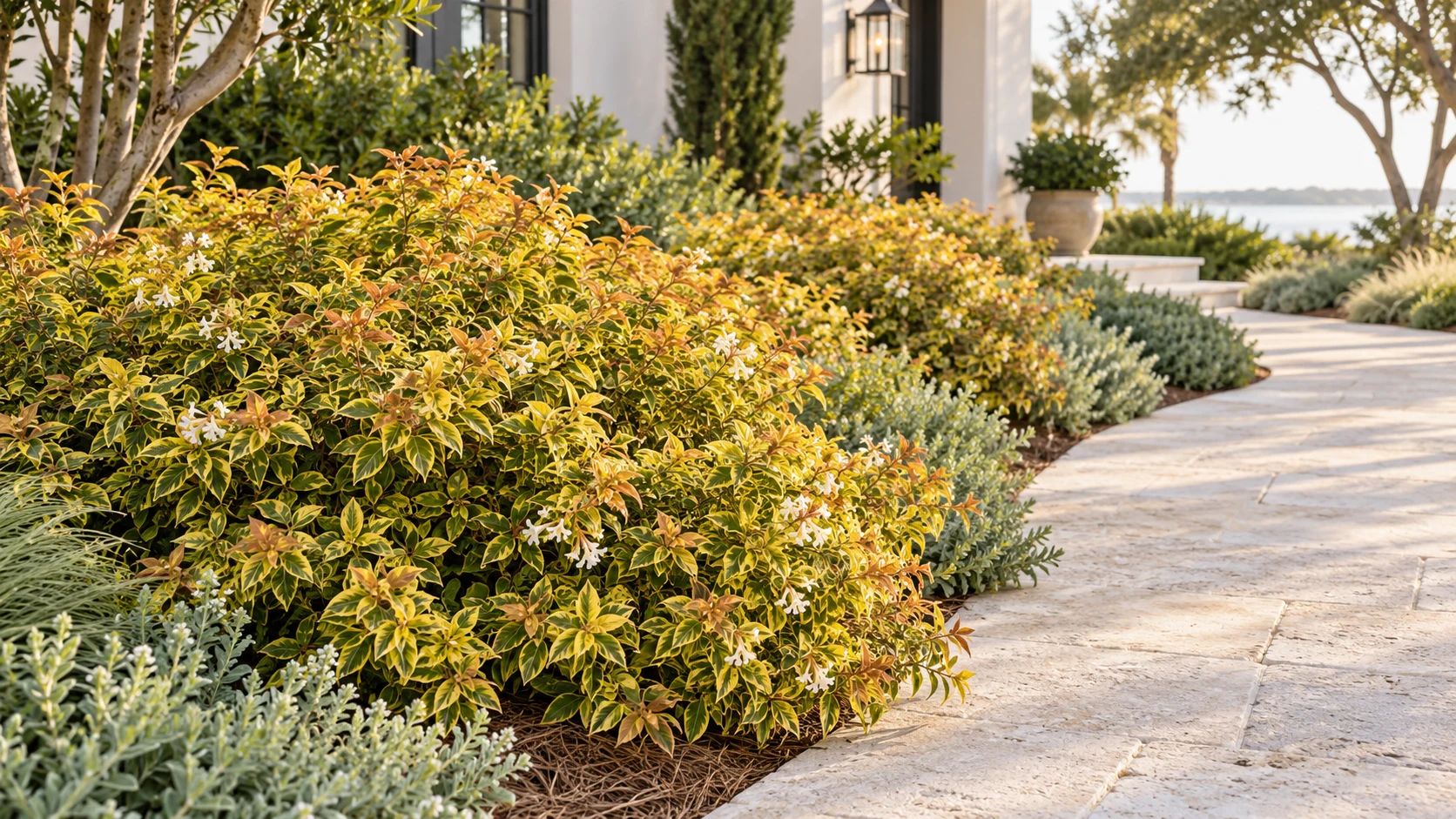
Golden leaf edges and warm seasonal tones bring brightness at the front of a garden. Use this abelia as a repeated accent or a soft planting edge, allowing its loose, spreading branches to do the work without crowding the path.
Illustrative planting concept
Size and space
Mature range: 2–3.5 ft high × 3–6 ft wide.
Southern Living lists a compact 2–3 ft height and 3–4 ft spread. NC State Extension reports plants up to about 3.5 ft high and 6 ft wide. The diagram includes that broader possibility so a tight path does not depend on constant trimming.
Compare with a six-foot person: installed example 1 ft high by 1.5 ft wide. This example is not a fixed pot size or a growth timeline.
Sun to part shade · Well-drained soil; water to establish · Variegated foliage · small white flowers
Where it works around Pensacola
A useful foliage accent for Pensacola-area beds with good drainage. Repeat it where the color helps organize the view, and balance it with calmer green plants so the garden still feels settled when everything matures.
A bright edge to a mixed border
Repeated color near an entry
A soft, informal low hedge
Contrast beside dark green foliage
A container accent with room for roots
Does the color help the layout?
Try a few repeated groups rather than a different colorful shrub in every gap. View the planting with the house, paving and furniture so the foliage supports the space instead of competing with it.
Is the path outside the future branches?
Compact height can disguise substantial spread. Reserve space for arching stems and maintenance access before deciding the distance between each plant and the walking surface.
Will the bed drain after rain?
Choose a bed that releases excess water. Water new plants reliably, then adjust to actual soil moisture and weather. Established drought tolerance does not mean a newly planted shrub can be ignored.
Are you planning beyond one season?
The leaf colors shift, and colder conditions can reduce foliage. Treat it as a changing accent rather than the only year-round screening layer. Use its natural form when deciding how formal the garden should feel.
Before it goes on the plan
Will it always be bright yellow?
No. Green and gold foliage can develop orange, red and bronze tones with the seasons. Light and growing conditions influence the display, so one photograph is only a moment in its year.
Can it fit in a narrow strip?
Only if the available width suits the plant and the maintenance plan. Mature examples can spread farther than a compact nursery label suggests. A wider bed allows the arching form to remain attractive.
Does it need regular shearing?
It can be shaped, but repeated shearing changes the natural habit. If pruning is needed, selective work in late winter or early spring is usually a better starting point than clipping every new shoot.
Pairing ideas
Vintage Jade Distylium: Vintage Jade distylium can give the border a quieter evergreen layer where sun and drainage suit both. Allow separate mature footprints rather than alternating them too closely.
Purple Pixie Loropetalum: Purple Pixie loropetalum offers a darker, lower contrast in compatible sun or part shade. Both spread, so use deliberate groups and keep the weeping branches clear of the walk.
{"key":"kaleidoscope","id":"PLT-ABEL-KALEIDOSCOPE","slug":"kaleidoscope-abelia","name":"Kaleidoscope Abelia","botanical":"Abelia × grandiflora ‘Kaleidoscope’","eyebrow":"COLOR FROM THE FOLIAGE","benefit":"A little color can shape the whole border.","intro":"Golden leaf edges and warm seasonal tones bring brightness at the front of a garden. Use this abelia as a repeated accent or a soft planting edge, allowing its loose, spreading branches to do the work without crowding the path.","h":[2,3.5],"w":[3,6],"install":[1,1.5],"color":"#9D9F4D","habit":"Low, arching, spreading shrub","light":"Sun to part shade","lightTags":["sun","part"],"water":"Well-drained soil; water to establish","season":"Variegated foliage · small white flowers","care":"Selective shaping; allow natural spread","site":"A useful foliage accent for Pensacola-area beds with good drainage. Repeat it where the color helps organize the view, and balance it with calmer green plants so the garden still feels settled when everything matures.","sizeNote":"Southern Living lists a compact 2–3 ft height and 3–4 ft spread. NC State Extension reports plants up to about 3.5 ft high and 6 ft wide. The diagram includes that broader possibility so a tight path does not depend on constant trimming.","uses":["A bright edge to a mixed border","Repeated color near an entry","A soft, informal low hedge","Contrast beside dark green foliage","A container accent with room for roots"],"checks":[["Does the color help the layout?","Try a few repeated groups rather than a different colorful shrub in every gap. View the planting with the house, paving and furniture so the foliage supports the space instead of competing with it."],["Is the path outside the future branches?","Compact height can disguise substantial spread. Reserve space for arching stems and maintenance access before deciding the distance between each plant and the walking surface."],["Will the bed drain after rain?","Choose a bed that releases excess water. Water new plants reliably, then adjust to actual soil moisture and weather. Established drought tolerance does not mean a newly planted shrub can be ignored."],["Are you planning beyond one season?","The leaf colors shift, and colder conditions can reduce foliage. Treat it as a changing accent rather than the only year-round screening layer. Use its natural form when deciding how formal the garden should feel."]],"faq":[["Will it always be bright yellow?","No. Green and gold foliage can develop orange, red and bronze tones with the seasons. Light and growing conditions influence the display, so one photograph is only a moment in its year."],["Can it fit in a narrow strip?","Only if the available width suits the plant and the maintenance plan. Mature examples can spread farther than a compact nursery label suggests. A wider bed allows the arching form to remain attractive."],["Does it need regular shearing?","It can be shaped, but repeated shearing changes the natural habit. If pruning is needed, selective work in late winter or early spring is usually a better starting point than clipping every new shoot."]],"sources":[["Southern Living Plant Collection · cultivar size and season","https://southernlivingplants.com/the-collection/plant/kaleidoscope-abelia/"],["NC State Extension · larger mature examples and care","https://plants.ces.ncsu.edu/plants/abelia-x-grandiflora-kaleidoscope/"],["Missouri Botanical Garden · cultivar reference","https://plantfinder.mobot.org/PlantFinderDetails.aspx?basic=abelia&isprofile=1&taxonid=359785"]],"companions":[{"slug":"vintage-jade-distylium","name":"Vintage Jade Distylium","title":"A CALMER GREEN FOUNDATION","reason":"Vintage Jade distylium can give the border a quieter evergreen layer where sun and drainage suit both. Allow separate mature footprints rather than alternating them too closely.","image":{"id":"6a9f291814791b3f2092920c","url":"https://cdn.prod.website-files.com/6a975baac0f352647862d847/6a9f291814791b3f2092920c_landova-shrub-vintage-context.webp","alt":"Illustrative planting concept with Vintage Jade Distylium"}},{"slug":"purple-pixie-loropetalum","name":"Purple Pixie Loropetalum","title":"A SMALL DOSE OF CONTRAST","reason":"Purple Pixie loropetalum offers a darker, lower contrast in compatible sun or part shade. Both spread, so use deliberate groups and keep the weeping branches clear of the walk.","image":{"id":"6a9f291974e53ce05046a866","url":"https://cdn.prod.website-files.com/6a975baac0f352647862d847/6a9f291974e53ce05046a866_landova-shrub-pixie-context.webp","alt":"Illustrative planting concept with Purple Pixie Loropetalum"}}],"wholeCaption":"A photographed plant shows the loose, twiggy form and spreading growth. Foliage color and density change with light, weather and season.","detailCaption":"Small variegated leaves surround a delicate white flower. The foliage provides much of the color; the blooms are a finer detail rather than large showpiece flowers.","wholeFit":"contain","images":{"context":{"id":"6a9f348631acb08063518ae3","url":"https://cdn.prod.website-files.com/6a975baac0f352647862d847/6a9f348631acb08063518ae3_landova-shrub-kaleidoscope-context-r02.webp","alt":"Illustrative planting concept with Kaleidoscope Abelia"},"whole":{"id":"6a9f348870cbbf5668040e4b","url":"https://cdn.prod.website-files.com/6a975baac0f352647862d847/6a9f348870cbbf5668040e4b_landova-shrub-kaleidoscope-whole-r02.webp","credit":{"author":"David J. Stang","sourcePage":"https://plants.ces.ncsu.edu/plants/abelia-x-grandiflora-kaleidoscope/","license":"CC BY-SA 4.0","licenseUrl":"http://creativecommons.org/licenses/by-sa/4.0/legalcode"},"alt":"Kaleidoscope Abelia — overall shrub form","fit":"contain"},"detail":{"id":"6a9f3488f6a76dadd034daa4","url":"https://cdn.prod.website-files.com/6a975baac0f352647862d847/6a9f3488f6a76dadd034daa4_landova-shrub-kaleidoscope-detail-r02.webp","credit":{"author":"Jennifer Snyder","sourcePage":"https://plants.ces.ncsu.edu/plants/abelia-x-grandiflora-kaleidoscope/","license":"CC-BY-SA 2.0","licenseUrl":"https://creativecommons.org/licenses/by-sa/2.0/"},"alt":"Kaleidoscope Abelia — foliage and seasonal detail"}},"caution":"Some mature plants spread to 6 ft; plan beyond the nursery pot."}
LANDOVA / PLANTING DECISIONS
Choose plants with the whole space in mind.
Explore a planting goal, then compare the growing needs and mature size of individual plants.
LANDOVA is in beta
Join the launch waitlist.
We are not accepting paying clients yet. We expect to launch around January 2027 and may open sooner. Explore our free tools now, and sign up for launch updates and educational planning emails.
Thank you. Your waitlist signup has been received. We will email you with launch updates. No purchase or project booking has been made.
We could not save your signup. Please try again or email info@landovadesign.com.