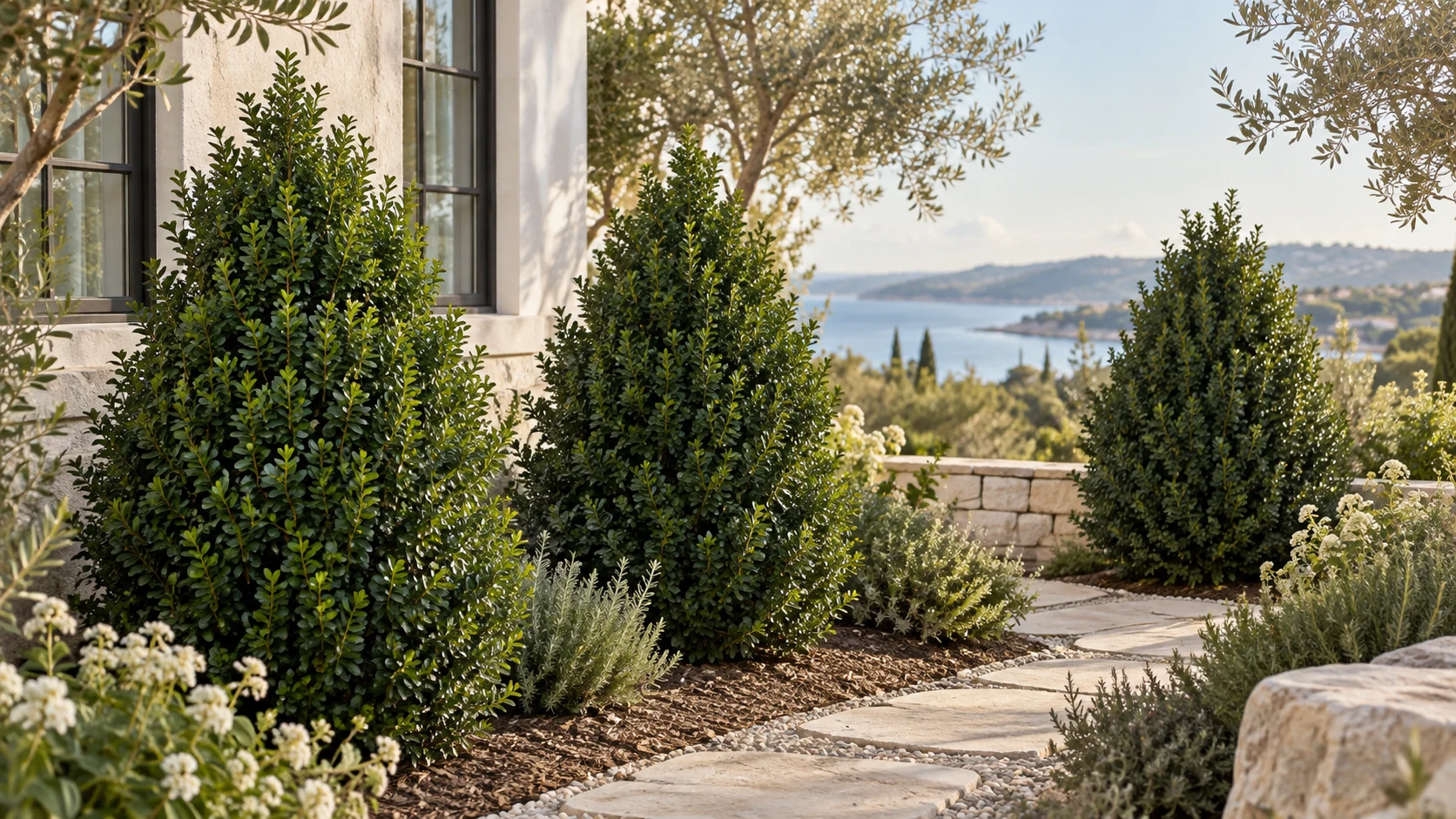
A dense, upright holly can give a garden a sense of order without relying on flowers. Steeds works best when its full base fits the bed, the soil drains well and its eventual height frames the view you actually want to keep.
Illustrative planting concept
Size and space
Mature range: 6–8 ft high × 5–6 ft wide.
Allow roughly 6–8 ft high and 5–6 ft wide for Steeds. Its pointed outline does not mean a narrow footprint. These grower dimensions are a planning range, not a height that every plant stops at. Match the cultivar label; other Japanese hollies grow differently.
Compare with a six-foot person: installed example 3 ft high by 2 ft wide. This example is not a fixed pot size or a growth timeline.
Sun to part shade · Acidic, well-drained soil; water to establish · Evergreen fine-textured foliage
Where it works around Pensacola
Consider Steeds for a sheltered Pensacola-area garden with suitable acidic soil and dependable drainage. Japanese holly is sensitive to site problems; confirm local nursery performance before using a long row as the only privacy layer.
An upright accent in a deep border
A repeated evergreen rhythm
A frame beside a garden opening
An informal screen with room to spread
Structure behind lower flowering plants
What will it frame when it is full-grown?
Mark the canopy beside the window or opening before choosing the planting point. Keep the view from a seated position in mind, and leave the whole walking route outside the future foliage.
Is the base wider than the available bed?
The widest part of this holly can occupy five or six feet. Planting against a narrow passage creates recurring trimming work. Allow access behind the plant where a wall or fence needs maintenance.
Where does rainwater collect?
Japanese holly can struggle with root problems in poorly drained soil. A roof outlet, compacted construction soil or low pocket deserves attention before planting; extra mulch will not correct the grade.
Will one problem affect the entire screen?
A mixed planting gives you more flexibility than a long single-species row. Discuss soil conditions and local pest history with the nursery, and include a way to inspect and water each plant.
Before it goes on the plan
Is Steeds the same as Sky Pencil?
No. Steeds has a broader pyramidal habit. Use the measurements for the exact cultivar being purchased, even when two hollies look similarly upright in nursery pots.
Will it have the classic red holly berries?
Do not select Steeds for a red-berry display. Japanese holly has small leaves and differs from the familiar large, spiny-leaved holiday hollies. The everyday benefit here is evergreen form.
Can it stay much smaller?
Regular pruning changes the maintained outline, but it does not make the plant a dwarf cultivar. If the available bed is permanently small, compare naturally smaller selections first.
Pairing ideas
Vintage Jade Distylium: Vintage Jade offers a spreading form in a bright, well-drained bed. Keep it beyond the holly’s future base so both plants retain light and their natural outline.
Rose Creek Abelia: Rose Creek can soften the composition in a sunnier front pocket. Reserve its own spread and leave access between the planting and the path.
{"key":"steeds","id":"PLT-ILEX-CREN-STEEDS","slug":"steeds-japanese-holly","name":"Steeds Japanese Holly","botanical":"Ilex crenata 'Steeds'","eyebrow":"UPRIGHT FORM / LEAVE ROOM AT THE BASE","benefit":"Frame the view with evergreen structure.","intro":"A dense, upright holly can give a garden a sense of order without relying on flowers. Steeds works best when its full base fits the bed, the soil drains well and its eventual height frames the view you actually want to keep.","h":[6,8],"w":[5,6],"install":[3,2],"color":"#40543B","habit":"Upright pyramidal evergreen shrub","light":"Sun to part shade","lightTags":["sun","part"],"water":"Acidic, well-drained soil; water to establish","season":"Evergreen fine-textured foliage","care":"Selective shaping; watch drainage and plant health","site":"Consider Steeds for a sheltered Pensacola-area garden with suitable acidic soil and dependable drainage. Japanese holly is sensitive to site problems; confirm local nursery performance before using a long row as the only privacy layer.","sizeNote":"Allow roughly 6–8 ft high and 5–6 ft wide for Steeds. Its pointed outline does not mean a narrow footprint. These grower dimensions are a planning range, not a height that every plant stops at. Match the cultivar label; other Japanese hollies grow differently.","uses":["An upright accent in a deep border","A repeated evergreen rhythm","A frame beside a garden opening","An informal screen with room to spread","Structure behind lower flowering plants"],"checks":[["What will it frame when it is full-grown?","Mark the canopy beside the window or opening before choosing the planting point. Keep the view from a seated position in mind, and leave the whole walking route outside the future foliage."],["Is the base wider than the available bed?","The widest part of this holly can occupy five or six feet. Planting against a narrow passage creates recurring trimming work. Allow access behind the plant where a wall or fence needs maintenance."],["Where does rainwater collect?","Japanese holly can struggle with root problems in poorly drained soil. A roof outlet, compacted construction soil or low pocket deserves attention before planting; extra mulch will not correct the grade."],["Will one problem affect the entire screen?","A mixed planting gives you more flexibility than a long single-species row. Discuss soil conditions and local pest history with the nursery, and include a way to inspect and water each plant."]],"faq":[["Is Steeds the same as Sky Pencil?","No. Steeds has a broader pyramidal habit. Use the measurements for the exact cultivar being purchased, even when two hollies look similarly upright in nursery pots."],["Will it have the classic red holly berries?","Do not select Steeds for a red-berry display. Japanese holly has small leaves and differs from the familiar large, spiny-leaved holiday hollies. The everyday benefit here is evergreen form."],["Can it stay much smaller?","Regular pruning changes the maintained outline, but it does not make the plant a dwarf cultivar. If the available bed is permanently small, compare naturally smaller selections first."]],"sources":[["Perfect Plants nursery · Steeds dimensions","https://myperfectplants.com/products/ilex-crenata-steeds-holly"],["NC State Extension · Japanese holly growing conditions","https://plants.ces.ncsu.edu/plants/ilex-crenata/"],["Clemson Extension · holly health and drainage","https://hgic.clemson.edu/factsheet/holly-diseases-insect-pests/"]],"companions":[{"slug":"vintage-jade-distylium","name":"Vintage Jade Distylium","title":"A LOWER EVERGREEN LAYER","reason":"Vintage Jade offers a spreading form in a bright, well-drained bed. Keep it beyond the holly’s future base so both plants retain light and their natural outline.","image":{"id":"6a9f291814791b3f2092920c","url":"https://cdn.prod.website-files.com/6a975baac0f352647862d847/6a9f291814791b3f2092920c_landova-shrub-vintage-context.webp","alt":"Illustrative planting concept with Vintage Jade Distylium"}},{"slug":"rose-creek-abelia","name":"Rose Creek Abelia","title":"FLOWERS IN FRONT","reason":"Rose Creek can soften the composition in a sunnier front pocket. Reserve its own spread and leave access between the planting and the path.","image":{"id":"6a9f29186dd776cdaf22637e","url":"https://cdn.prod.website-files.com/6a975baac0f352647862d847/6a9f29186dd776cdaf22637e_landova-shrub-rose-context.webp","alt":"Illustrative planting concept with Rose Creek Abelia"}}],"wholeCaption":"Illustrative study of the upright, broad-based Steeds habit. See the measured comparison for the space its foliage may occupy.","detailCaption":"Illustration of small glossy Japanese holly leaves. Leaf appearance alone cannot confirm a cultivar; match the nursery label.","wholeFit":"contain","images":{"context":{"id":"6a9f4a4b2702bd340facc631","url":"https://cdn.prod.website-files.com/6a975baac0f352647862d847/6a9f4a4b2702bd340facc631_landova-steeds-context-r04.webp","alt":"Illustrative planting concept with Steeds Japanese Holly"},"whole":{"id":"6a9f4a4b9abf8bef4ff2b8c9","url":"https://cdn.prod.website-files.com/6a975baac0f352647862d847/6a9f4a4b9abf8bef4ff2b8c9_landova-steeds-whole-r04.webp","alt":"Illustrative view of Steeds Japanese Holly overall form","fit":"contain"},"detail":{"id":"6a9f4a4b4f259866ad3d52ec","url":"https://cdn.prod.website-files.com/6a975baac0f352647862d847/6a9f4a4b4f259866ad3d52ec_landova-steeds-detail-r04.webp","alt":"Illustrative view of Steeds Japanese Holly foliage and seasonal detail"}},"caution":"Allow the full 5–6 ft base; confirm acidic soil, drainage and local performance."}
LANDOVA / PLANTING DECISIONS
Choose plants with the whole space in mind.
Explore a planting goal, then compare the growing needs and mature size of individual plants.
LANDOVA is in beta
Join the launch waitlist.
We are not accepting paying clients yet. We expect to launch around January 2027 and may open sooner. Explore our free tools now, and sign up for launch updates and educational planning emails.
Thank you. Your waitlist signup has been received. We will email you with launch updates. No purchase or project booking has been made.
We could not save your signup. Please try again or email info@landovadesign.com.