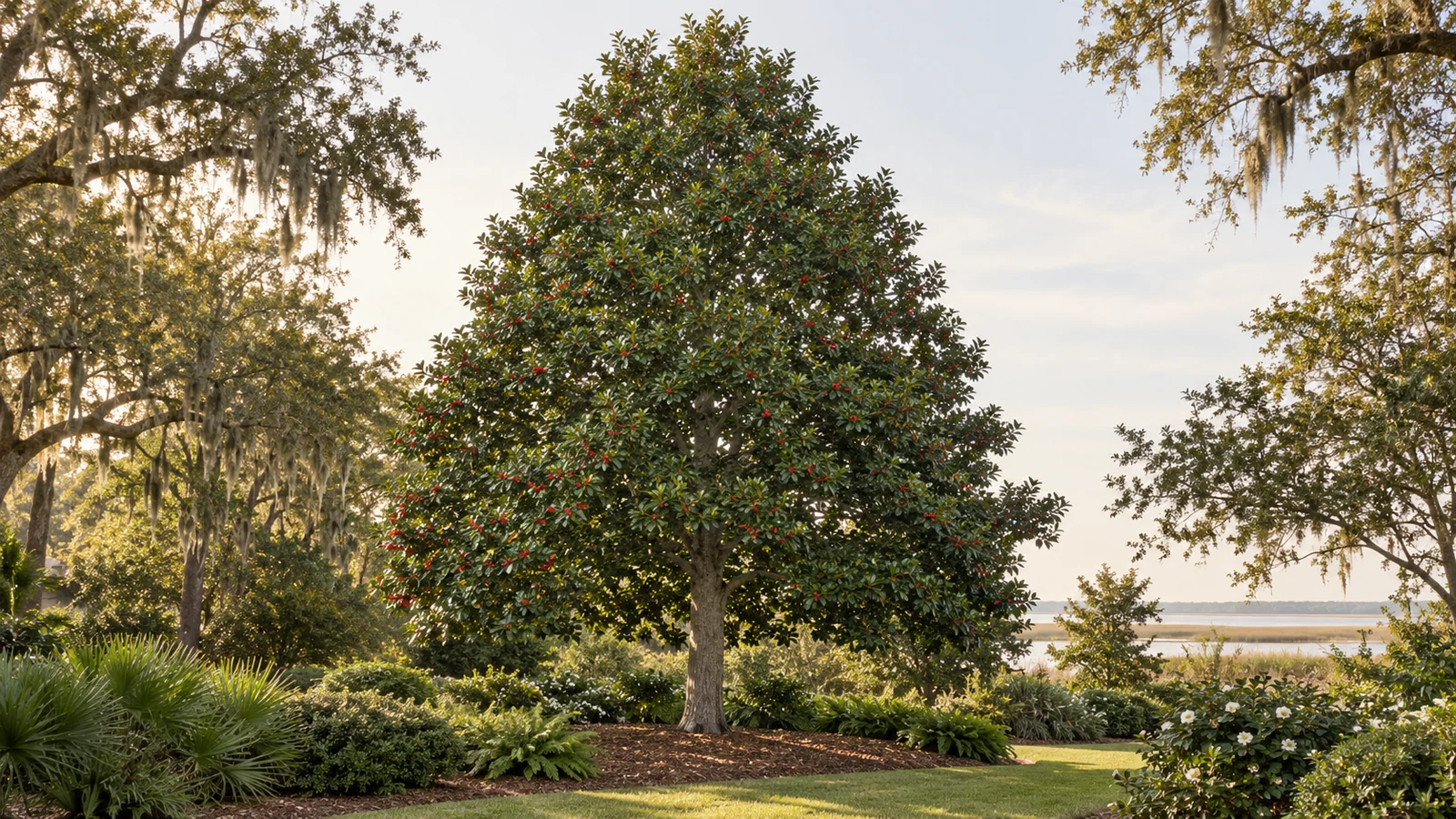
American Holly brings a clear, upright shape to a landscape that needs a lasting green anchor. Its pointed leaves and seasonal berries offer closer detail, but the whole crown is the main design feature. Give it a role in the background or at a broad garden edge where it can mature into a tree.
Before you choose: American Holly is a full-size tree with prickly leaves, not a dwarf foundation shrub. Female fruiting requires suitable male pollen nearby. Berries are not food for people or pets; choose placement with access and everyday use in mind.
Illustrative planting concept
Size and space
Mature height: 35–50 ft. Mature spread: 15–25 ft.
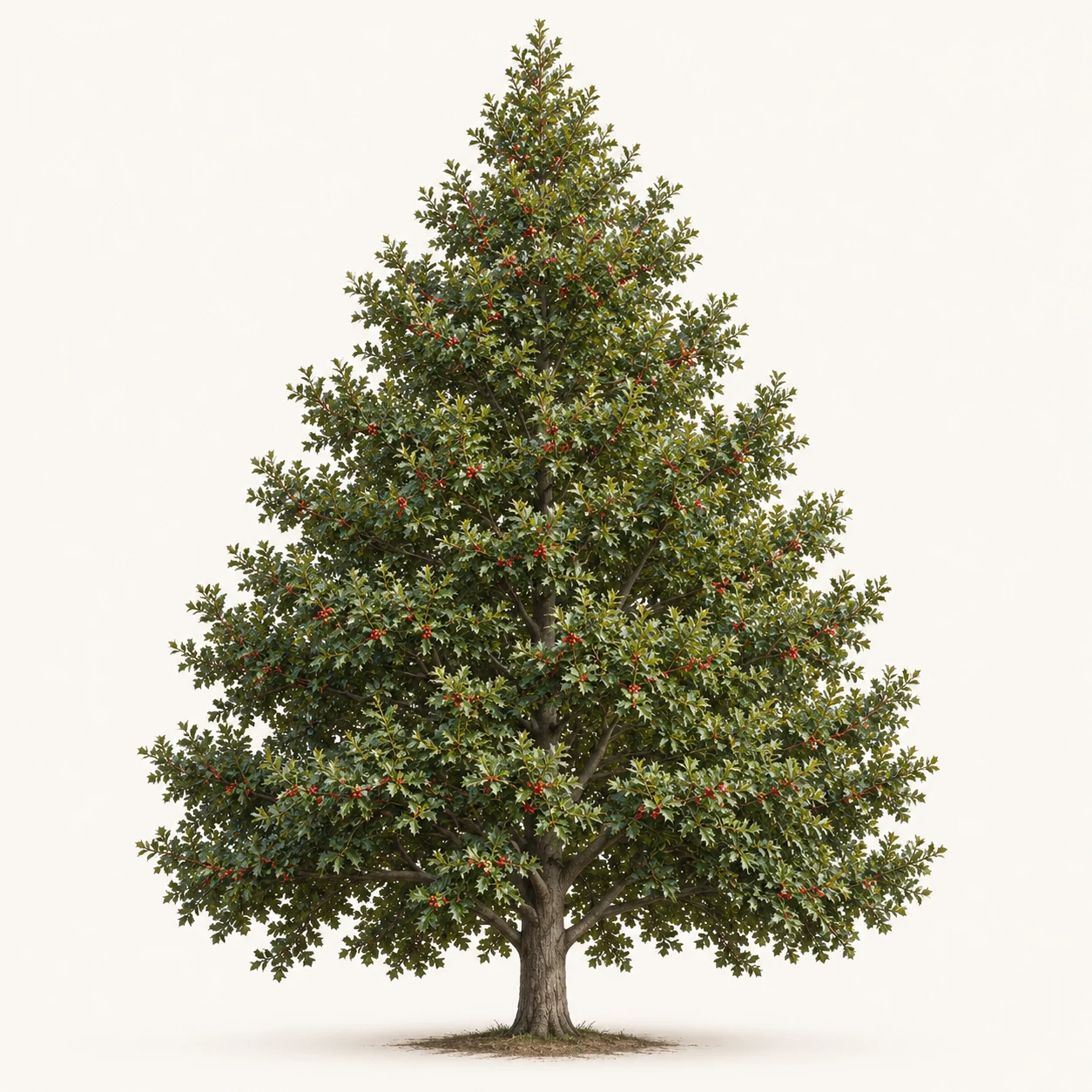
UF/IFAS gives a 35–50 ft height and 15–25 ft spread for American Holly. Named cultivars can differ, including dwarf forms; this is the species guide. The illustration shows a full natural tree, not a promise of a particular screening height within a set number of years.
Installed example: 6 ft high × 3 ft wide. This is an illustrative size, not a pot-size or growth-timeline promise.
Full sun to part shade; canopy density falls in heavy shade · Prefer moist, well-drained, slightly acidic soil; water young trees consistently · Evergreen leaves · red fall and winter berries on pollinated female trees
Care: Protect thin bark from equipment and allow the natural crown to develop
Know the whole plant
Illustrative natural American Holly crown; the pictured berries represent a pollinated female tree.Illustrative prickly American Holly leaves and red berries; fruiting depends on plant sex and pollination.
Where it works around Pensacola
Use American Holly where a Pensacola garden needs a substantial evergreen layer and has enough soil and branch space for it. If the goal is privacy, plan the view at both eye level and second-story height. The selected nursery form and the light available will influence how that cover develops.
A tall evergreen garden anchor
A generous mixed privacy border
A native specimen near a woodland edge
Seasonal berries for a wildlife planting
A green backdrop for smaller flowering plants
Is a tree the right screening scale?
Draw the full crown above and beside the area being screened. A narrow gap beside a house can be too small even when the desired privacy is tall.
How close will people pass?
Keep prickly foliage outside the usable width of paths and gathering areas. Allow room to move around the planting without brushing through branches.
Are berries part of the goal?
Ask about plant sex and nearby compatible pollen sources. A photograph of a heavily fruiting female does not tell you what every nursery specimen will produce.
Can the trunk stay protected?
Leave a practical mulch area and keep mower and string-trimmer work away from the bark. Plan access for maintenance before the lower crown fills in.
Before it goes on the plan
Is it the same as Yaupon Holly?
No. American Holly is Ilex opaca, with larger, often prickly leaves and a different mature scale. Yaupon and dwarf yaupon selections have their own guides.
Will one tree have red berries?
Only female trees fruit, and fruiting depends on pollination from a suitable male nearby. Confirm the nursery stock and local pollination situation if berries are a priority.
Can it be kept as a small hedge?
Some named forms are compact, but the species becomes a tree. Choose a plant that fits the intended hedge height instead of building the design around repeated heavy cutting.
Pairing ideas
Yaupon Holly: Yaupon offers smaller leaves and a different branching character. Compare both around the actual mature space and screening needs.
American Fringetree: American Fringetree adds a separate spring-flowering layer in a compatible sheltered site. Keep enough room for both mature crowns.
{"key":"americanholly","id":"PLT-ILEX-OPACA","slug":"american-holly","name":"American Holly","botanical":"Ilex opaca","h":[35,50],"w":[15,25],"install":[6,3],"treeForm":"pyramidal","color":"#536a46","native":true,"type":"trees","categoryLabel":"Trees","reviewDate":"2026-09-08","guideKind":"Native evergreen structure guide","eyebrow":"A NATURAL GREEN PYRAMID + SEASONAL BERRIES","benefit":"Let evergreen structure rise above the garden.","intro":"American Holly brings a clear, upright shape to a landscape that needs a lasting green anchor. Its pointed leaves and seasonal berries offer closer detail, but the whole crown is the main design feature. Give it a role in the background or at a broad garden edge where it can mature into a tree.","light":"Full sun to part shade; canopy density falls in heavy shade","lightTags":["sun","part"],"water":"Prefer moist, well-drained, slightly acidic soil; water young trees consistently","season":"Evergreen leaves · red fall and winter berries on pollinated female trees","care":"Protect thin bark from equipment and allow the natural crown to develop","caution":"American Holly is a full-size tree with prickly leaves, not a dwarf foundation shrub. Female fruiting requires suitable male pollen nearby. Berries are not food for people or pets; choose placement with access and everyday use in mind.","site":"Use American Holly where a Pensacola garden needs a substantial evergreen layer and has enough soil and branch space for it. If the goal is privacy, plan the view at both eye level and second-story height. The selected nursery form and the light available will influence how that cover develops.","sizeNote":"UF/IFAS gives a 35–50 ft height and 15–25 ft spread for American Holly. Named cultivars can differ, including dwarf forms; this is the species guide. The illustration shows a full natural tree, not a promise of a particular screening height within a set number of years.","uses":["A tall evergreen garden anchor","A generous mixed privacy border","A native specimen near a woodland edge","Seasonal berries for a wildlife planting","A green backdrop for smaller flowering plants"],"checks":[["Is a tree the right screening scale?","Draw the full crown above and beside the area being screened. A narrow gap beside a house can be too small even when the desired privacy is tall."],["How close will people pass?","Keep prickly foliage outside the usable width of paths and gathering areas. Allow room to move around the planting without brushing through branches."],["Are berries part of the goal?","Ask about plant sex and nearby compatible pollen sources. A photograph of a heavily fruiting female does not tell you what every nursery specimen will produce."],["Can the trunk stay protected?","Leave a practical mulch area and keep mower and string-trimmer work away from the bark. Plan access for maintenance before the lower crown fills in."]],"faq":[["Is it the same as Yaupon Holly?","No. American Holly is Ilex opaca, with larger, often prickly leaves and a different mature scale. Yaupon and dwarf yaupon selections have their own guides."],["Will one tree have red berries?","Only female trees fruit, and fruiting depends on pollination from a suitable male nearby. Confirm the nursery stock and local pollination situation if berries are a priority."],["Can it be kept as a small hedge?","Some named forms are compact, but the species becomes a tree. Choose a plant that fits the intended hedge height instead of building the design around repeated heavy cutting."]],"sources":[["UF/IFAS · American Holly species dimensions and care","https://ask.ifas.ufl.edu/publication/ST304"],["NC State Extension · American Holly fruiting and plant cautions","https://plants.ces.ncsu.edu/plants/ilex-opaca/"]],"wholeCaption":"Illustrative natural American Holly crown; the pictured berries represent a pollinated female tree.","detailCaption":"Illustrative prickly American Holly leaves and red berries; fruiting depends on plant sex and pollination.","aliases":["american holly","ilex opaca","evergreen","red berries","screen","privacy"],"goals":["privacy","color"],"images":{"context":{"id":"6aa02557e4f8742729198b54","url":"https://cdn.prod.website-files.com/6a975baac0f352647862d847/6aa02557e4f8742729198b54_landova-tree-americanholly-context.webp","alt":"Illustrative planting concept with American Holly","width":1600,"height":900},"whole":{"id":"6aa0255732d6f7ac1af0da45","url":"https://cdn.prod.website-files.com/6a975baac0f352647862d847/6aa0255732d6f7ac1af0da45_landova-tree-americanholly-whole.webp","alt":"Illustrative whole-plant form of American Holly","width":1254,"height":1254,"fit":"contain"},"detail":{"id":"6aa0255709e2740e0542c155","url":"https://cdn.prod.website-files.com/6a975baac0f352647862d847/6aa0255709e2740e0542c155_landova-tree-americanholly-detail.webp","alt":"Illustrative foliage and seasonal detail of American Holly","width":1122,"height":1402}},"companions":[{"slug":"yaupon-holly","name":"Yaupon Holly","title":"Compare another native evergreen tree","reason":"Yaupon offers smaller leaves and a different branching character. Compare both around the actual mature space and screening needs.","image":{"id":"6aa0171262f370de12c071ea","url":"https://cdn.prod.website-files.com/6a975baac0f352647862d847/6aa0171262f370de12c071ea_landova-tree-yaupon-context.webp","alt":"Illustrative planting concept with Yaupon Holly","width":1600,"height":900}},{"slug":"american-fringetree","name":"American Fringetree","title":"Give the composition a seasonal counterpart","reason":"American Fringetree adds a separate spring-flowering layer in a compatible sheltered site. Keep enough room for both mature crowns.","image":{"id":"6aa01713d9c686655a9ae785","url":"https://cdn.prod.website-files.com/6a975baac0f352647862d847/6aa01713d9c686655a9ae785_landova-tree-fringetree-context.webp","alt":"Illustrative planting concept with American Fringetree","width":1600,"height":900}}]}
LANDOVA / PLANTING DECISIONS
Choose plants with the whole space in mind.
Explore a planting goal, then compare the growing needs and mature size of individual plants.
LANDOVA is in beta
Join the launch waitlist.
We are not accepting paying clients yet. We expect to launch around January 2027 and may open sooner. Explore our free tools now, and sign up for launch updates and educational planning emails.
Thank you. Your waitlist signup has been received. We will email you with launch updates. No purchase or project booking has been made.
We could not save your signup. Please try again or email info@landovadesign.com.