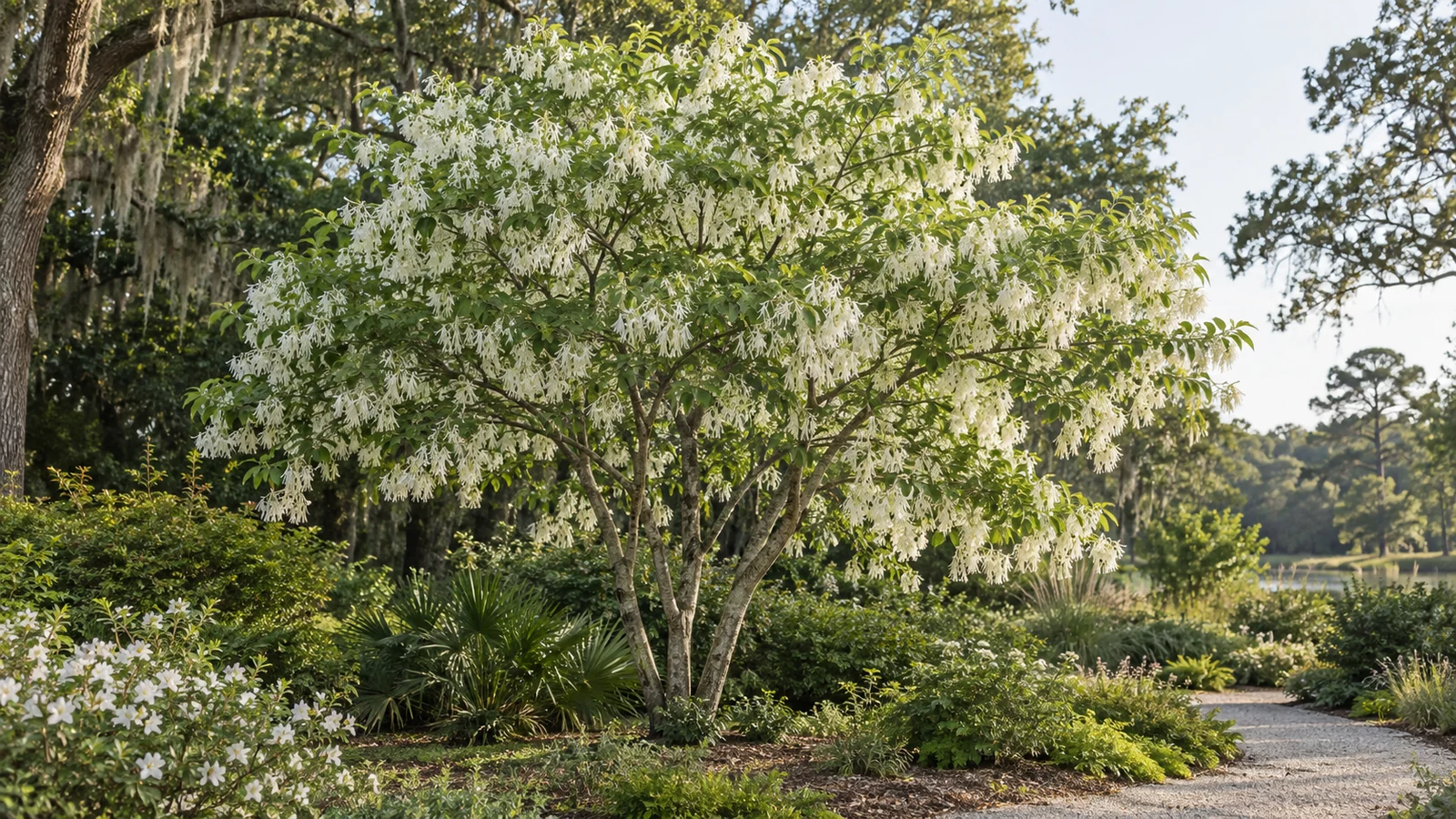
American Fringetree brings loose white ribbons of bloom to a small, rounded tree. Its flowers can stand out beautifully against an evergreen background, then give way to a quieter leafy crown. Choose it for a sheltered garden where its seasonal detail can be seen and where the ordinary summer form has a comfortable place.
Before you choose: American Fringetree is a sheltered-site choice with poor salt-spray tolerance. It is deciduous and relatively slow growing. Confirm Chionanthus virginicus rather than substituting Chinese or pygmy fringetree.
Illustrative planting concept
Size and space
Mature height: 12–20 ft. Mature spread: 10–15 ft.
UF/IFAS lists 12–20 ft high and 10–15 ft wide for landscape planning; woodland plants can become taller. The diagram shows a simplified tree-trained form. A plant kept as a natural multi-stem shrub can carry foliage lower, and the crown is not a root-protection boundary.
Installed example: 5 ft high × 4 ft wide. This is an illustrative size, not a pot-size or growth-timeline promise.
Sun to part shade; afternoon shade can suit a sheltered site · Prefer moist acidic soil; provide establishment care and review dry spells · Airy white spring flowers · green summer leaves · bare winter form
Care: Choose the form while young and avoid unnecessary relocation or heavy pruning
Know the whole plant
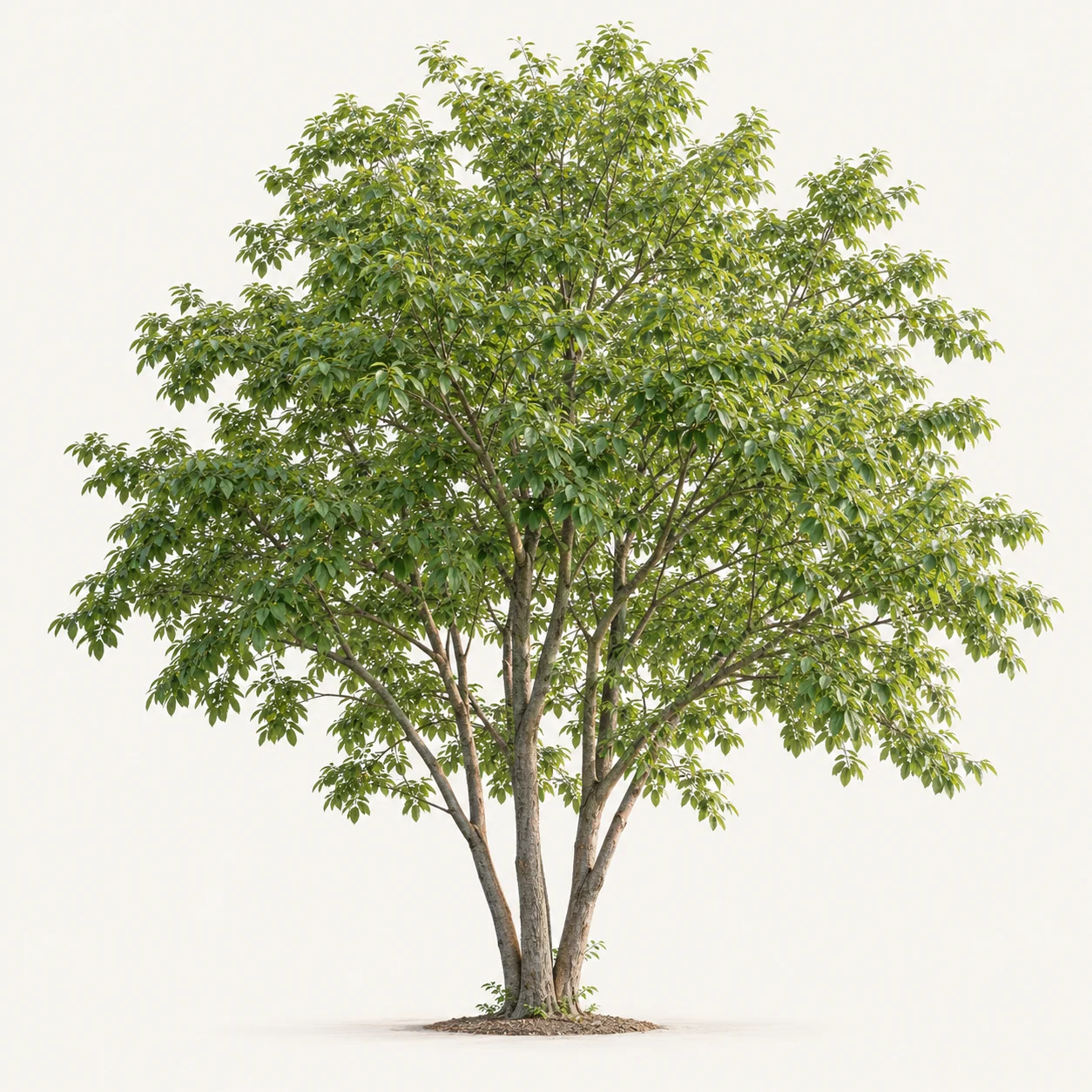
Illustrative leafy summer American Fringetree; white spring bloom is shown separately.Illustrative narrow ribbon-like petals and emerging green leaves of American Fringetree.
Where it works around Pensacola
For a Pensacola home, look for an inland or protected garden with appropriate moisture and relief from direct salt exposure. A view from a porch or window can make the brief flowering display valuable without relying on flowers every month. Plan the final position carefully so the tree can settle in.
A sheltered native flowering accent
White spring color against evergreen foliage
A small tree near a generous garden path
A woodland-edge composition
A bird-friendly planting with suitable female plants
Is this garden protected from salt spray?
A Gulf Coast address includes very different exposures. Choose this tree for a compatible sheltered setting rather than assuming that regional suitability means beachfront tolerance.
What will frame the white flowers?
A darker background can make the spring display easier to see. Leave visual space around the crown instead of surrounding it with several competing flowering trees.
Can the tree stay in this position?
Consider future paths, utilities and structures now. A permanent location avoids asking an established tree to move because another project was not yet planned.
Will the summer and winter forms feel complete?
Look beyond the bloom image. The leafy crown and bare winter branches should fit the same composition, with other plants supplying the year-round structure.
Before it goes on the plan
Is it the same as Chinese Fringetree?
No. This guide covers the native Chionanthus virginicus. Chinese Fringetree is C. retusus, with different identity and growth details.
Will it flower all summer?
No. Its white flowers are a spring event. The whole-plant image shows the leafy form so the selection is not based only on peak bloom.
Will every tree have blue-black fruit?
No. Female plants produce fruit when pollination is suitable. Confirm the nursery plant if fruit for birds is an important part of the selection.
Pairing ideas
Florida Anise: Florida Anise can supply a larger evergreen layer in a compatible sheltered, moist setting. Keep each plant’s mature crown distinct.
Big Blue Liriope: Big Blue can provide a low green border where light, soil and moisture match. Place new planting with care around the developing tree roots.
{"key":"fringetree","id":"PLT-CHIO-VIRGINICUS","slug":"american-fringetree","name":"American Fringetree","botanical":"Chionanthus virginicus","h":[12,20],"w":[10,15],"install":[5,4],"treeForm":"rounded","color":"#82906c","native":true,"type":"trees","categoryLabel":"Trees","reviewDate":"2026-09-08","guideKind":"Native flowering small-tree guide","eyebrow":"WHITE SPRING FLOWERS + A SHELTERED GARDEN","benefit":"Give the spring garden one soft, luminous moment.","intro":"American Fringetree brings loose white ribbons of bloom to a small, rounded tree. Its flowers can stand out beautifully against an evergreen background, then give way to a quieter leafy crown. Choose it for a sheltered garden where its seasonal detail can be seen and where the ordinary summer form has a comfortable place.","light":"Sun to part shade; afternoon shade can suit a sheltered site","lightTags":["sun","part"],"water":"Prefer moist acidic soil; provide establishment care and review dry spells","season":"Airy white spring flowers · green summer leaves · bare winter form","care":"Choose the form while young and avoid unnecessary relocation or heavy pruning","caution":"American Fringetree is a sheltered-site choice with poor salt-spray tolerance. It is deciduous and relatively slow growing. Confirm Chionanthus virginicus rather than substituting Chinese or pygmy fringetree.","site":"For a Pensacola home, look for an inland or protected garden with appropriate moisture and relief from direct salt exposure. A view from a porch or window can make the brief flowering display valuable without relying on flowers every month. Plan the final position carefully so the tree can settle in.","sizeNote":"UF/IFAS lists 12–20 ft high and 10–15 ft wide for landscape planning; woodland plants can become taller. The diagram shows a simplified tree-trained form. A plant kept as a natural multi-stem shrub can carry foliage lower, and the crown is not a root-protection boundary.","uses":["A sheltered native flowering accent","White spring color against evergreen foliage","A small tree near a generous garden path","A woodland-edge composition","A bird-friendly planting with suitable female plants"],"checks":[["Is this garden protected from salt spray?","A Gulf Coast address includes very different exposures. Choose this tree for a compatible sheltered setting rather than assuming that regional suitability means beachfront tolerance."],["What will frame the white flowers?","A darker background can make the spring display easier to see. Leave visual space around the crown instead of surrounding it with several competing flowering trees."],["Can the tree stay in this position?","Consider future paths, utilities and structures now. A permanent location avoids asking an established tree to move because another project was not yet planned."],["Will the summer and winter forms feel complete?","Look beyond the bloom image. The leafy crown and bare winter branches should fit the same composition, with other plants supplying the year-round structure."]],"faq":[["Is it the same as Chinese Fringetree?","No. This guide covers the native Chionanthus virginicus. Chinese Fringetree is C. retusus, with different identity and growth details."],["Will it flower all summer?","No. Its white flowers are a spring event. The whole-plant image shows the leafy form so the selection is not based only on peak bloom."],["Will every tree have blue-black fruit?","No. Female plants produce fruit when pollination is suitable. Confirm the nursery plant if fruit for birds is an important part of the selection."]],"sources":[["UF/IFAS · American Fringetree dimensions and culture","https://ask.ifas.ufl.edu/publication/ST161"],["UF/IFAS Gardening Solutions · fringetree identity and exposure","https://gardeningsolutions.ifas.ufl.edu/plants/trees-and-shrubs/trees/fringetree/"],["NC State Extension · Chionanthus virginicus","https://plants.ces.ncsu.edu/plants/chionanthus-virginicus/"]],"wholeCaption":"Illustrative leafy summer American Fringetree; white spring bloom is shown separately.","detailCaption":"Illustrative narrow ribbon-like petals and emerging green leaves of American Fringetree.","aliases":["fringe tree","fringetree","American Fringetree","Grancy Greybeard","white","native","spring"],"goals":["color"],"images":{"context":{"id":"6aa01713d9c686655a9ae785","url":"https://cdn.prod.website-files.com/6a975baac0f352647862d847/6aa01713d9c686655a9ae785_landova-tree-fringetree-context.webp","alt":"Illustrative planting concept with American Fringetree","width":1600,"height":900},"whole":{"id":"6aa01714432a95e80f8b0d1a","url":"https://cdn.prod.website-files.com/6a975baac0f352647862d847/6aa01714432a95e80f8b0d1a_landova-tree-fringetree-whole.webp","alt":"Illustrative whole-plant form of American Fringetree","width":1254,"height":1254,"fit":"contain"},"detail":{"id":"6aa017146f66cec53f64ae71","url":"https://cdn.prod.website-files.com/6a975baac0f352647862d847/6aa017146f66cec53f64ae71_landova-tree-fringetree-detail.webp","alt":"Illustrative foliage and seasonal detail of American Fringetree","width":1122,"height":1402}},"companions":[{"slug":"florida-anise","name":"Florida Anise","title":"Create a darker green background","reason":"Florida Anise can supply a larger evergreen layer in a compatible sheltered, moist setting. Keep each plant’s mature crown distinct.","image":{"id":"6a9f3484598f07756d53faf0","url":"https://cdn.prod.website-files.com/6a975baac0f352647862d847/6a9f3484598f07756d53faf0_landova-shrub-anise-context-r02.webp","alt":"Illustrative planting concept with Florida Anise"}},{"slug":"big-blue-liriope","name":"Big Blue Liriope","title":"Keep the foreground simple","reason":"Big Blue can provide a low green border where light, soil and moisture match. Place new planting with care around the developing tree roots.","image":{"id":"6aa00228a713a3c64d2d24fb","url":"https://cdn.prod.website-files.com/6a975baac0f352647862d847/6aa00228a713a3c64d2d24fb_landova-grass-bigblue-context.webp","alt":"Illustrative planting concept with Big Blue Liriope","width":1600,"height":900}}]}
LANDOVA / PLANTING DECISIONS
Choose plants with the whole space in mind.
Explore a planting goal, then compare the growing needs and mature size of individual plants.
LANDOVA is in beta
Join the launch waitlist.
We are not accepting paying clients yet. We expect to launch around January 2027 and may open sooner. Explore our free tools now, and sign up for launch updates and educational planning emails.
Thank you. Your waitlist signup has been received. We will email you with launch updates. No purchase or project booking has been made.
We could not save your signup. Please try again or email info@landovadesign.com.