Small arching clumps can give a planting bed a clear edge without making a tall visual barrier. Big Blue adds dark-green texture and upright purple-blue flower spikes. Use its repetition to guide the eye along a path while leaving the actual walking surface open.
Before you choose: Confirm Big Blue on the nursery label. It is smaller than Emerald Goddess and different from spreading Liriope spicata; it still needs room to broaden.
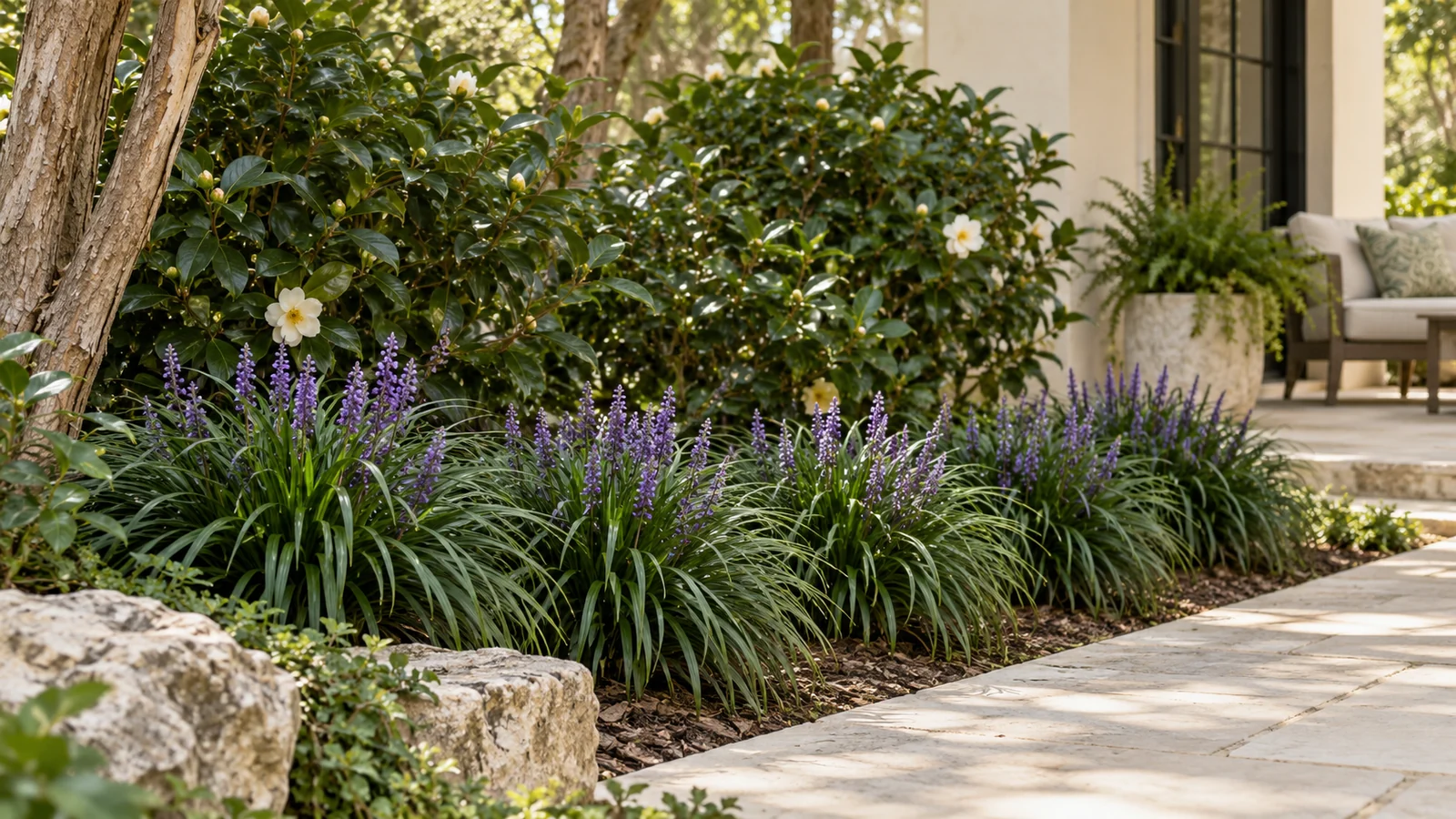
Illustrative planting concept
Size and space
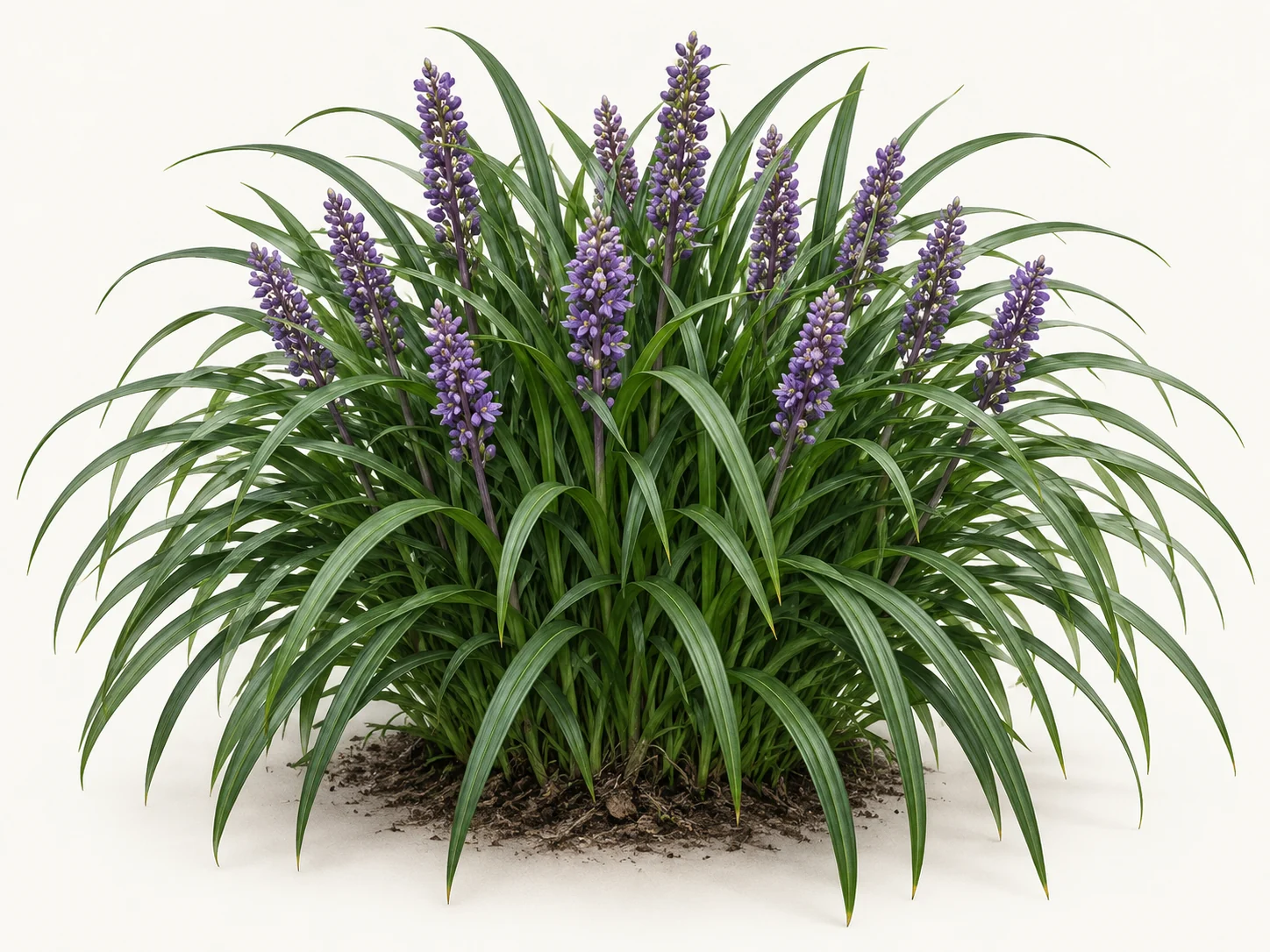
Mature height: 12–18 in. Mature spread: 12–18 in.
Monrovia lists Big Blue at 12–15 inches high and wide; NC State describes Liriope muscari clumps around 12–18 inches. This guide reserves a rounded 12–18 inches in both directions. Flowers can rise above the foliage, and site conditions may change the eventual clump.
Installed example: 6 in high × 6 in wide. This is an illustrative size, not a pot-size or growth-timeline promise.
Part sun to shade; sun with suitable moisture · Water to establish; avoid persistently wet crowns and poorly drained beds · Evergreen to semi-evergreen foliage · late-season violet flower spikes
Care: Tidy old foliage before new growth; divide crowded clumps as needed
Know the whole plant
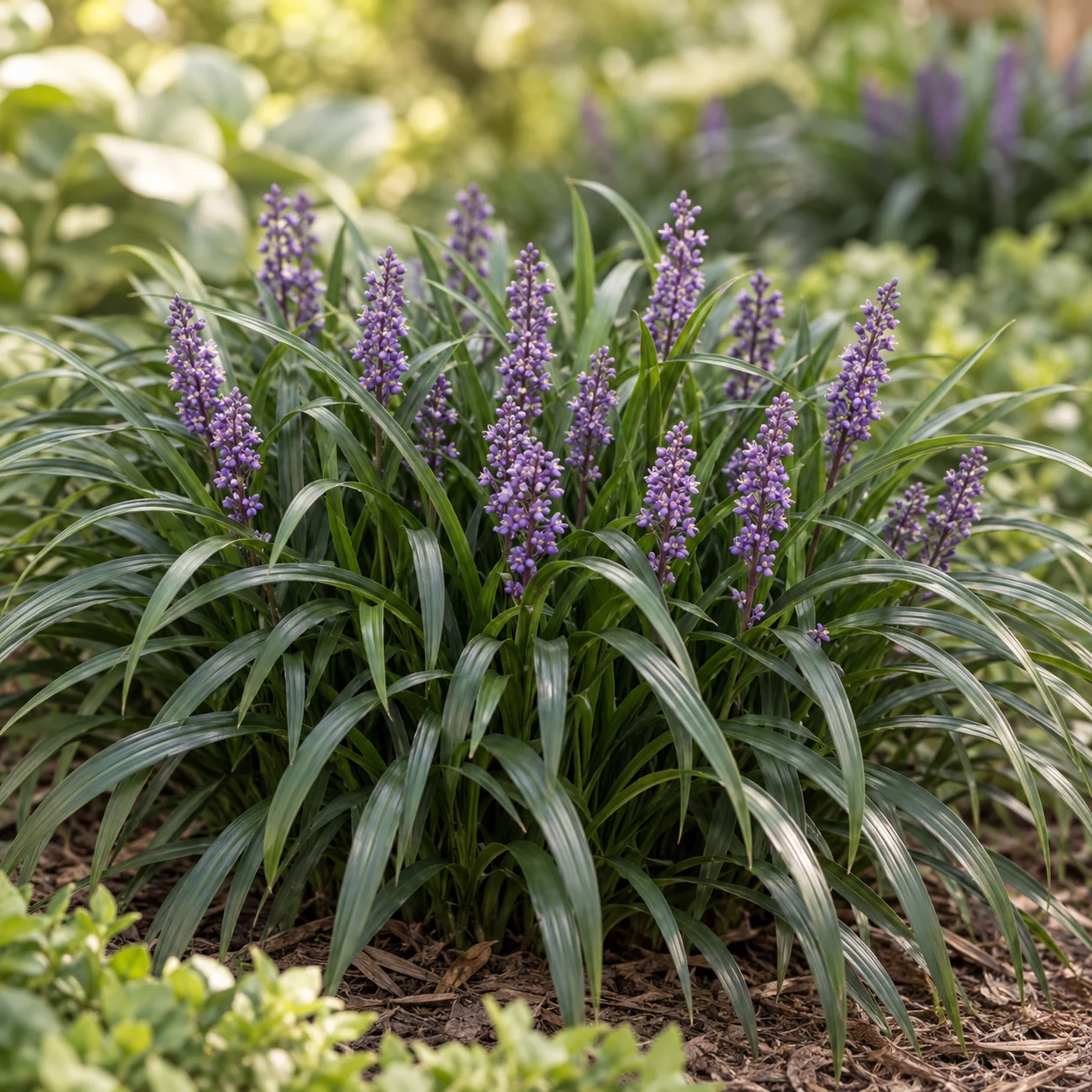
Illustrative compact Big Blue habit, separate from the larger Emerald Goddess guide.Illustrative violet-purple flower spikes above arching leaves.
Where it works around Pensacola
Big Blue can form a low foliage layer in a sheltered Pensacola bed with filtered light and drainage. Review root competition below established trees and shrubs. Keeping a narrow border healthy means matching the planting to the space that remains after the larger plants mature.
A low path border
Foreground below camellias
Small repeated foliage groups
A shaded planting edge
Seasonal purple detail
Is the edge a planting bed or a path?
Keep regular walking on paving or another planned surface. A low, grasslike appearance does not make lilyturf a durable walking surface.
Will the repetition stay readable?
Use a consistent spacing pattern and keep enough open bed for the clumps to broaden. Avoid filling every gap before the plants have grown.
How dry are the roots below the canopy?
Observe the existing trees and irrigation pattern. Shade can reduce sunlight while tree roots still compete strongly for water.
Can the flowers be seen?
Place the low layer where its small flower spikes can be appreciated. A taller foreground planting may hide the very feature that prompted the choice.
Before it goes on the plan
Why separate it from Emerald Goddess?
The named selections have different dimensions. Keeping separate pages helps compare a roughly 12–18-inch Big Blue clump with the fuller Emerald Goddess border.
Is every plant called monkey grass the same?
No. That common name can refer to different lilyturfs and other grasslike plants. Use Liriope muscari Big Blue when confirming a purchase.
Will the foliage always look fresh?
Weather and aging leaves can change its appearance. Review cleanup before new growth and avoid cutting through fresh emerging leaves.
Pairing ideas
Radicans Gardenia: Radicans offers broader leaves and white flowers in compatible acidic soil with morning sun. These are neighboring clumps, each with its own footprint.
Shi Shi Gashira Camellia: Shi Shi Gashira can give the low border a larger evergreen backdrop. Set the camellia back far enough for its eventual width and care access.
{"key":"bigblue","id":"PLT-LIRI-BIG-BLUE","slug":"big-blue-liriope","name":"Big Blue Liriope","botanical":"Liriope muscari ‘Big Blue’","eyebrow":"A LOWER EDGE + PURPLE FLOWER SPIKES","benefit":"Finish the bed with a quieter lower edge.","intro":"Small arching clumps can give a planting bed a clear edge without making a tall visual barrier. Big Blue adds dark-green texture and upright purple-blue flower spikes. Use its repetition to guide the eye along a path while leaving the actual walking surface open.","h":[1,1.5],"w":[1,1.5],"install":[0.5,0.5],"unit":"in","color":"#536b49","plantKind":"grasslike","light":"Part sun to shade; sun with suitable moisture","lightTags":["sun","part","shade"],"water":"Water to establish; avoid persistently wet crowns and poorly drained beds","season":"Evergreen to semi-evergreen foliage · late-season violet flower spikes","care":"Tidy old foliage before new growth; divide crowded clumps as needed","caution":"Confirm Big Blue on the nursery label. It is smaller than Emerald Goddess and different from spreading Liriope spicata; it still needs room to broaden.","site":"Big Blue can form a low foliage layer in a sheltered Pensacola bed with filtered light and drainage. Review root competition below established trees and shrubs. Keeping a narrow border healthy means matching the planting to the space that remains after the larger plants mature.","sizeNote":"Monrovia lists Big Blue at 12–15 inches high and wide; NC State describes Liriope muscari clumps around 12–18 inches. This guide reserves a rounded 12–18 inches in both directions. Flowers can rise above the foliage, and site conditions may change the eventual clump.","uses":["A low path border","Foreground below camellias","Small repeated foliage groups","A shaded planting edge","Seasonal purple detail"],"checks":[["Is the edge a planting bed or a path?","Keep regular walking on paving or another planned surface. A low, grasslike appearance does not make lilyturf a durable walking surface."],["Will the repetition stay readable?","Use a consistent spacing pattern and keep enough open bed for the clumps to broaden. Avoid filling every gap before the plants have grown."],["How dry are the roots below the canopy?","Observe the existing trees and irrigation pattern. Shade can reduce sunlight while tree roots still compete strongly for water."],["Can the flowers be seen?","Place the low layer where its small flower spikes can be appreciated. A taller foreground planting may hide the very feature that prompted the choice."]],"faq":[["Why separate it from Emerald Goddess?","The named selections have different dimensions. Keeping separate pages helps compare a roughly 12–18-inch Big Blue clump with the fuller Emerald Goddess border."],["Is every plant called monkey grass the same?","No. That common name can refer to different lilyturfs and other grasslike plants. Use Liriope muscari Big Blue when confirming a purchase."],["Will the foliage always look fresh?","Weather and aging leaves can change its appearance. Review cleanup before new growth and avoid cutting through fresh emerging leaves."]],"sources":[["Monrovia · Big Blue cultivar size","https://www.monrovia.com/big-blue-lilyturf.html"],["NC State Extension · Lilyturf growth and care","https://plants.ces.ncsu.edu/plants/liriope-muscari/"]],"wholeCaption":"Illustrative compact Big Blue habit, separate from the larger Emerald Goddess guide.","detailCaption":"Illustrative violet-purple flower spikes above arching leaves.","native":false,"guideKind":"Grasslike cultivar guide","aliases":["Big Blue","lily turf","lilyturf","monkey grass","border grass"],"goals":["color","pool"],"type":"grasses","categoryLabel":"Grasses + grass-like plants","habit":"grass","reviewDate":"2026-09-08","images":{"context":{"id":"6aa00228a713a3c64d2d24fb","url":"https://cdn.prod.website-files.com/6a975baac0f352647862d847/6aa00228a713a3c64d2d24fb_landova-grass-bigblue-context.webp","alt":"Illustrative planting concept with Big Blue Liriope","width":1600,"height":900},"whole":{"id":"6aa00229a4225aca32db4794","url":"https://cdn.prod.website-files.com/6a975baac0f352647862d847/6aa00229a4225aca32db4794_landova-grass-bigblue-whole.webp","alt":"Illustrative whole-plant form of Big Blue Liriope","width":1448,"height":1086,"fit":"contain"},"detail":{"id":"6aa002294d65b472a9cac882","url":"https://cdn.prod.website-files.com/6a975baac0f352647862d847/6aa002294d65b472a9cac882_landova-grass-bigblue-detail.webp","alt":"Illustrative foliage and seasonal detail of Big Blue Liriope","width":1254,"height":1254}},"companions":[{"slug":"radicans-gardenia","name":"Radicans Gardenia","title":"Add a different low-leaf texture","reason":"Radicans offers broader leaves and white flowers in compatible acidic soil with morning sun. These are neighboring clumps, each with its own footprint.","image":{"id":"6a9f291b4f259866ad352735","url":"https://cdn.prod.website-files.com/6a975baac0f352647862d847/6a9f291b4f259866ad352735_landova-shrub-radicans-context.webp","alt":"Illustrative planting concept with Radicans Gardenia"}},{"slug":"shi-shi-gashira-camellia","name":"Shi Shi Gashira Camellia","title":"Build a taller layer behind the border","reason":"Shi Shi Gashira can give the low border a larger evergreen backdrop. Set the camellia back far enough for its eventual width and care access.","image":{"id":"6a9f34851fbbc23ce57e8e85","url":"https://cdn.prod.website-files.com/6a975baac0f352647862d847/6a9f34851fbbc23ce57e8e85_landova-shrub-shishi-context-r02.webp","alt":"Illustrative planting concept with Shi Shi Gashira Camellia"}}]}
LANDOVA / PLANTING DECISIONS
Choose plants with the whole space in mind.
Explore a planting goal, then compare the growing needs and mature size of individual plants.
LANDOVA is in beta
Join the launch waitlist.
We are not accepting paying clients yet. We expect to launch around January 2027 and may open sooner. Explore our free tools now, and sign up for launch updates and educational planning emails.
Thank you. Your waitlist signup has been received. We will email you with launch updates. No purchase or project booking has been made.
We could not save your signup. Please try again or email info@landovadesign.com.