Black-eyed Susan supplies an open, sunny garden with clear yellow flowers and dark raised centers. It has a looser, more natural character than clipped foundation shrubs. Group it within a sunny perennial bed, where seasonal changes and occasional replacement are part of the planting rather than a surprise.
Before you choose: Rudbeckia hirta is often a biennial or short-lived perennial. Do not promise a permanent, uniform evergreen border. It can reseed, and nursery cultivars may behave differently from local native forms.
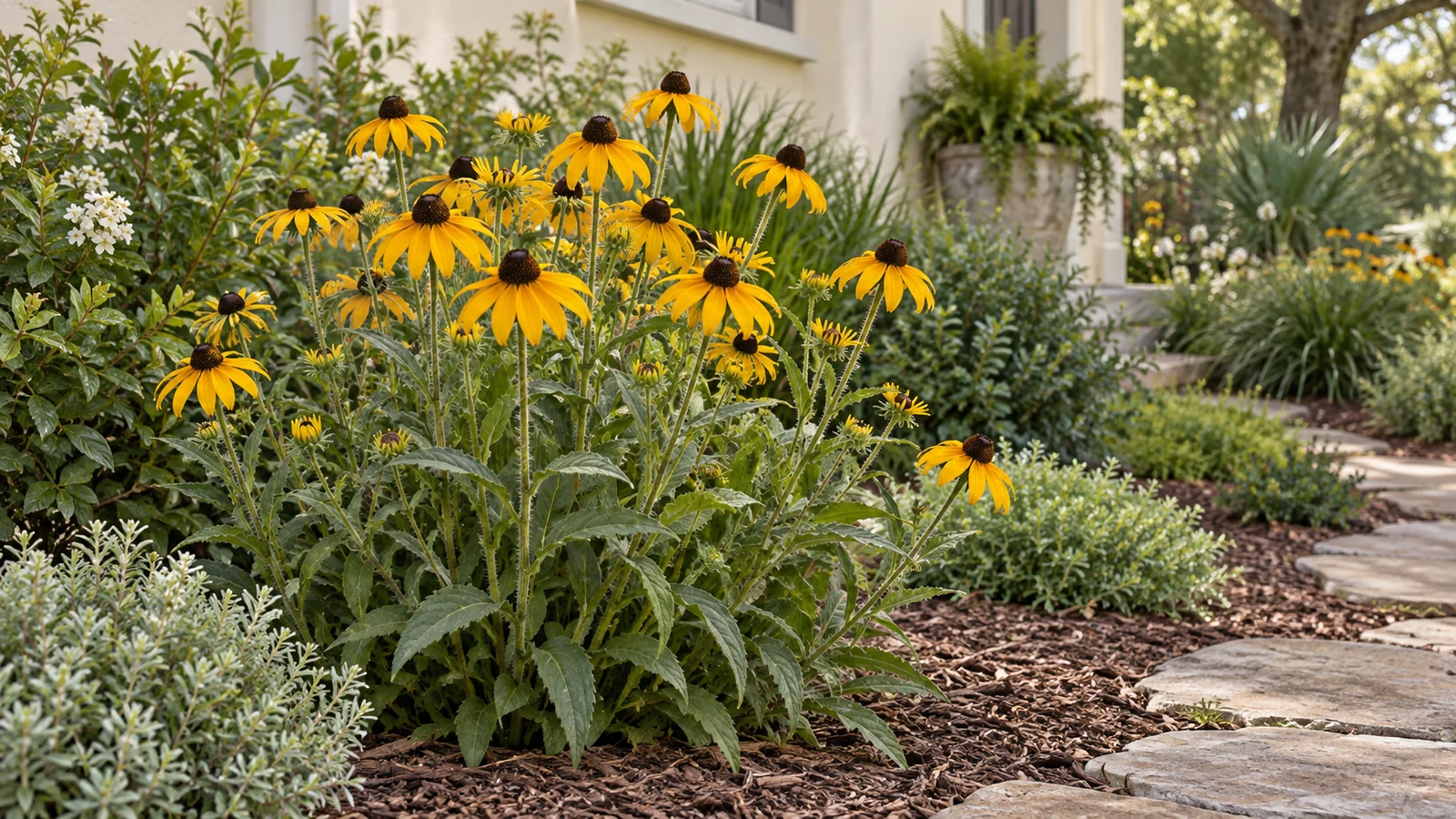
Illustrative planting concept
Size and space
Typical height: 2–4 ft. Typical spread: 1–2 ft.
Allow approximately 2–4 feet of flowering height and 1–2 feet of spread, with cultivar differences checked before purchase. Leaves sit below and along the stems. Keep the taller flowering layer behind low edging, and leave breathing room around neighboring plants rather than pressing everything together at installation.
Installed example: 0.5 ft high × 0.5 ft wide. This is an illustrative size, not a pot-size or growth-timeline promise.
Full sun; tolerates part shade · Moderate to low once established; drainage matters · Primarily summer flowers; short-lived planting
Care: Leave selected seed heads; manage seedlings
Know the whole plant
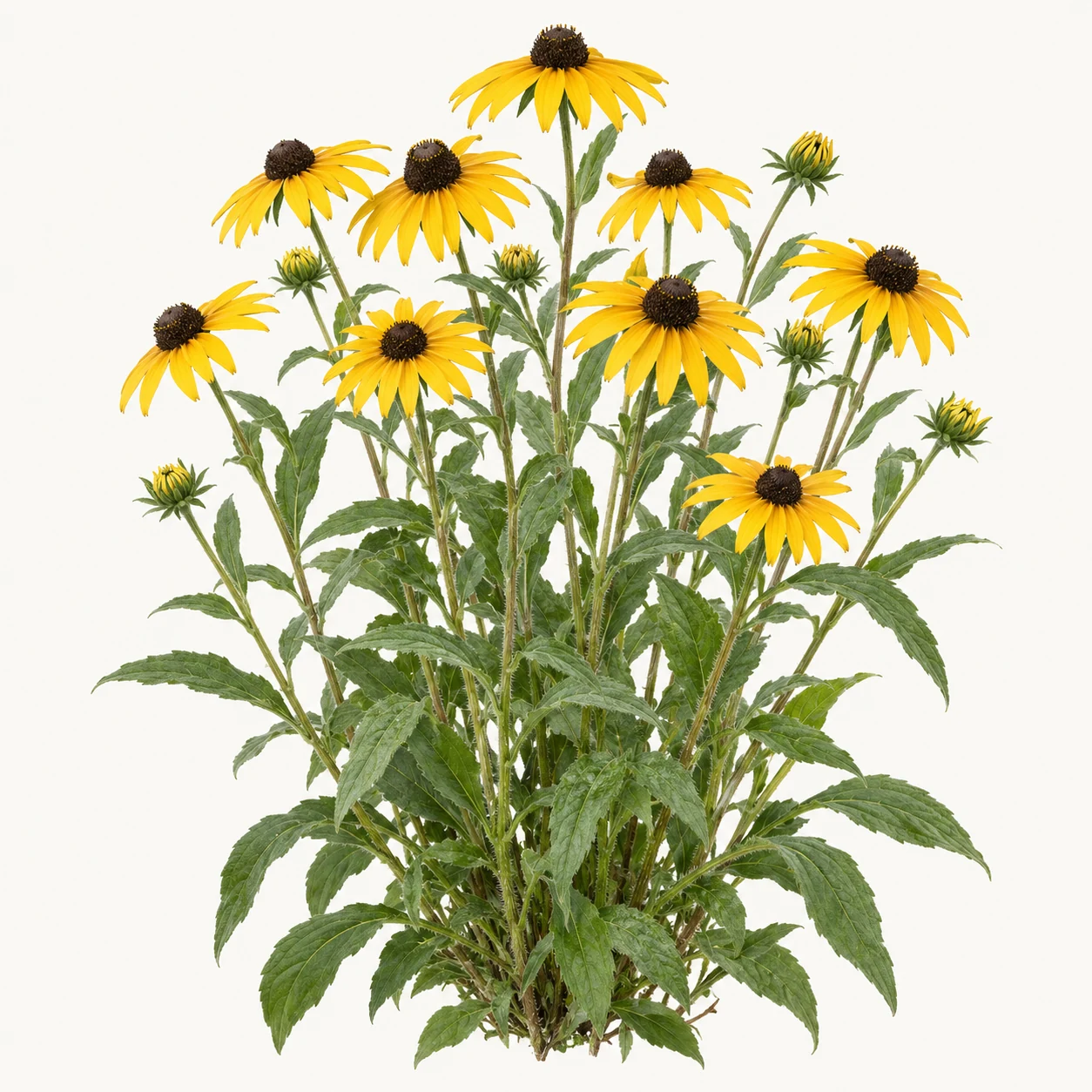
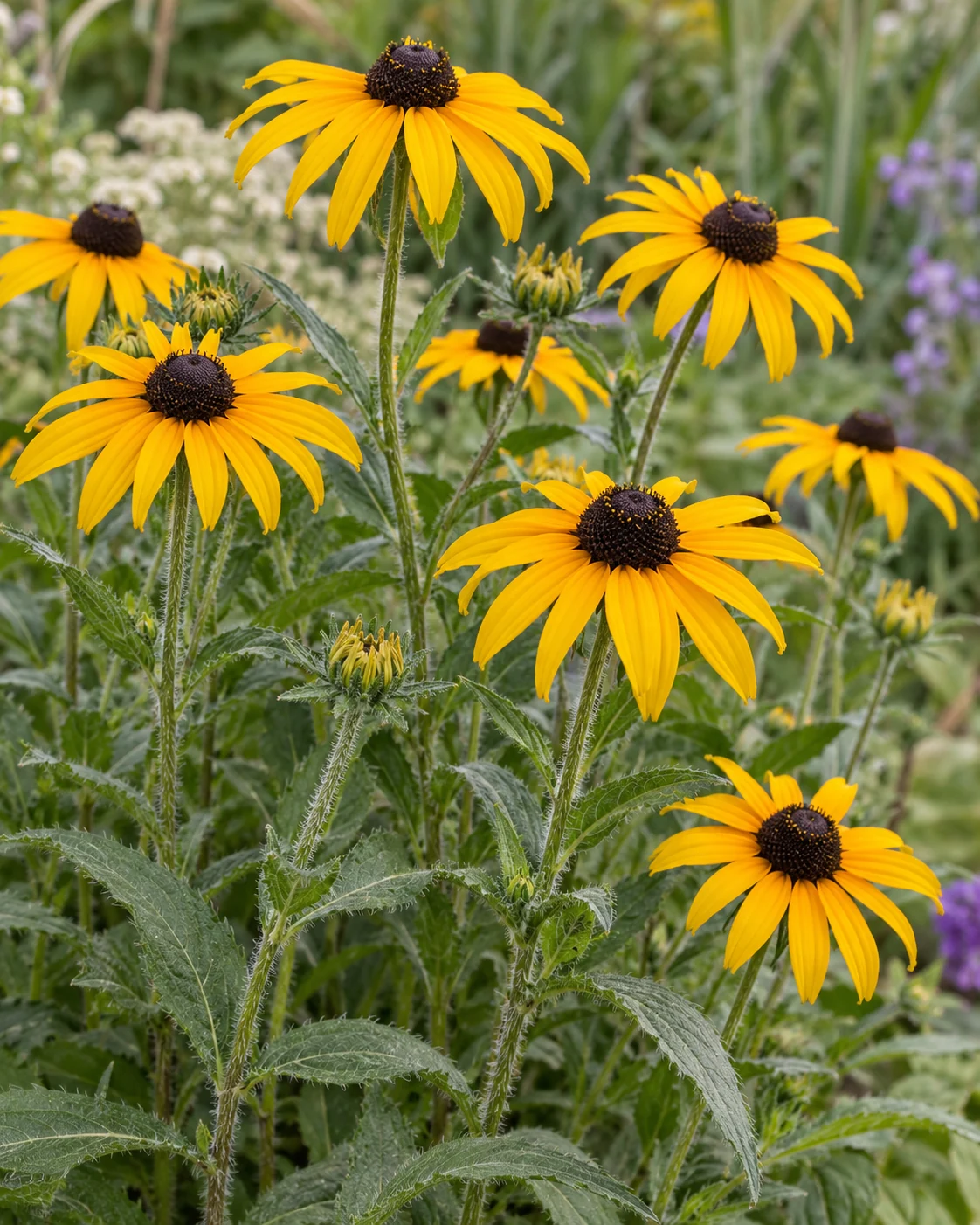
Illustrative overall form of Black-Eyed Susan. The nursery selection, season and site affect appearance.Illustrative foliage and seasonal detail of Black-Eyed Susan; confirm the botanical name and selection on the nursery label.
Where it works around Pensacola
A sunny, well-drained Pensacola garden is the strongest starting point. Established plants can cope with some dry conditions, but new plants still need establishment water. This is a useful choice for a relaxed native border; it is less suited to a tiny formal bed where every plant must look identical throughout the year.
Add summer yellow to an informal mixed perennial border.
Plant a visible cluster near a sunny seating area.
Combine with grasses in a small meadow-inspired garden bed.
Use selected seed heads for seasonal texture and bird interest.
Build a pollinator planting with flowers that bloom at different times.
How much sun?
Give it a bright position for a strong flower display. Although part shade is possible, too little light can make a planting less compact.
How much water?
Water through establishment and prolonged dry weather as needed. Avoid routinely saturating a bed that already holds moisture after rain.
Should flowers be cut off?
Remove some spent blooms for neatness, or leave selected seed heads for birds and reseeding. Decide how natural you want the bed to look.
Will it spread?
Seedlings may appear around the original plants. Keep useful seedlings where space allows and remove unwanted ones before the border becomes crowded.
Before it goes on the plan
Is it native?
Rudbeckia hirta is native to Florida. Confirm the species on the label; other plants sold as black-eyed Susan may have different growth habits.
Will the same plant last forever?
No. Plan for a short-lived plant that may renew itself through seed, with occasional replanting needed to maintain the design.
Can it face the beach?
Some coastal tolerance does not equal tolerance of direct salt spray, storm surge or prolonged flooding. Evaluate the exposure of the actual property.
Pairing ideas
Little Bluestem: Little bluestem supplies a fine-textured backdrop in a sunny, draining bed, with space for both plants to reach their full form.
Stokes’ Aster: Stokes’ aster adds lavender-blue flowers and lower foliage; use placement that accommodates its moisture needs.
Scarlet Sage: Scarlet sage adds red flower spikes to a relaxed sunny planting and extends the variety of flower shapes.
{"key":"susan","name":"Black-Eyed Susan","botanical":"Rudbeckia hirta","slug":"black-eyed-susan","id":"PLT-RUDB-HIRT","type":"accents","h":[2,4],"w":[1,2],"install":[0.5,0.5],"native":true,"accentGroup":"wildflower","accentForm":"daisy","light":"Full sun; tolerates part shade","lightTags":["sun","part"],"water":"Moderate to low once established; drainage matters","season":"Primarily summer flowers; short-lived planting","care":"Leave selected seed heads; manage seedlings","benefit":"Golden native flowers with bold dark centers","intro":"Black-eyed Susan supplies an open, sunny garden with clear yellow flowers and dark raised centers. It has a looser, more natural character than clipped foundation shrubs. Group it within a sunny perennial bed, where seasonal changes and occasional replacement are part of the planting rather than a surprise.","caution":"Rudbeckia hirta is often a biennial or short-lived perennial. Do not promise a permanent, uniform evergreen border. It can reseed, and nursery cultivars may behave differently from local native forms.","sizeNote":"Allow approximately 2–4 feet of flowering height and 1–2 feet of spread, with cultivar differences checked before purchase. Leaves sit below and along the stems. Keep the taller flowering layer behind low edging, and leave breathing room around neighboring plants rather than pressing everything together at installation.","site":"A sunny, well-drained Pensacola garden is the strongest starting point. Established plants can cope with some dry conditions, but new plants still need establishment water. This is a useful choice for a relaxed native border; it is less suited to a tiny formal bed where every plant must look identical throughout the year.","uses":["Add summer yellow to an informal mixed perennial border.","Plant a visible cluster near a sunny seating area.","Combine with grasses in a small meadow-inspired garden bed.","Use selected seed heads for seasonal texture and bird interest.","Build a pollinator planting with flowers that bloom at different times."],"checks":[["How much sun?","Give it a bright position for a strong flower display. Although part shade is possible, too little light can make a planting less compact."],["How much water?","Water through establishment and prolonged dry weather as needed. Avoid routinely saturating a bed that already holds moisture after rain."],["Should flowers be cut off?","Remove some spent blooms for neatness, or leave selected seed heads for birds and reseeding. Decide how natural you want the bed to look."],["Will it spread?","Seedlings may appear around the original plants. Keep useful seedlings where space allows and remove unwanted ones before the border becomes crowded."]],"faq":[["Is it native?","Rudbeckia hirta is native to Florida. Confirm the species on the label; other plants sold as black-eyed Susan may have different growth habits."],["Will the same plant last forever?","No. Plan for a short-lived plant that may renew itself through seed, with occasional replanting needed to maintain the design."],["Can it face the beach?","Some coastal tolerance does not equal tolerance of direct salt spray, storm surge or prolonged flooding. Evaluate the exposure of the actual property."]],"sources":[["UF/IFAS: Black-Eyed Susan","https://gardeningsolutions.ifas.ufl.edu/plants/ornamentals/black-eyed-susan/"],["NC State Extension: Rudbeckia hirta","https://plants.ces.ncsu.edu/plants/rudbeckia-hirta/"]],"unit":"ft","heightLabel":"Typical height","spreadLabel":"Typical spread","heightText":"2–4 ft","spreadText":"1–2 ft","sizeSummary":"2–4 ft high × 1–2 ft wide","color":"#70815a","bloomColor":"#e5b746","guideKind":"Flowering + accent plant","eyebrow":"FLOWERS + FOLIAGE / FORM + SEASON","aliases":["Rudbeckia","yellow daisy","native wildflower","yellow","pollinators"],"goals":["color"],"wholeCaption":"Illustrative overall form of Black-Eyed Susan. The nursery selection, season and site affect appearance.","detailCaption":"Illustrative foliage and seasonal detail of Black-Eyed Susan; confirm the botanical name and selection on the nursery label.","images":{"context":{"id":"6aa09dc2cbbf3a9cda1972d2","url":"https://cdn.prod.website-files.com/6a975baac0f352647862d847/6aa09dc2cbbf3a9cda1972d2_landova-accent-susan-context.webp","alt":"Illustrative planting concept with Black-Eyed Susan","width":1600,"height":900},"whole":{"id":"6aa09dc24ac77bd28cb450ee","url":"https://cdn.prod.website-files.com/6a975baac0f352647862d847/6aa09dc24ac77bd28cb450ee_landova-accent-susan-whole.webp","alt":"Illustrative whole-plant form of Black-Eyed Susan","width":1254,"height":1254,"fit":"contain"},"detail":{"id":"6aa09dc20a603d3b7b2715f1","url":"https://cdn.prod.website-files.com/6a975baac0f352647862d847/6aa09dc20a603d3b7b2715f1_landova-accent-susan-detail.webp","alt":"Illustrative foliage and seasonal detail of Black-Eyed Susan","width":1122,"height":1402}},"companions":[{"slug":"little-bluestem","name":"Little Bluestem","title":"Fine grass texture","reason":"Little bluestem supplies a fine-textured backdrop in a sunny, draining bed, with space for both plants to reach their full form.","image":{"id":"6aa00d166a78cbdca0ff1a4e","url":"https://cdn.prod.website-files.com/6a975baac0f352647862d847/6aa00d166a78cbdca0ff1a4e_landova-grass-bluestem-context.webp","alt":"Illustrative planting concept with Little Bluestem","width":1600,"height":900}},{"slug":"stokes-aster","name":"Stokes’ Aster","title":"Different flower season","reason":"Stokes’ aster adds lavender-blue flowers and lower foliage; use placement that accommodates its moisture needs.","image":{"id":"6aa09dc133de90abdd4f3038","url":"https://cdn.prod.website-files.com/6a975baac0f352647862d847/6aa09dc133de90abdd4f3038_landova-accent-stokes-context.webp","alt":"Illustrative planting concept with Stokes’ Aster","width":1600,"height":900}},{"slug":"scarlet-sage","name":"Scarlet Sage","title":"Warm color combination","reason":"Scarlet sage adds red flower spikes to a relaxed sunny planting and extends the variety of flower shapes.","image":{"id":"6aa093da22d595060ab68f44","url":"https://cdn.prod.website-files.com/6a975baac0f352647862d847/6aa093da22d595060ab68f44_landova-accent-scarlet-context.webp","alt":"Illustrative planting concept with Scarlet Sage","width":1600,"height":900}}]}
LANDOVA / PLANTING DECISIONS
Choose plants with the whole space in mind.
Explore a planting goal, then compare the growing needs and mature size of individual plants.
LANDOVA is in beta
Join the launch waitlist.
We are not accepting paying clients yet. We expect to launch around January 2027 and may open sooner. Explore our free tools now, and sign up for launch updates and educational planning emails.
Thank you. Your waitlist signup has been received. We will email you with launch updates. No purchase or project booking has been made.
We could not save your signup. Please try again or email info@landovadesign.com.