Bring large patterned leaves to a shaded seasonal pocket.
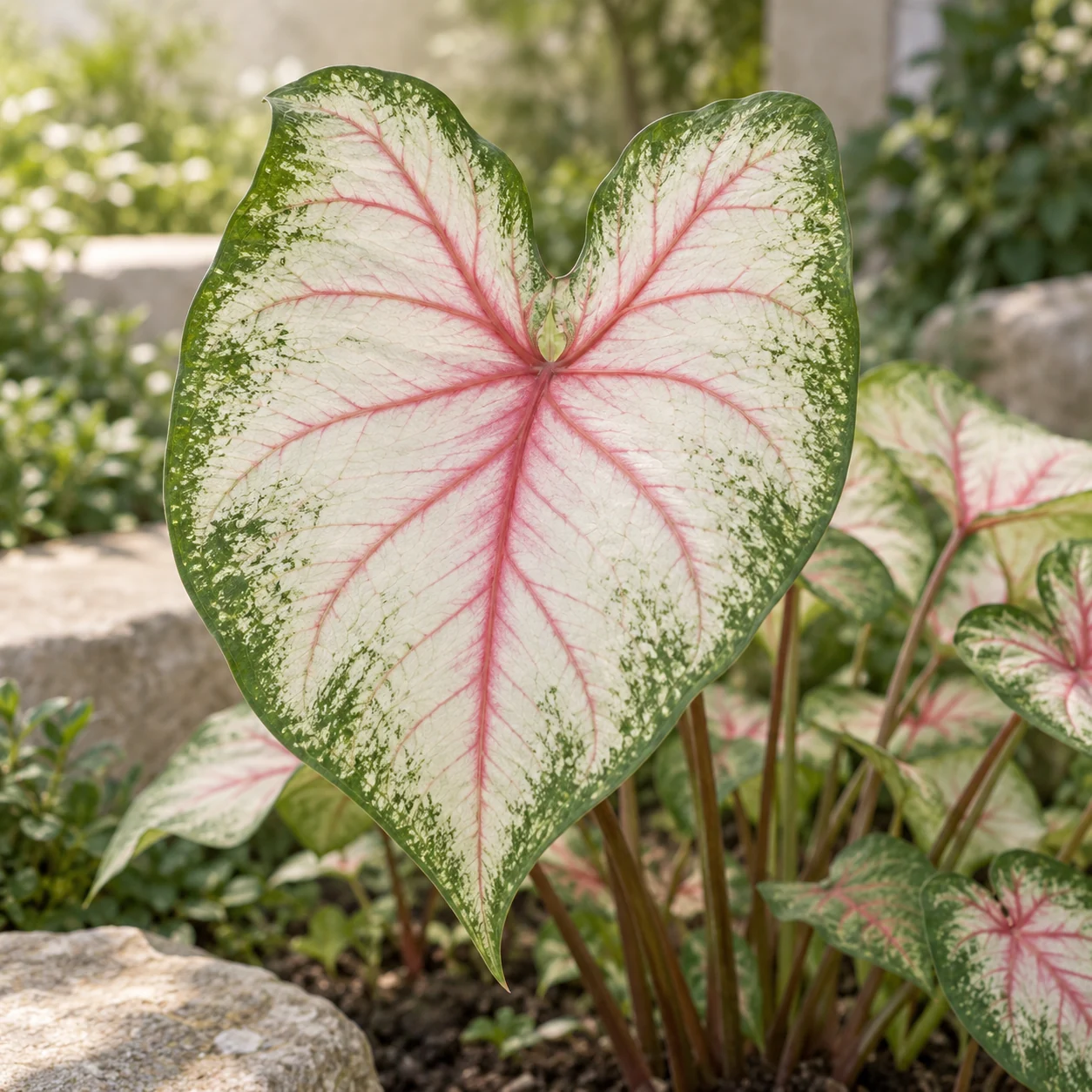
Caladium supplies color through its leaves rather than relying on showy flowers. Fancy-leafed garden forms carry broad heart-shaped leaves in combinations of green, white, pink and red. A small repeated group can brighten a shaded bed, especially against plain foliage. The illustrations show a representative white-and-pink leaf with green edging, not a verified named cultivar.
Before you choose: All caladium varieties lose their leaves and become dormant in winter. Plan a finished view for that bare period, and confirm the light requirements of the actual cultivar. Caladiums are toxic if ingested because they contain calcium oxalates; consider children and pets that chew plants before choosing an accessible planting position.
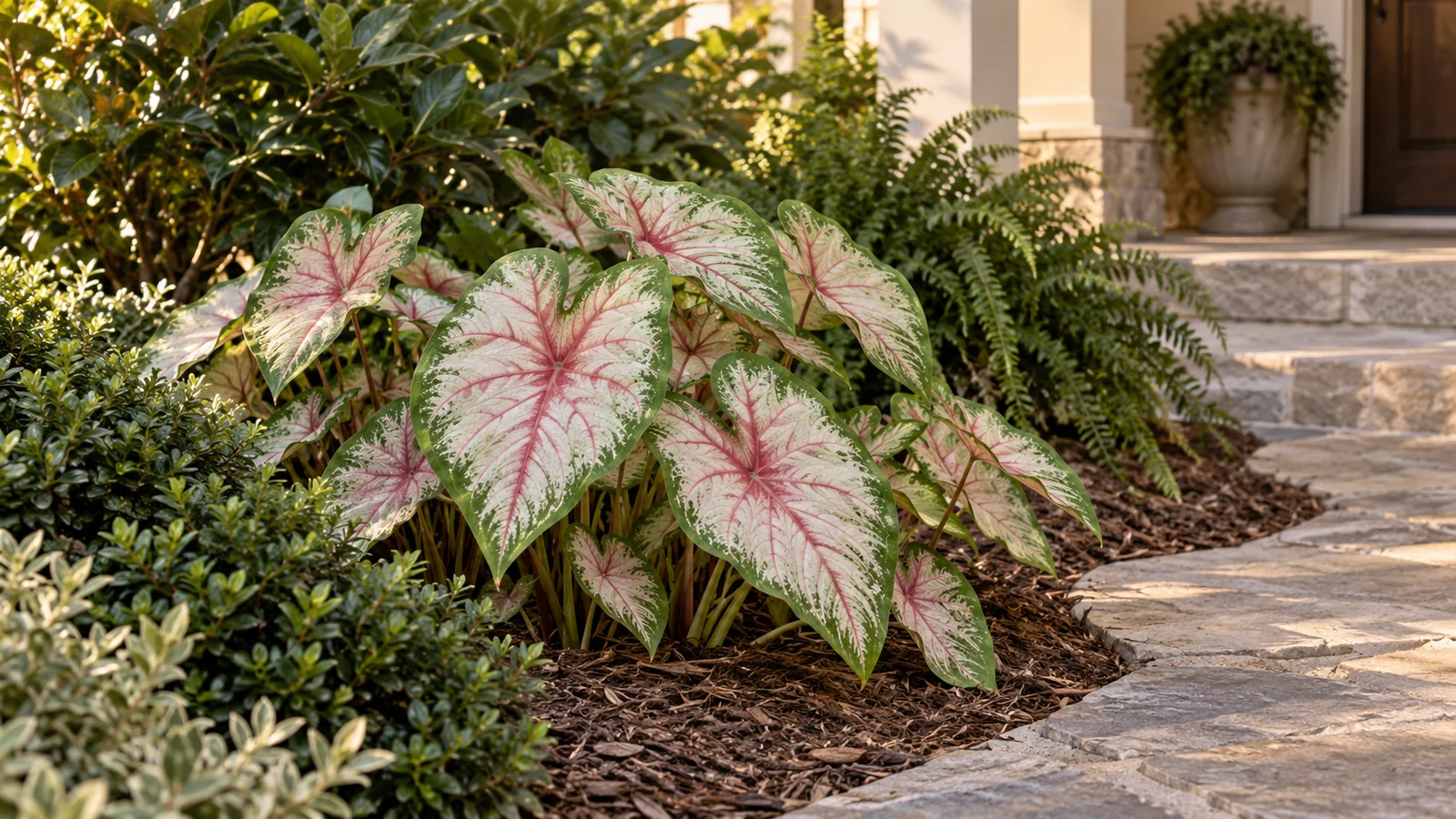
Illustrative planting concept
Size and space
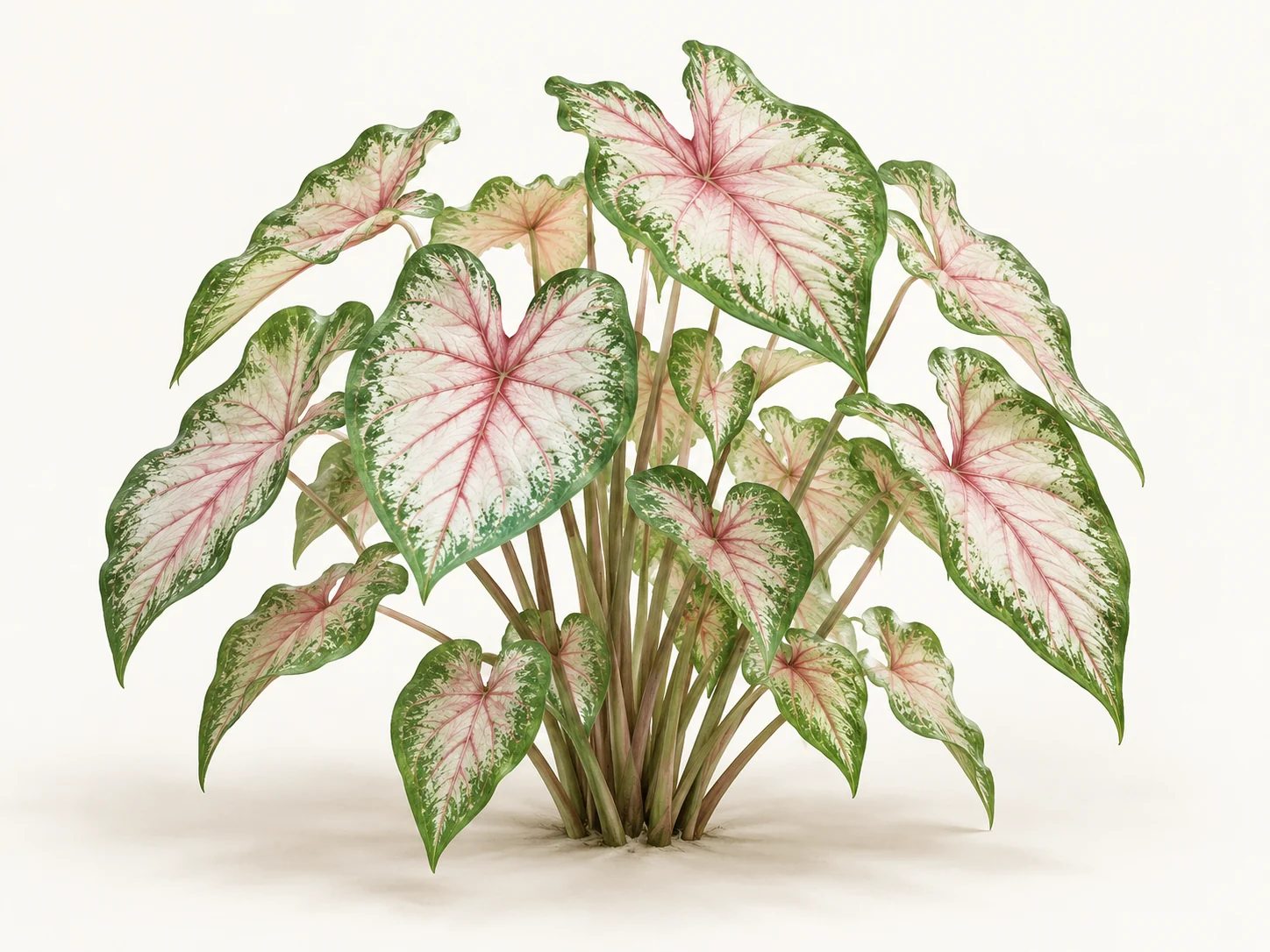
Typical height: 1–2.5 ft. Typical spread: 1–2 ft.
UF/IFAS describes garden caladiums commonly reaching 1–2.5 ft high; its landscape fact sheet gives a typical spread of 1–2 ft. The measured view uses those upper reference dimensions. Compact and lance-leafed cultivars can be smaller or have a different shape, so confirm the selection before using the same spacing across an entire bed.
Installed example: 0.5 ft high × 0.5 ft wide. This is an illustrative size, not a pot-size or growth-timeline promise.
Morning sun and part shade; deeper shade or sun tolerance depends on selection · Moist, well-drained soil; neither dry tubers nor saturated roots · Colorful warm-season leaves; all varieties become dormant in winter
Care: Remove fading leaves as they decline; protect tubers from unsuitable cold and wet conditions
Know the whole plant
Illustrative fancy-leafed garden Caladium. Leaf color, pattern, size and sun tolerance vary by cultivar.Illustrative heart-shaped Caladium leaves with white, pink and green patterning. This is a representative garden form, not a named-cultivar identification image.
Where it works around Pensacola
Choose a partly shaded Pensacola location with warm growing-season soil and useful drainage. Morning sun followed by protection is a practical starting point for many selections. Place small groups where their winter absence will not leave the whole bed without structure. Keep the planting separate from aggressive neighboring crowns so emerging leaves have space and seasonal care remains simple.
A seasonal foliage pocket in part shade
A bright detail beneath separate taller plants
A container with drainage near a sheltered entry
A repeated leaf color in a shaded border
A contrast between broad hearts and fine foliage
Which cultivar and leaf shape are you buying?
Fancy-leafed and lance-leafed caladiums differ in appearance, size and light tolerance. Match the label to the planned location instead of buying by color alone.
Will the bed still work in winter?
Caladium foliage disappears naturally. Use the surrounding layout, mulch and suitable permanent plants to hold the view through dormancy.
Can the root zone stay moist without saturation?
Check the bed during both dry weather and heavy rain. Tubers need suitable moisture and drainage; persistent winter wetness can cause problems.
Is this an appropriate household location?
Avoid positions where children or pets are likely to chew the plant. The colorful leaves are ornamental and should not be treated as edible.
Before it goes on the plan
Are the colorful parts flowers?
The display comes from patterned leaves. Flowers are not the main ornamental feature, so choose a cultivar whose foliage color and shape suit the garden.
Does winter leaf loss mean the plant is dead?
Not necessarily. Dormancy is normal. Tubers may return when conditions suit them, but cold, rot and declining vigor can require protection or replacement.
Can every caladium grow in full sun?
No. Some named cultivars are selected for greater sun tolerance, while many perform best with morning light and partial shade. Check the actual selection before planting.
Pairing ideas
Wax Begonia: Compact Wax Begonia can share a suitable partly shaded bed in a separate accessible pocket. Keep both seasonal plants clear of permanent crowns.
Cast Iron Plant: Cast Iron Plant offers a different leaf texture in shade. Match the moisture needs of each root zone and allow its own mature spread.
Dwarf Mondo Grass: Dwarf Mondo Grass can create a quieter texture in a suitable shaded position, with room for the caladium’s larger seasonal leaves.
{"key":"caladium","name":"Caladium","botanical":"Caladium × hortulanum","slug":"caladium","id":"PLT-CALA-HORT","type":"accents","h":[1,2.5],"w":[1,2],"install":[0.5,0.5],"native":false,"accentGroup":"foliage","accentForm":"heart","light":"Morning sun and part shade; deeper shade or sun tolerance depends on selection","lightTags":["part","shade"],"water":"Moist, well-drained soil; neither dry tubers nor saturated roots","season":"Colorful warm-season leaves; all varieties become dormant in winter","care":"Remove fading leaves as they decline; protect tubers from unsuitable cold and wet conditions","benefit":"Bring large patterned leaves to a shaded seasonal pocket.","intro":"Caladium supplies color through its leaves rather than relying on showy flowers. Fancy-leafed garden forms carry broad heart-shaped leaves in combinations of green, white, pink and red. A small repeated group can brighten a shaded bed, especially against plain foliage. The illustrations show a representative white-and-pink leaf with green edging, not a verified named cultivar.","caution":"All caladium varieties lose their leaves and become dormant in winter. Plan a finished view for that bare period, and confirm the light requirements of the actual cultivar. Caladiums are toxic if ingested because they contain calcium oxalates; consider children and pets that chew plants before choosing an accessible planting position.","sizeNote":"UF/IFAS describes garden caladiums commonly reaching 1–2.5 ft high; its landscape fact sheet gives a typical spread of 1–2 ft. The measured view uses those upper reference dimensions. Compact and lance-leafed cultivars can be smaller or have a different shape, so confirm the selection before using the same spacing across an entire bed.","site":"Choose a partly shaded Pensacola location with warm growing-season soil and useful drainage. Morning sun followed by protection is a practical starting point for many selections. Place small groups where their winter absence will not leave the whole bed without structure. Keep the planting separate from aggressive neighboring crowns so emerging leaves have space and seasonal care remains simple.","uses":["A seasonal foliage pocket in part shade","A bright detail beneath separate taller plants","A container with drainage near a sheltered entry","A repeated leaf color in a shaded border","A contrast between broad hearts and fine foliage"],"checks":[["Which cultivar and leaf shape are you buying?","Fancy-leafed and lance-leafed caladiums differ in appearance, size and light tolerance. Match the label to the planned location instead of buying by color alone."],["Will the bed still work in winter?","Caladium foliage disappears naturally. Use the surrounding layout, mulch and suitable permanent plants to hold the view through dormancy."],["Can the root zone stay moist without saturation?","Check the bed during both dry weather and heavy rain. Tubers need suitable moisture and drainage; persistent winter wetness can cause problems."],["Is this an appropriate household location?","Avoid positions where children or pets are likely to chew the plant. The colorful leaves are ornamental and should not be treated as edible."]],"faq":[["Are the colorful parts flowers?","The display comes from patterned leaves. Flowers are not the main ornamental feature, so choose a cultivar whose foliage color and shape suit the garden."],["Does winter leaf loss mean the plant is dead?","Not necessarily. Dormancy is normal. Tubers may return when conditions suit them, but cold, rot and declining vigor can require protection or replacement."],["Can every caladium grow in full sun?","No. Some named cultivars are selected for greater sun tolerance, while many perform best with morning light and partial shade. Check the actual selection before planting."]],"sources":[["UF/IFAS: Caladiums","https://gardeningsolutions.ifas.ufl.edu/plants/ornamentals/caladiums/"],["UF/IFAS: Caladium landscape fact sheet","https://ask.ifas.ufl.edu/publication/FP083"]],"unit":"ft","heightLabel":"Typical height","spreadLabel":"Typical spread","heightText":"1–2.5 ft","spreadText":"1–2 ft","sizeSummary":"1–2.5 ft high × 1–2 ft wide","color":"#839061","bloomColor":"#cb8ca5","guideKind":"Flowering + accent plant","eyebrow":"FLOWERS + FOLIAGE / FORM + SEASON","aliases":["Caladium","Caladium hortulanum","Fancy-leaf Caladium","Angel Wings"],"goals":["color"],"wholeCaption":"Illustrative fancy-leafed garden Caladium. Leaf color, pattern, size and sun tolerance vary by cultivar.","detailCaption":"Illustrative heart-shaped Caladium leaves with white, pink and green patterning. This is a representative garden form, not a named-cultivar identification image.","images":{"context":{"id":"6aa093e3e788bb371fe2c981","url":"https://cdn.prod.website-files.com/6a975baac0f352647862d847/6aa093e3e788bb371fe2c981_landova-accent-caladium-context.webp","alt":"Illustrative planting concept with Caladium","width":1600,"height":900},"whole":{"id":"6aa093e3888ea64800ceba2e","url":"https://cdn.prod.website-files.com/6a975baac0f352647862d847/6aa093e3888ea64800ceba2e_landova-accent-caladium-whole.webp","alt":"Illustrative whole-plant form of Caladium","width":1448,"height":1086,"fit":"contain"},"detail":{"id":"6aa093e43aacb0a0fb61738c","url":"https://cdn.prod.website-files.com/6a975baac0f352647862d847/6aa093e43aacb0a0fb61738c_landova-accent-caladium-detail.webp","alt":"Illustrative foliage and seasonal detail of Caladium","width":1254,"height":1254}},"companions":[{"slug":"wax-begonia","name":"Wax Begonia","title":"Set small flowers against larger patterned leaves","reason":"Compact Wax Begonia can share a suitable partly shaded bed in a separate accessible pocket. Keep both seasonal plants clear of permanent crowns.","image":{"id":"6aa093ddaf7952c7ec799d37","url":"https://cdn.prod.website-files.com/6a975baac0f352647862d847/6aa093ddaf7952c7ec799d37_landova-accent-begonia-context.webp","alt":"Illustrative planting concept with Wax Begonia","width":1600,"height":900}},{"slug":"cast-iron-plant","name":"Cast Iron Plant","title":"Provide a plain-green background","reason":"Cast Iron Plant offers a different leaf texture in shade. Match the moisture needs of each root zone and allow its own mature spread.","image":{"id":"6aa052e4beb1621af788dce7","url":"https://cdn.prod.website-files.com/6a975baac0f352647862d847/6aa052e4beb1621af788dce7_landova-groundcover-castiron-context.webp","alt":"Illustrative planting concept with Cast Iron Plant","width":1600,"height":900}},{"slug":"dwarf-mondo-grass","name":"Dwarf Mondo Grass","title":"Use a fine-leaved lower edge","reason":"Dwarf Mondo Grass can create a quieter texture in a suitable shaded position, with room for the caladium’s larger seasonal leaves.","image":{"id":"6aa00d183fe0798c1efa78ee","url":"https://cdn.prod.website-files.com/6a975baac0f352647862d847/6aa00d183fe0798c1efa78ee_landova-grass-mondo-context.webp","alt":"Illustrative planting concept with Dwarf Mondo Grass","width":1600,"height":900}}]}
LANDOVA / PLANTING DECISIONS
Choose plants with the whole space in mind.
Explore a planting goal, then compare the growing needs and mature size of individual plants.
LANDOVA is in beta
Join the launch waitlist.
We are not accepting paying clients yet. We expect to launch around January 2027 and may open sooner. Explore our free tools now, and sign up for launch updates and educational planning emails.
Thank you. Your waitlist signup has been received. We will email you with launch updates. No purchase or project booking has been made.
We could not save your signup. Please try again or email info@landovadesign.com.