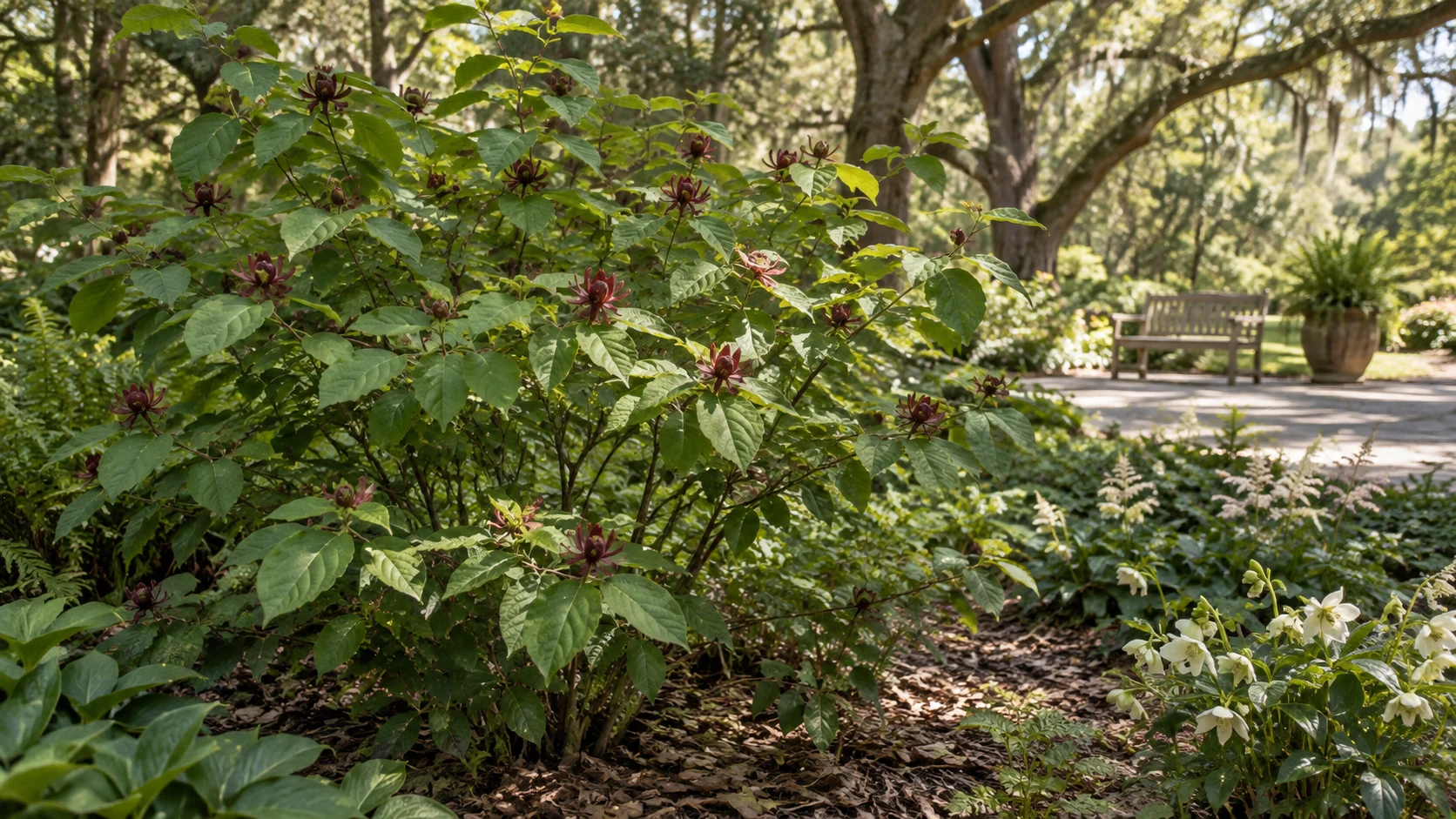
Dark maroon flowers among broad green leaves make Carolina Allspice a quieter kind of feature. Place this spreading native where the garden can be experienced nearby, while keeping the bench, path and maintenance route comfortably beyond its branches.
Illustrative planting concept
Size and space
Mature range: 6–9 ft high × 6–12 ft wide.
Plan for 6–9 ft high and 6–12 ft wide using UF/IFAS and FNPS. Rooting shoots can extend the planting beyond one canopy. The installed example is not a prediction of how quickly it will fill the bed.
Compare with a six-foot person: installed example 2 ft high by 1.5 ft wide. This example is not a fixed pot size or a growth timeline.
Part sun to shade · Moist, well-drained soil; establish with regular water and review dry spells. · Deciduous; maroon spring flowers with variable fragrance; possible yellow fall foliage.
Where it works around Pensacola
A sheltered Pensacola-area garden with moist soil is a better starting point than an exposed beachfront bed. FNPS lists poor salt tolerance. Ask for nursery-grown Calycanthus floridus and confirm the exact selection; flower color, scent and habit can differ among cultivars.
Sheltered woodland garden
Informal native border
Garden-room backdrop
Seasonal specimen
Roomy shaded planting
How close is close enough?
Position seating where flowers can be appreciated without branches leaning into the seat or walking route. Leave the shrub its own planted space.
Can the border expand?
Allow room to remove unwanted shoots and keep an eye on the outer edge. A spreading shrub is easier to manage when access is designed in.
What is the winter composition?
Plan the view with bare branches as well as summer leaves. Nearby evergreen planting can provide structure without squeezing both plants into the same space.
Is scent the deciding feature?
Ask to see and smell the actual nursery selection in bloom if possible. Fragrance varies, and a picture cannot tell a homeowner what that plant will smell like.
Before it goes on the plan
Is sweetshrub the same as summersweet?
No. Carolina Allspice is Calycanthus floridus. Summersweet is Clethra alnifolia; they have different flowers, forms and planting roles.
Can this be treated as culinary allspice?
No. Use the botanical name when ordering and do not treat an ornamental common name as permission to eat any plant part.
Will it remain a tidy single mound?
Not necessarily. It can spread by shoots and form a larger grouping. Choose a roomy setting or include ongoing control of the outer growth.
Pairing ideas
Florida Anise: Florida Anise can add evergreen structure in a compatible moist, sheltered setting. Both are large shrubs, so give each its own footprint.
Oakleaf Hydrangea: Oakleaf Hydrangea provides a different flower and leaf form in a sheltered, well-drained bed. Allow for winter leaf loss and the width of both shrubs.
{"key":"sweetshrub","id":"PLT-CALY-FLORIDUS","slug":"carolina-allspice-sweetshrub","name":"Carolina Allspice","botanical":"Calycanthus floridus","eyebrow":"A sheltered garden to experience up close","benefit":"Design a place to pause, not just a view.","intro":"Dark maroon flowers among broad green leaves make Carolina Allspice a quieter kind of feature. Place this spreading native where the garden can be experienced nearby, while keeping the bench, path and maintenance route comfortably beyond its branches.","h":[6,9],"w":[6,12],"install":[2,1.5],"color":"#668058","habit":"round","light":"Part sun to shade","lightTags":["part","shade"],"water":"Moist, well-drained soil; establish with regular water and review dry spells.","season":"Deciduous; maroon spring flowers with variable fragrance; possible yellow fall foliage.","care":"Watch spreading shoots; thin or remove unwanted growth to keep the bed usable.","site":"A sheltered Pensacola-area garden with moist soil is a better starting point than an exposed beachfront bed. FNPS lists poor salt tolerance. Ask for nursery-grown Calycanthus floridus and confirm the exact selection; flower color, scent and habit can differ among cultivars.","sizeNote":"Plan for 6–9 ft high and 6–12 ft wide using UF/IFAS and FNPS. Rooting shoots can extend the planting beyond one canopy. The installed example is not a prediction of how quickly it will fill the bed.","uses":["Sheltered woodland garden","Informal native border","Garden-room backdrop","Seasonal specimen","Roomy shaded planting"],"checks":[["How close is close enough?","Position seating where flowers can be appreciated without branches leaning into the seat or walking route. Leave the shrub its own planted space."],["Can the border expand?","Allow room to remove unwanted shoots and keep an eye on the outer edge. A spreading shrub is easier to manage when access is designed in."],["What is the winter composition?","Plan the view with bare branches as well as summer leaves. Nearby evergreen planting can provide structure without squeezing both plants into the same space."],["Is scent the deciding feature?","Ask to see and smell the actual nursery selection in bloom if possible. Fragrance varies, and a picture cannot tell a homeowner what that plant will smell like."]],"faq":[["Is sweetshrub the same as summersweet?","No. Carolina Allspice is Calycanthus floridus. Summersweet is Clethra alnifolia; they have different flowers, forms and planting roles."],["Can this be treated as culinary allspice?","No. Use the botanical name when ordering and do not treat an ornamental common name as permission to eat any plant part."],["Will it remain a tidy single mound?","Not necessarily. It can spread by shoots and form a larger grouping. Choose a roomy setting or include ongoing control of the outer growth."]],"sources":[["UF/IFAS Carolina Allspice","https://ask.ifas.ufl.edu/publication/FP095"],["Florida Native Plant Society","https://www.fnps.org/plant/calycanthus-floridus"]],"companions":[{"slug":"florida-anise","name":"Florida Anise","title":"Keep an evergreen layer nearby","reason":"Florida Anise can add evergreen structure in a compatible moist, sheltered setting. Both are large shrubs, so give each its own footprint.","image":{"id":"6a9f3484598f07756d53faf0","url":"https://cdn.prod.website-files.com/6a975baac0f352647862d847/6a9f3484598f07756d53faf0_landova-shrub-anise-context-r02.webp","alt":"Illustrative planting concept with Florida Anise"}},{"slug":"oakleaf-hydrangea","name":"Oakleaf Hydrangea","title":"Extend seasonal interest","reason":"Oakleaf Hydrangea provides a different flower and leaf form in a sheltered, well-drained bed. Allow for winter leaf loss and the width of both shrubs.","image":{"id":"6a9f5cd62a41d062f4f88b9c","url":"https://cdn.prod.website-files.com/6a975baac0f352647862d847/6a9f5cd62a41d062f4f88b9c_landova-oakleaf-context-r05.webp","alt":"Illustrative planting concept with Oakleaf Hydrangea"}}],"wholeCaption":"Illustrative leafy-season form with understated maroon blooms among the foliage.","detailCaption":"Illustrative strap-like maroon flower parts; scent cannot be judged from an image.","wholeFit":"contain","native":true,"guideKind":"Native species guide","aliases":["sweetshrub","sweet shrub","Carolina sweetshrub"],"images":{"context":{"id":"6a9fefd55db149f2910b14ba","url":"https://cdn.prod.website-files.com/6a975baac0f352647862d847/6a9fefd55db149f2910b14ba_landova-sweetshrub-context-r07.webp","alt":"Illustrative planting concept with Carolina Allspice"},"whole":{"id":"6a9fefd55db149f2910b14cf","url":"https://cdn.prod.website-files.com/6a975baac0f352647862d847/6a9fefd55db149f2910b14cf_landova-sweetshrub-whole-r07.webp","alt":"Illustrative view of Carolina Allspice overall form","fit":"contain"},"detail":{"id":"6a9fefd6c7d8ea3556dcb659","url":"https://cdn.prod.website-files.com/6a975baac0f352647862d847/6a9fefd6c7d8ea3556dcb659_landova-sweetshrub-detail-r07.webp","alt":"Illustrative view of Carolina Allspice foliage and seasonal detail"}},"caution":"Allow 6–12 ft of width and spreading shoots. Sheltered moist beds suit it better than beachfront exposure."}
LANDOVA / PLANTING DECISIONS
Choose plants with the whole space in mind.
Explore a planting goal, then compare the growing needs and mature size of individual plants.
LANDOVA is in beta
Join the launch waitlist.
We are not accepting paying clients yet. We expect to launch around January 2027 and may open sooner. Explore our free tools now, and sign up for launch updates and educational planning emails.
Thank you. Your waitlist signup has been received. We will email you with launch updates. No purchase or project booking has been made.
We could not save your signup. Please try again or email info@landovadesign.com.