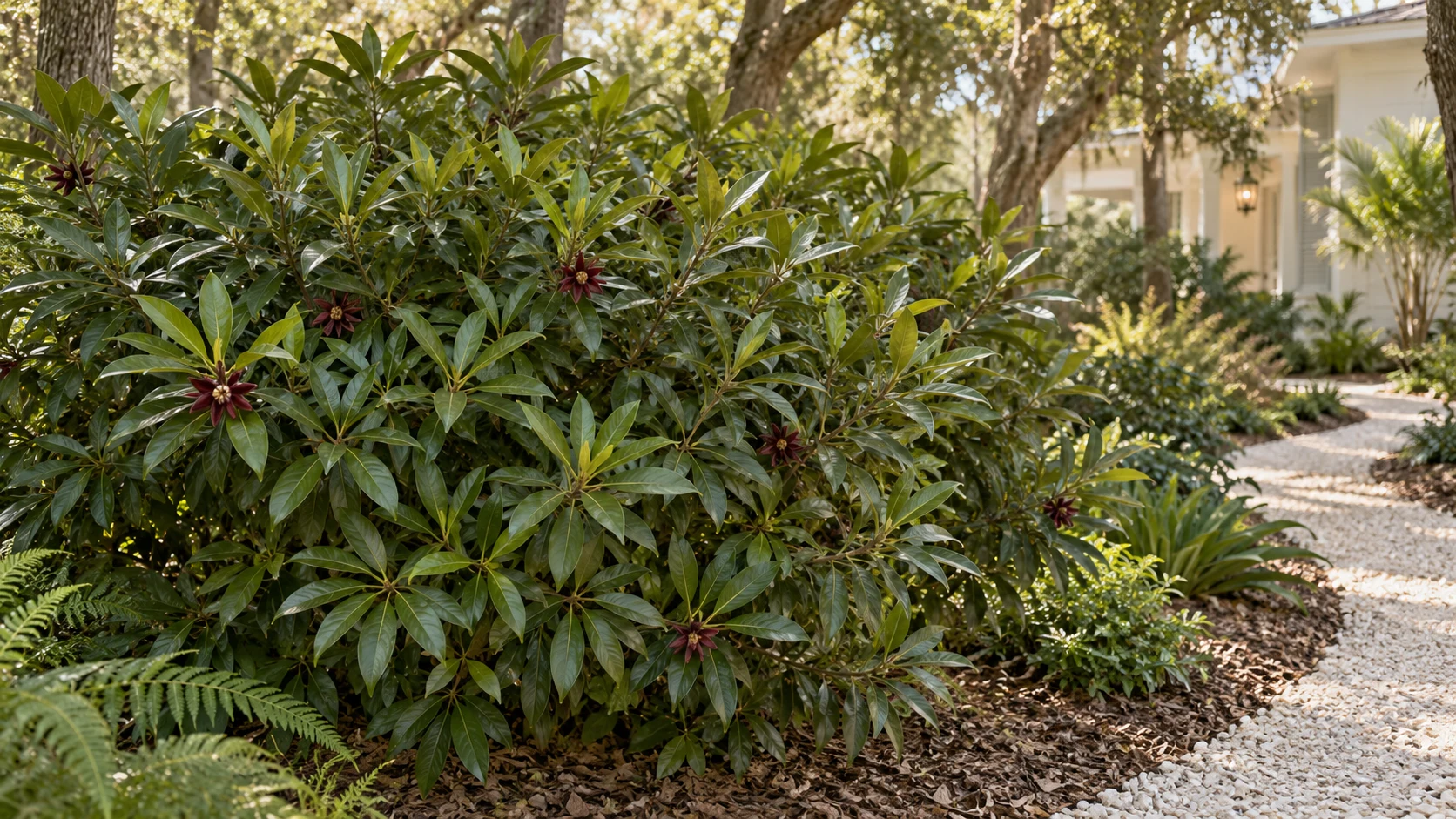
A leafy native shrub can turn a sheltered property edge into a softer, greener backdrop. Florida anise is an option for generous beds where moisture and filtered light support the plant, and its eventual size supports the plan.
Illustrative planting concept
Size and space
Mature range: 10–15 ft high × 6–10 ft wide.
The 10–15 ft height and 6–10 ft spread describe the species, not a dwarf cultivar. A younger plant can look modest beside the house; reserve its future width before placing paths, windows or the next planting layer.
Compare with a six-foot person: installed example 3 ft high by 2.5 ft wide. This example is not a fixed pot size or a growth timeline.
Part shade to shade · Moist soil; support during dry spells · Evergreen · maroon spring flowers
Where it works around Pensacola
A useful native option for sheltered Pensacola gardens with a moist woodland character. Place it where a substantial evergreen layer is welcome, rather than expecting a dry, exposed strip to support the same result.
A leafy privacy backdrop
A shaded property-edge planting
A native woodland garden
A tall layer behind smaller shrubs
A broad, informal screen
Is the shade also dry?
Shade from mature trees does not automatically mean moist soil. Check the bed through a dry period and plan establishment watering without burying or cutting important tree roots.
Where will the broad shrub end?
Draw the mature canopy before deciding where the walkway or gate goes. Leave room to pass, reach utilities and maintain the house without repeatedly cutting the plant back.
Will the moisture pattern suit it?
Florida anise favors moisture and can suit wetter garden settings. Persistent flooding or redirected runoff still needs a site assessment; adding shrubs is not a stormwater design.
Is this near an edible or play area?
Florida anise is toxic if eaten and is not the culinary star anise. Keep that distinction clear around edible gardens. Its spring flowers can also have an unusual, unpleasant scent, so consider distance from seating.
Before it goes on the plan
Can it stay as a small foundation shrub?
It can be pruned, but this species naturally becomes substantial. If the available space is permanently small, select a genuinely compact plant instead of building frequent heavy trimming into the design.
Does native mean it will work anywhere here?
No. Native origin is useful context, but the actual light, moisture, soil and exposure still decide suitability. A sheltered inland bed and an exposed beach property are different planting situations.
Can I use the leaves or seed pods in cooking?
No. This is an ornamental landscape plant, and its parts are toxic when consumed. The anise-like leaf aroma does not make it an edible herb.
Pairing ideas
Shi Shi Gashira Camellia: Explore camellias in the brighter part of a moist, acidic, well-drained border. Keep them outside the anise canopy and away from any persistently saturated area.
Radicans Gardenia: Radicans gardenia can add a low flowering layer where morning light reaches the bed. Match its drainage needs and give both plants separate growing space.
{"key":"anise","id":"PLT-ILLI-FLOR","slug":"florida-anise","name":"Florida Anise","botanical":"Illicium floridanum","eyebrow":"A NATIVE WOODLAND LAYER","benefit":"Make shade feel like a garden.","intro":"A leafy native shrub can turn a sheltered property edge into a softer, greener backdrop. Florida anise is an option for generous beds where moisture and filtered light support the plant, and its eventual size supports the plan.","h":[10,15],"w":[6,10],"install":[3,2.5],"color":"#526943","habit":"Upright, broad, multi-stemmed evergreen shrub","light":"Part shade to shade","lightTags":["part","shade"],"water":"Moist soil; support during dry spells","season":"Evergreen · maroon spring flowers","care":"Room to grow; selective pruning","site":"A useful native option for sheltered Pensacola gardens with a moist woodland character. Place it where a substantial evergreen layer is welcome, rather than expecting a dry, exposed strip to support the same result.","sizeNote":"The 10–15 ft height and 6–10 ft spread describe the species, not a dwarf cultivar. A younger plant can look modest beside the house; reserve its future width before placing paths, windows or the next planting layer.","uses":["A leafy privacy backdrop","A shaded property-edge planting","A native woodland garden","A tall layer behind smaller shrubs","A broad, informal screen"],"checks":[["Is the shade also dry?","Shade from mature trees does not automatically mean moist soil. Check the bed through a dry period and plan establishment watering without burying or cutting important tree roots."],["Where will the broad shrub end?","Draw the mature canopy before deciding where the walkway or gate goes. Leave room to pass, reach utilities and maintain the house without repeatedly cutting the plant back."],["Will the moisture pattern suit it?","Florida anise favors moisture and can suit wetter garden settings. Persistent flooding or redirected runoff still needs a site assessment; adding shrubs is not a stormwater design."],["Is this near an edible or play area?","Florida anise is toxic if eaten and is not the culinary star anise. Keep that distinction clear around edible gardens. Its spring flowers can also have an unusual, unpleasant scent, so consider distance from seating."]],"faq":[["Can it stay as a small foundation shrub?","It can be pruned, but this species naturally becomes substantial. If the available space is permanently small, select a genuinely compact plant instead of building frequent heavy trimming into the design."],["Does native mean it will work anywhere here?","No. Native origin is useful context, but the actual light, moisture, soil and exposure still decide suitability. A sheltered inland bed and an exposed beach property are different planting situations."],["Can I use the leaves or seed pods in cooking?","No. This is an ornamental landscape plant, and its parts are toxic when consumed. The anise-like leaf aroma does not make it an edible herb."]],"sources":[["UF/IFAS · Florida anise and planting conditions","https://gardeningsolutions.ifas.ufl.edu/plants/trees-and-shrubs/shrubs/florida-anise/"],["Santa Rosa County Extension · regional size reference","https://sfyl.ifas.ufl.edu/media/sfylifasufledu/santa-rosa/docs/pdfs/demo-garden/Florida-Anise.pdf"],["NC State Extension · form, moisture and flower scent","https://plants.ces.ncsu.edu/plants/illicium-floridanum/"]],"companions":[{"slug":"shi-shi-gashira-camellia","name":"Shi Shi Gashira Camellia","title":"FLOWERS IN A LOWER LAYER","reason":"Explore camellias in the brighter part of a moist, acidic, well-drained border. Keep them outside the anise canopy and away from any persistently saturated area.","image":{"id":"6a9f34851fbbc23ce57e8e85","url":"https://cdn.prod.website-files.com/6a975baac0f352647862d847/6a9f34851fbbc23ce57e8e85_landova-shrub-shishi-context-r02.webp","alt":"Illustrative planting concept with Shi Shi Gashira Camellia"}},{"slug":"radicans-gardenia","name":"Radicans Gardenia","title":"DETAIL NEAR THE FRONT","reason":"Radicans gardenia can add a low flowering layer where morning light reaches the bed. Match its drainage needs and give both plants separate growing space.","image":{"id":"6a9f291b4f259866ad352735","url":"https://cdn.prod.website-files.com/6a975baac0f352647862d847/6a9f291b4f259866ad352735_landova-shrub-radicans-context.webp","alt":"Illustrative planting concept with Radicans Gardenia"}}],"wholeCaption":"Illustrative view of the upright, branching shrub form. The measured comparison above is the guide to future space; this view does not represent a guaranteed nursery size.","detailCaption":"The maroon, many-petaled spring flower sits among broad olive-green leaves. This is ornamental Florida anise; its fragrance does not indicate an edible plant.","images":{"context":{"id":"6a9f3484598f07756d53faf0","url":"https://cdn.prod.website-files.com/6a975baac0f352647862d847/6a9f3484598f07756d53faf0_landova-shrub-anise-context-r02.webp","alt":"Illustrative planting concept with Florida Anise"},"whole":{"id":"6a9f3484d7f880ff25066cda","url":"https://cdn.prod.website-files.com/6a975baac0f352647862d847/6a9f3484d7f880ff25066cda_landova-shrub-anise-whole-r02.webp","alt":"Illustrative view of Florida Anise overall form"},"detail":{"id":"6a9f34842bf2b5aadf04ff23","url":"https://cdn.prod.website-files.com/6a975baac0f352647862d847/6a9f34842bf2b5aadf04ff23_landova-shrub-anise-detail-r02.webp","credit":{"author":"peganum","sourcePage":"https://plants.ces.ncsu.edu/plants/illicium-floridanum/","license":"CC-BY-SA 2.0","licenseUrl":"https://creativecommons.org/licenses/by-sa/2.0/"},"alt":"Florida Anise — foliage and seasonal detail"}},"caution":"A large native shrub for moist, sheltered beds; not culinary anise."}
LANDOVA / PLANTING DECISIONS
Choose plants with the whole space in mind.
Explore a planting goal, then compare the growing needs and mature size of individual plants.
LANDOVA is in beta
Join the launch waitlist.
We are not accepting paying clients yet. We expect to launch around January 2027 and may open sooner. Explore our free tools now, and sign up for launch updates and educational planning emails.
Thank you. Your waitlist signup has been received. We will email you with launch updates. No purchase or project booking has been made.
We could not save your signup. Please try again or email info@landovadesign.com.