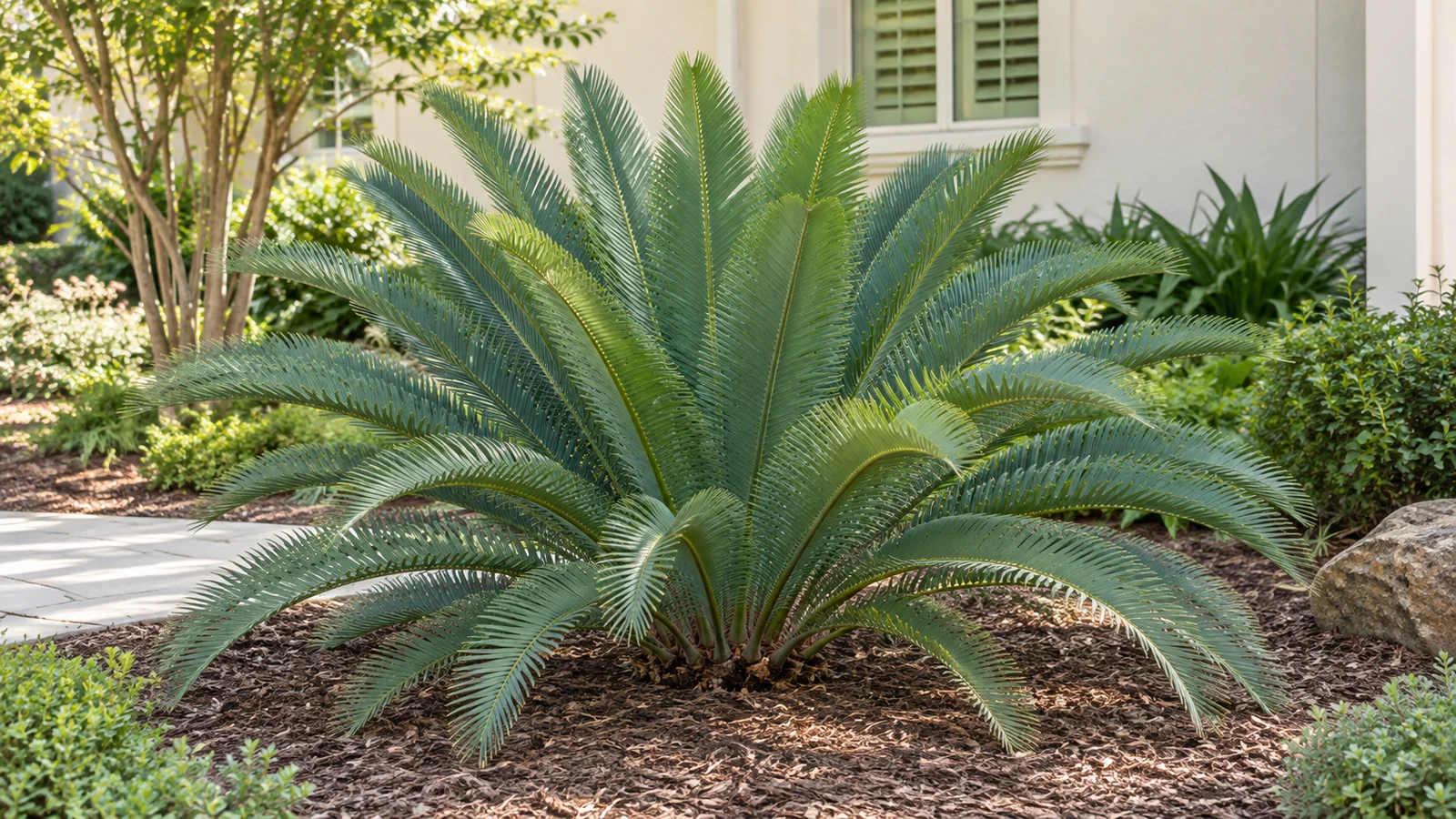
Create a sculptural focal point in a sunny garden bed.
Chestnut Dioon brings a rosette of stiff, blue-green fronds to a residential landscape. Its very slow growth and strong outline make it a candidate for a deliberate accent with open space around it. Choose Dioon edule by name: the larger, less cold-hardy Giant Dioon is a different plant.
Before you choose: This is a cycad with sharp leaf tips and toxic plant material. Keep it away from places where children or pets may chew foliage or reach seeds. Its low nursery height does not make it suitable for a tight walkway or narrow bed.
Illustrative planting concept
Size and space
Landscape height reference: 8 ft. Frond-space planning allowance: 11 ft.
UF/IFAS describes Chestnut Dioon as very slow growing and reaching up to 8 ft in Florida landscapes. The Gymnosperm Database reports leaves 0.7–1.6 m long. LANDOVA reserves an 11 ft frond-space circle by doubling 1.6 m and rounding up from about 10.5 ft. This is a design allowance, not a published mature-spread measurement. Clumping, form and age can change the footprint; confirm local stock and leave access beyond it. The 2 × 3 ft installed example carries no growth timeline.
Installed example: 2 ft high × 3 ft wide. This is an illustrative size, not a pot-size or growth-timeline promise.
Full sun to part shade · Well-drained soil; irrigate to establish, then adjust to rainfall · Evergreen blue-green fronds · periodic new growth · cones on mature plants
Care: Very slow growth; selective cleanup and routine pest inspection
Know the whole plant
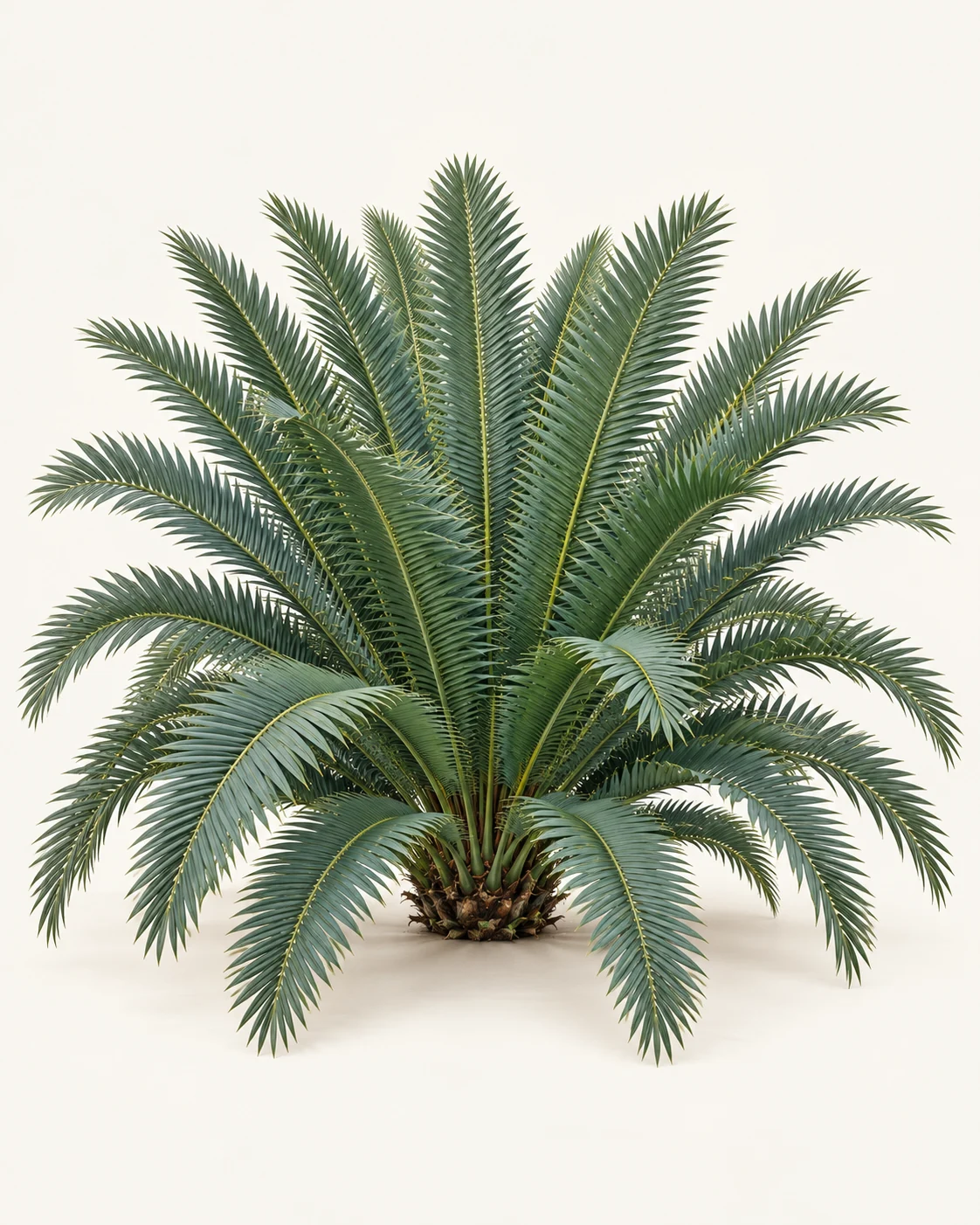
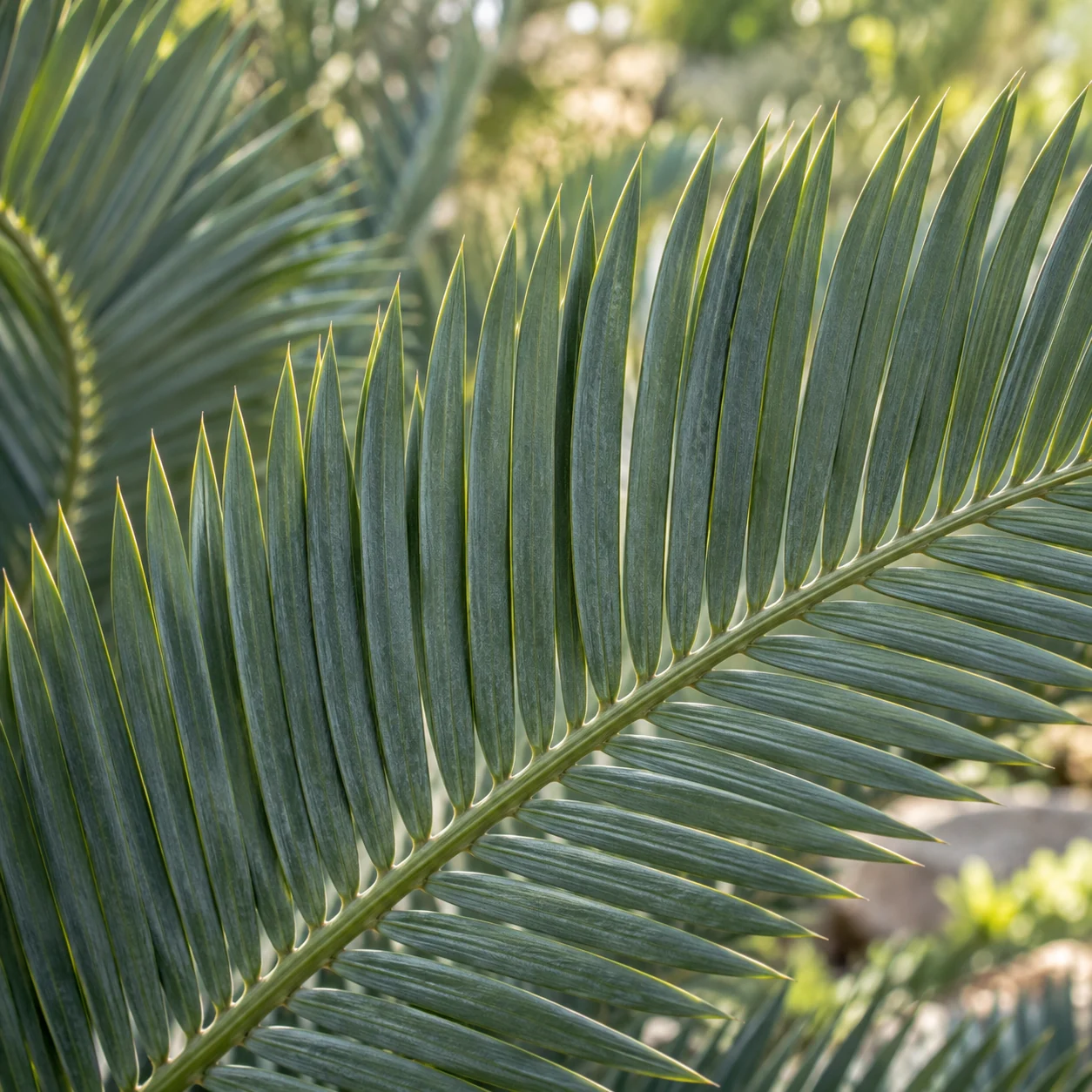
Illustrative whole-plant form of Chestnut Dioon; fronds, stems and overall proportions vary with age and growing conditions.Illustrative foliage detail of Chestnut Dioon. Use the botanical name and nursery label to confirm the plant.
Where it works around Pensacola
Consider Chestnut Dioon for a broad, well-drained Pensacola garden bed where the rosette can be seen from a patio or window without touching a walking route. UF/IFAS lists zones 8–11. Match the individual site to winter exposure, drainage and household use before selecting the plant.
A single sculptural garden focal point
An architectural accent in a broad sunny bed
A blue-green contrast to finer foliage
A set-back feature viewed from a patio
A possible Sago alternative where the site suits it
Is the label Dioon edule?
Giant Dioon, Dioon spinulosum, has different size and cold requirements. Inspect the botanical name and confirm the expected form of the actual nursery plant.
Can people pass without contact?
Measure the frond-space allowance from the center in every direction, then add separate walking and maintenance clearance. Keep pointed leaves outside doorways, play areas and narrow paths.
Does this bed drain after rain?
Check runoff from paving and roofs, not just the top layer of soil. Keep the plant out of locations that remain saturated; adjust irrigation to soil moisture and establishment needs.
Is this a practical plant for the household?
Treat the foliage and seeds as unsafe to eat. Where children or animals may have access to plant material, choose another accent. Purchase nursery-propagated stock from a reputable supplier.
Before it goes on the plan
Is Chestnut Dioon a palm?
No. It is a cone-bearing cycad with feather-like fronds. The word chestnut is a common name and should never be taken as an edible-plant label.
Why is the spread called a planning allowance?
The regional UF/IFAS guide gives a height but no mature spread. The diagram therefore reserves space using published leaf length, with the calculation explained above. It does not claim that every plant will be eleven feet wide or stop at that width.
Is it a lower-care substitute for Sago Palm?
UF/IFAS identifies it as an alternative that is less prone to cycad aulacaspis scale. It still needs site-appropriate care and pest inspection. The sharp foliage and cycad toxicity also remain part of the placement decision.
Pairing ideas
Coontie: Coontie provides a lower Florida-native rosette with a different size range. Both require the same careful household review for cycad toxicity.
Pink Muhly Grass: Pink Muhly Grass can provide fine texture and seasonal color in a separate sunny, well-drained part of the bed, beyond the cycad's fronds and maintenance area.
{"type":"palms","unit":"ft","color":"#70815a","native":false,"eyebrow":"EVERGREEN FORM + THOUGHTFUL PLACEMENT","heightLabel":"Landscape height reference","spreadLabel":"Frond-space planning allowance","sizeBasis":"Landscape planning reference","key":"dioon","name":"Chestnut Dioon","botanical":"Dioon edule","slug":"chestnut-dioon","id":"PLT-DIOO-EDUL","h":[8,8],"w":[11,11],"install":[2,3],"palmForm":"cycad-trunk","trunkRatio":0.26,"guideKind":"Cycad · additional care","aliases":["Chestnut Dioon","Dioon edule","Palma de la Virgen","Chestnut Cycad"],"goals":[],"light":"Full sun to part shade","lightTags":["sun","part"],"water":"Well-drained soil; irrigate to establish, then adjust to rainfall","season":"Evergreen blue-green fronds · periodic new growth · cones on mature plants","care":"Very slow growth; selective cleanup and routine pest inspection","sizeSummary":"8 ft height reference × 11 ft frond-space allowance","referenceNote":"The eight-foot height comes from UF/IFAS. The eleven-foot width is LANDOVA's rounded planning allowance based on published leaf length, not a measured mature-width limit. Confirm the actual nursery form and allow additional access space. The person remains six feet tall.","benefit":"Create a sculptural focal point in a sunny garden bed.","intro":"Chestnut Dioon brings a rosette of stiff, blue-green fronds to a residential landscape. Its very slow growth and strong outline make it a candidate for a deliberate accent with open space around it. Choose Dioon edule by name: the larger, less cold-hardy Giant Dioon is a different plant.","caution":"This is a cycad with sharp leaf tips and toxic plant material. Keep it away from places where children or pets may chew foliage or reach seeds. Its low nursery height does not make it suitable for a tight walkway or narrow bed.","sizeNote":"UF/IFAS describes Chestnut Dioon as very slow growing and reaching up to 8 ft in Florida landscapes. The Gymnosperm Database reports leaves 0.7–1.6 m long. LANDOVA reserves an 11 ft frond-space circle by doubling 1.6 m and rounding up from about 10.5 ft. This is a design allowance, not a published mature-spread measurement. Clumping, form and age can change the footprint; confirm local stock and leave access beyond it. The 2 × 3 ft installed example carries no growth timeline.","site":"Consider Chestnut Dioon for a broad, well-drained Pensacola garden bed where the rosette can be seen from a patio or window without touching a walking route. UF/IFAS lists zones 8–11. Match the individual site to winter exposure, drainage and household use before selecting the plant.","uses":["A single sculptural garden focal point","An architectural accent in a broad sunny bed","A blue-green contrast to finer foliage","A set-back feature viewed from a patio","A possible Sago alternative where the site suits it"],"checks":[["Is the label Dioon edule?","Giant Dioon, Dioon spinulosum, has different size and cold requirements. Inspect the botanical name and confirm the expected form of the actual nursery plant."],["Can people pass without contact?","Measure the frond-space allowance from the center in every direction, then add separate walking and maintenance clearance. Keep pointed leaves outside doorways, play areas and narrow paths."],["Does this bed drain after rain?","Check runoff from paving and roofs, not just the top layer of soil. Keep the plant out of locations that remain saturated; adjust irrigation to soil moisture and establishment needs."],["Is this a practical plant for the household?","Treat the foliage and seeds as unsafe to eat. Where children or animals may have access to plant material, choose another accent. Purchase nursery-propagated stock from a reputable supplier."]],"faq":[["Is Chestnut Dioon a palm?","No. It is a cone-bearing cycad with feather-like fronds. The word chestnut is a common name and should never be taken as an edible-plant label."],["Why is the spread called a planning allowance?","The regional UF/IFAS guide gives a height but no mature spread. The diagram therefore reserves space using published leaf length, with the calculation explained above. It does not claim that every plant will be eleven feet wide or stop at that width."],["Is it a lower-care substitute for Sago Palm?","UF/IFAS identifies it as an alternative that is less prone to cycad aulacaspis scale. It still needs site-appropriate care and pest inspection. The sharp foliage and cycad toxicity also remain part of the placement decision."]],"sources":[["UF/IFAS: Dioon","https://gardeningsolutions.ifas.ufl.edu/plants/trees-and-shrubs/palms-and-cycads/dioon/"],["The Gymnosperm Database: Dioon edule leaf dimensions","https://www.conifers.org/za/Dioon_edule.php"],["UF/IFAS: Sago Alternatives","https://gardeningsolutions.ifas.ufl.edu/plants/trees-and-shrubs/palms-and-cycads/sago-alternatives/"]],"wholeCaption":"Illustrative whole-plant form of Chestnut Dioon; fronds, stems and overall proportions vary with age and growing conditions.","detailCaption":"Illustrative foliage detail of Chestnut Dioon. Use the botanical name and nursery label to confirm the plant.","images":{"context":{"id":"6aa04576cbe9e0997ce744dd","url":"https://cdn.prod.website-files.com/6a975baac0f352647862d847/6aa04576cbe9e0997ce744dd_landova-palm-dioon-context.webp","alt":"Illustrative planting concept with Chestnut Dioon","width":1600,"height":900},"whole":{"id":"6aa04576ea97d9a7fab6bf12","url":"https://cdn.prod.website-files.com/6a975baac0f352647862d847/6aa04576ea97d9a7fab6bf12_landova-palm-dioon-whole.webp","alt":"Illustrative whole-plant form of Chestnut Dioon","width":1122,"height":1402,"fit":"contain"},"detail":{"id":"6aa04576f5ce7c0b5e6e750d","url":"https://cdn.prod.website-files.com/6a975baac0f352647862d847/6aa04576f5ce7c0b5e6e750d_landova-palm-dioon-detail.webp","alt":"Illustrative foliage and seasonal detail of Chestnut Dioon","width":1254,"height":1254}},"companions":[{"slug":"coontie","name":"Coontie","title":"Compare a lower cycad option","reason":"Coontie provides a lower Florida-native rosette with a different size range. Both require the same careful household review for cycad toxicity.","image":{"id":"6aa03e15876c821d804ed501","url":"https://cdn.prod.website-files.com/6a975baac0f352647862d847/6aa03e15876c821d804ed501_landova-palm-coontie-context.webp","alt":"Illustrative planting concept with Coontie","width":1600,"height":900}},{"slug":"pink-muhly-grass","name":"Pink Muhly Grass","title":"Explore a finer sunny layer","reason":"Pink Muhly Grass can provide fine texture and seasonal color in a separate sunny, well-drained part of the bed, beyond the cycad's fronds and maintenance area.","image":{"id":"6aa00228430659e428d61061","url":"https://cdn.prod.website-files.com/6a975baac0f352647862d847/6aa00228430659e428d61061_landova-grass-muhly-context.webp","alt":"Illustrative planting concept with Pink Muhly Grass","width":1600,"height":900}}]}
LANDOVA / PLANTING DECISIONS
Choose plants with the whole space in mind.
Explore a planting goal, then compare the growing needs and mature size of individual plants.
LANDOVA is in beta
Join the launch waitlist.
We are not accepting paying clients yet. We expect to launch around January 2027 and may open sooner. Explore our free tools now, and sign up for launch updates and educational planning emails.
Thank you. Your waitlist signup has been received. We will email you with launch updates. No purchase or project booking has been made.
We could not save your signup. Please try again or email info@landovadesign.com.