Daylilies give homeowners a manageable flowering clump with arching leaves and upright stems of trumpet-shaped blooms. A repeated variety creates a more consistent border than a collection of unrelated colors and sizes. The yellow form illustrated here is representative of garden hybrids, not a promise that every daylily has the same appearance.
Before you choose: Choose a locally suitable, rust-resistant selection where available; the generic daylily name does not guarantee resistance. Flowering season, rebloom and winter foliage differ among cultivars. Avoid locations where cats may chew plants.
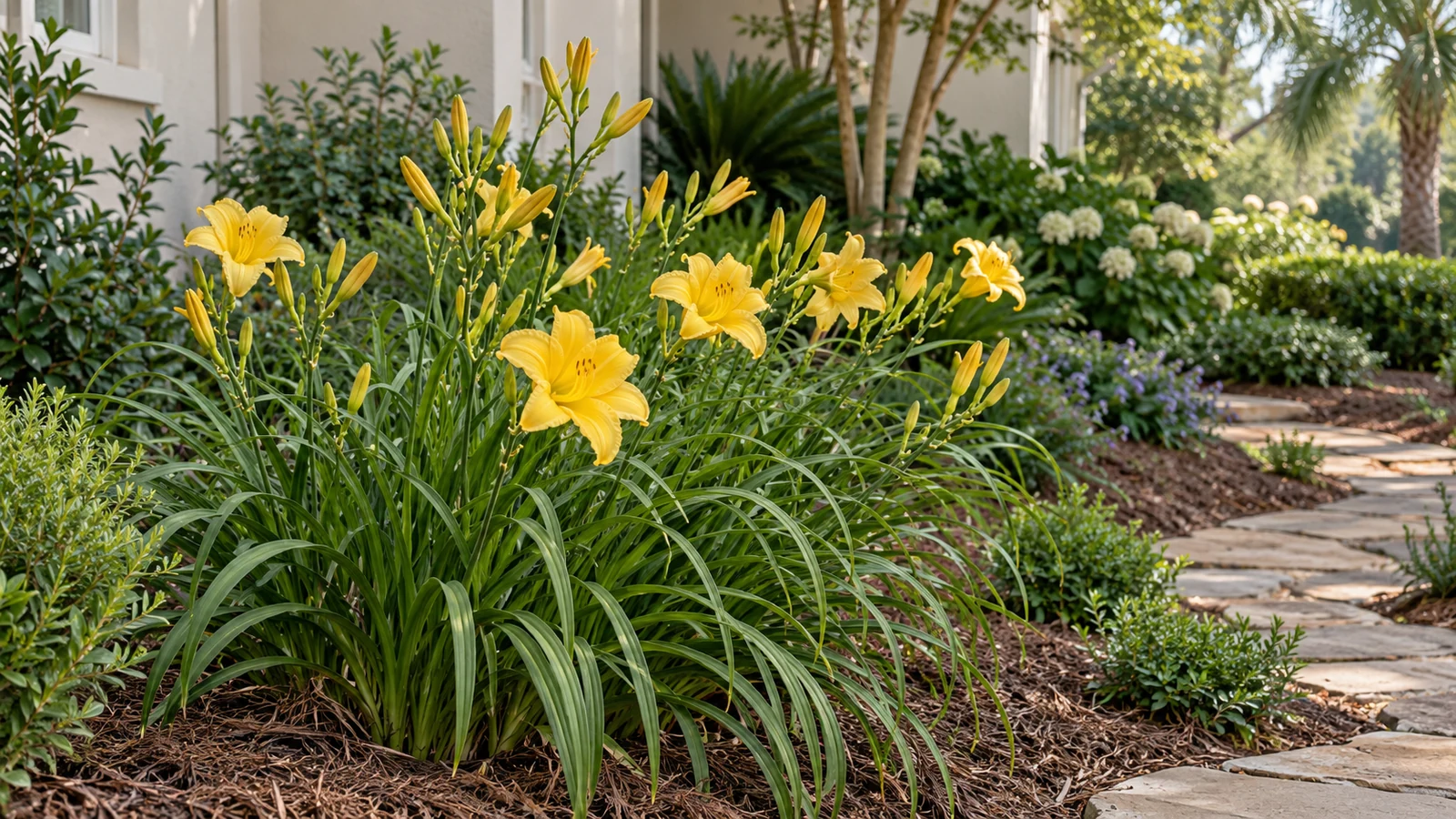
Illustrative planting concept
Size and space
Typical height: 1–3 ft. Typical spread: 1–3 ft.
The broad garden-hybrid reference is 1–3 feet tall and 1–3 feet wide. A named compact selection may occupy much less room than a taller variety. Confirm both leaf-clump width and flowering-stem height on the nursery label before setting spacing or positioning the plant beneath a window.
Installed example: 0.5 ft high × 0.5 ft wide. This is an illustrative size, not a pot-size or growth-timeline promise.
Sun to part shade · Moderate; moist, well-drained soil · Seasonal flowers; foliage varies by cultivar
Care: Remove old stalks; divide crowded fans
Know the whole plant
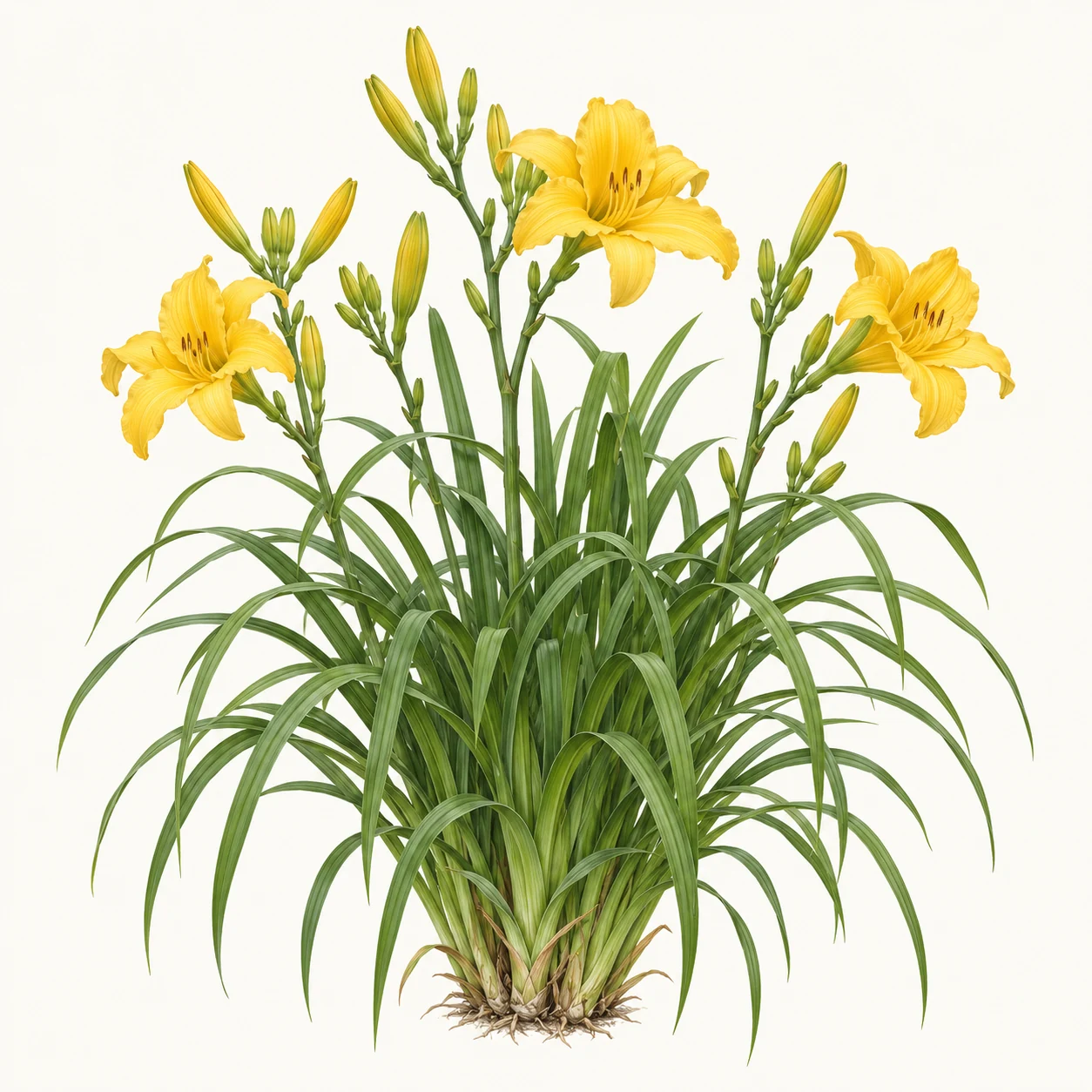
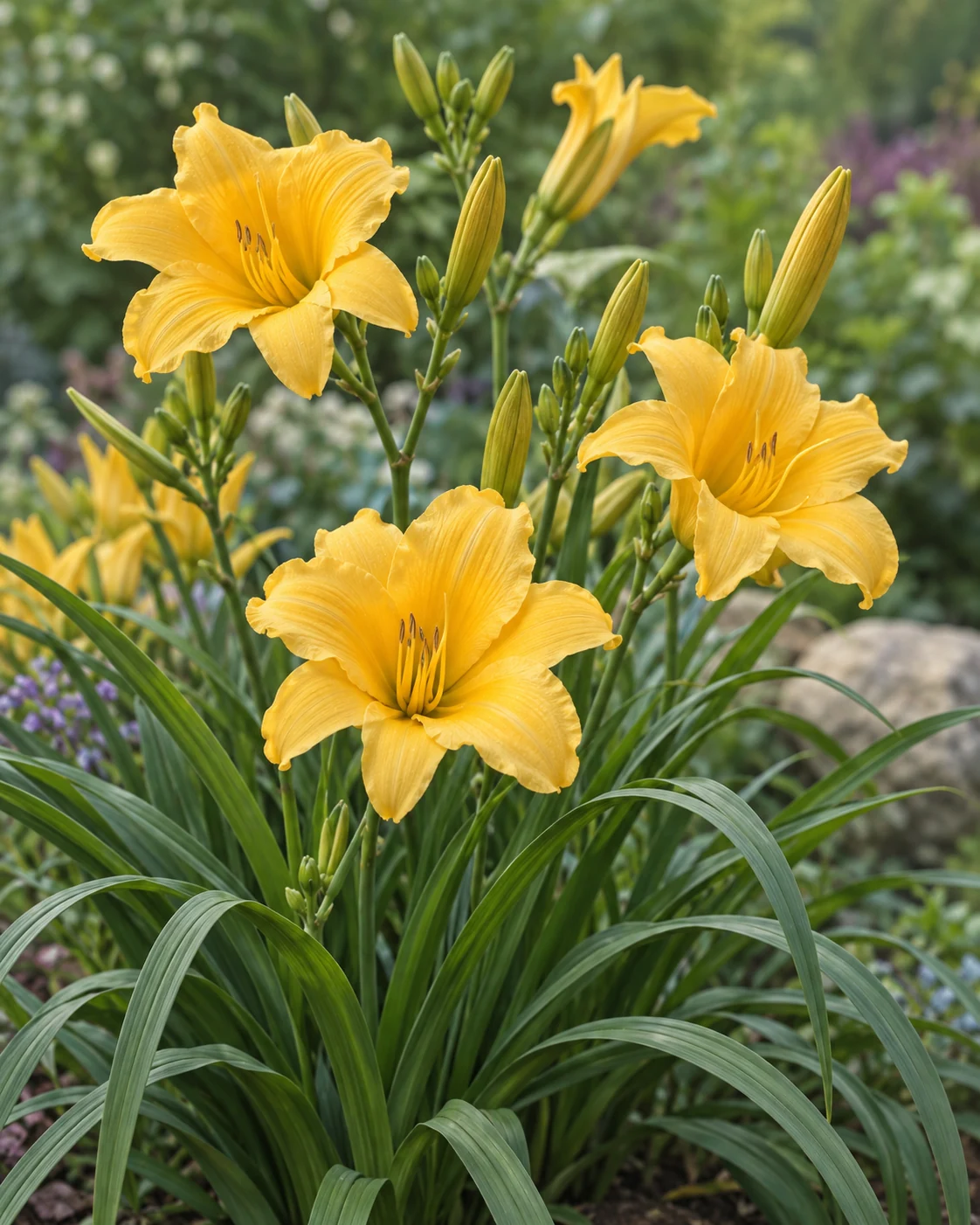
Illustrative overall form of Daylily. The nursery selection, season and site affect appearance.Illustrative foliage and seasonal detail of Daylily; confirm the botanical name and selection on the nursery label.
Where it works around Pensacola
A sunny or lightly shaded bed with moisture-retentive but freely draining soil is a practical Pensacola setting. Keep the crowns from being smothered by mulch. Give the fans room to expand without leaning across paving, and pair them with a permanent framework that still looks intentional when flowers are absent.
Repeat one selected variety along the front of a sunny mixed bed.
Add a seasonal flowering clump beside a patio or garden seat.
Bridge the scale between low ground covers and larger shrubs.
Use arching foliage to soften straight planting-bed edges.
Combine different bloom seasons deliberately, using clearly identified cultivars.
How long does each flower last?
An individual bloom generally lasts one day. Multiple buds open in sequence, so the plant’s overall display lasts longer than a single flower.
Does it need constant watering?
Established plants can tolerate some dry periods, but good flowering benefits from adequate moisture. Check the root zone instead of watering only by calendar.
What cleanup is needed?
Remove spent flower stalks and damaged leaves. Divide congested clumps when flowering or spacing suggests they have outgrown their position.
What about rust?
Ask the nursery about cultivar performance locally and inspect foliage before buying. Do not assume every hybrid sold under the common name has equal resistance.
Before it goes on the plan
Will it bloom all summer?
Not necessarily. Many varieties have a defined flowering period; repeat bloom depends on selection and growing conditions. Choose the cultivar for the season you need.
Is it evergreen?
Some daylilies retain foliage while others become dormant or partly dormant. Confirm the cultivar’s behavior rather than using the flowering image as a winter prediction.
Is it suitable around cats?
Daylilies are not a good choice where cats may chew the plants. Select another accent for those locations.
Pairing ideas
Society Garlic: Society garlic offers finer foliage and lilac flowers nearby, with individual clump spacing maintained.
Pink Muhly Grass: Pink muhly contributes a different flowering season and texture behind a lower daylily group.
Schilling’s Dwarf Yaupon Holly: Dwarf yaupon gives the bed a steady evergreen outline between the daylily’s bloom periods.
{"key":"daylily","name":"Daylily","botanical":"Hemerocallis garden hybrids","slug":"daylily","id":"PLT-HEME-HYBR","type":"accents","h":[1,3],"w":[1,3],"install":[0.5,0.5],"native":false,"accentGroup":"perennial","accentForm":"trumpet","light":"Sun to part shade","lightTags":["sun","part"],"water":"Moderate; moist, well-drained soil","season":"Seasonal flowers; foliage varies by cultivar","care":"Remove old stalks; divide crowded fans","benefit":"Trumpet flowers above arching strap leaves","intro":"Daylilies give homeowners a manageable flowering clump with arching leaves and upright stems of trumpet-shaped blooms. A repeated variety creates a more consistent border than a collection of unrelated colors and sizes. The yellow form illustrated here is representative of garden hybrids, not a promise that every daylily has the same appearance.","caution":"Choose a locally suitable, rust-resistant selection where available; the generic daylily name does not guarantee resistance. Flowering season, rebloom and winter foliage differ among cultivars. Avoid locations where cats may chew plants.","sizeNote":"The broad garden-hybrid reference is 1–3 feet tall and 1–3 feet wide. A named compact selection may occupy much less room than a taller variety. Confirm both leaf-clump width and flowering-stem height on the nursery label before setting spacing or positioning the plant beneath a window.","site":"A sunny or lightly shaded bed with moisture-retentive but freely draining soil is a practical Pensacola setting. Keep the crowns from being smothered by mulch. Give the fans room to expand without leaning across paving, and pair them with a permanent framework that still looks intentional when flowers are absent.","uses":["Repeat one selected variety along the front of a sunny mixed bed.","Add a seasonal flowering clump beside a patio or garden seat.","Bridge the scale between low ground covers and larger shrubs.","Use arching foliage to soften straight planting-bed edges.","Combine different bloom seasons deliberately, using clearly identified cultivars."],"checks":[["How long does each flower last?","An individual bloom generally lasts one day. Multiple buds open in sequence, so the plant’s overall display lasts longer than a single flower."],["Does it need constant watering?","Established plants can tolerate some dry periods, but good flowering benefits from adequate moisture. Check the root zone instead of watering only by calendar."],["What cleanup is needed?","Remove spent flower stalks and damaged leaves. Divide congested clumps when flowering or spacing suggests they have outgrown their position."],["What about rust?","Ask the nursery about cultivar performance locally and inspect foliage before buying. Do not assume every hybrid sold under the common name has equal resistance."]],"faq":[["Will it bloom all summer?","Not necessarily. Many varieties have a defined flowering period; repeat bloom depends on selection and growing conditions. Choose the cultivar for the season you need."],["Is it evergreen?","Some daylilies retain foliage while others become dormant or partly dormant. Confirm the cultivar’s behavior rather than using the flowering image as a winter prediction."],["Is it suitable around cats?","Daylilies are not a good choice where cats may chew the plants. Select another accent for those locations."]],"sources":[["UF/IFAS: Daylilies","https://gardeningsolutions.ifas.ufl.edu/plants/ornamentals/daylilies/"],["NC State Extension: Hemerocallis","https://plants.ces.ncsu.edu/plants/hemerocallis/"]],"unit":"ft","heightLabel":"Typical height","spreadLabel":"Typical spread","heightText":"1–3 ft","spreadText":"1–3 ft","sizeSummary":"1–3 ft high × 1–3 ft wide","color":"#70815a","bloomColor":"#e7bd49","guideKind":"Flowering + accent plant","eyebrow":"FLOWERS + FOLIAGE / FORM + SEASON","aliases":["Hemerocallis","day lily","yellow trumpet flowers","yellow","orange","pink","red"],"goals":["color"],"wholeCaption":"Illustrative overall form of Daylily. The nursery selection, season and site affect appearance.","detailCaption":"Illustrative foliage and seasonal detail of Daylily; confirm the botanical name and selection on the nursery label.","images":{"context":{"id":"6aa09dc26b49be19d962720e","url":"https://cdn.prod.website-files.com/6a975baac0f352647862d847/6aa09dc26b49be19d962720e_landova-accent-daylily-context.webp","alt":"Illustrative planting concept with Daylily","width":1600,"height":900},"whole":{"id":"6aa09dc2742f79fb7f1887cd","url":"https://cdn.prod.website-files.com/6a975baac0f352647862d847/6aa09dc2742f79fb7f1887cd_landova-accent-daylily-whole.webp","alt":"Illustrative whole-plant form of Daylily","width":1254,"height":1254,"fit":"contain"},"detail":{"id":"6aa09dc27e06f5dfffb0266d","url":"https://cdn.prod.website-files.com/6a975baac0f352647862d847/6aa09dc27e06f5dfffb0266d_landova-accent-daylily-detail.webp","alt":"Illustrative foliage and seasonal detail of Daylily","width":1122,"height":1402}},"companions":[{"slug":"society-garlic","name":"Society Garlic","title":"Smaller flowering clumps","reason":"Society garlic offers finer foliage and lilac flowers nearby, with individual clump spacing maintained.","image":{"id":"6aa093dee788bb371fe2c6d5","url":"https://cdn.prod.website-files.com/6a975baac0f352647862d847/6aa093dee788bb371fe2c6d5_landova-accent-society-context.webp","alt":"Illustrative planting concept with Society Garlic","width":1600,"height":900}},{"slug":"pink-muhly-grass","name":"Pink Muhly Grass","title":"Later seasonal interest","reason":"Pink muhly contributes a different flowering season and texture behind a lower daylily group.","image":{"id":"6aa00228430659e428d61061","url":"https://cdn.prod.website-files.com/6a975baac0f352647862d847/6aa00228430659e428d61061_landova-grass-muhly-context.webp","alt":"Illustrative planting concept with Pink Muhly Grass","width":1600,"height":900}},{"slug":"schillings-dwarf-yaupon-holly","name":"Schilling’s Dwarf Yaupon Holly","title":"Year-round structure","reason":"Dwarf yaupon gives the bed a steady evergreen outline between the daylily’s bloom periods.","image":{"id":"6a9f5cd31fbbc23ce58d34ef","url":"https://cdn.prod.website-files.com/6a975baac0f352647862d847/6a9f5cd31fbbc23ce58d34ef_landova-schilling-context-r05.webp","alt":"Illustrative planting concept with Schilling’s Dwarf Yaupon Holly"}}]}
LANDOVA / PLANTING DECISIONS
Choose plants with the whole space in mind.
Explore a planting goal, then compare the growing needs and mature size of individual plants.
LANDOVA is in beta
Join the launch waitlist.
We are not accepting paying clients yet. We expect to launch around January 2027 and may open sooner. Explore our free tools now, and sign up for launch updates and educational planning emails.
Thank you. Your waitlist signup has been received. We will email you with launch updates. No purchase or project booking has been made.
We could not save your signup. Please try again or email info@landovadesign.com.