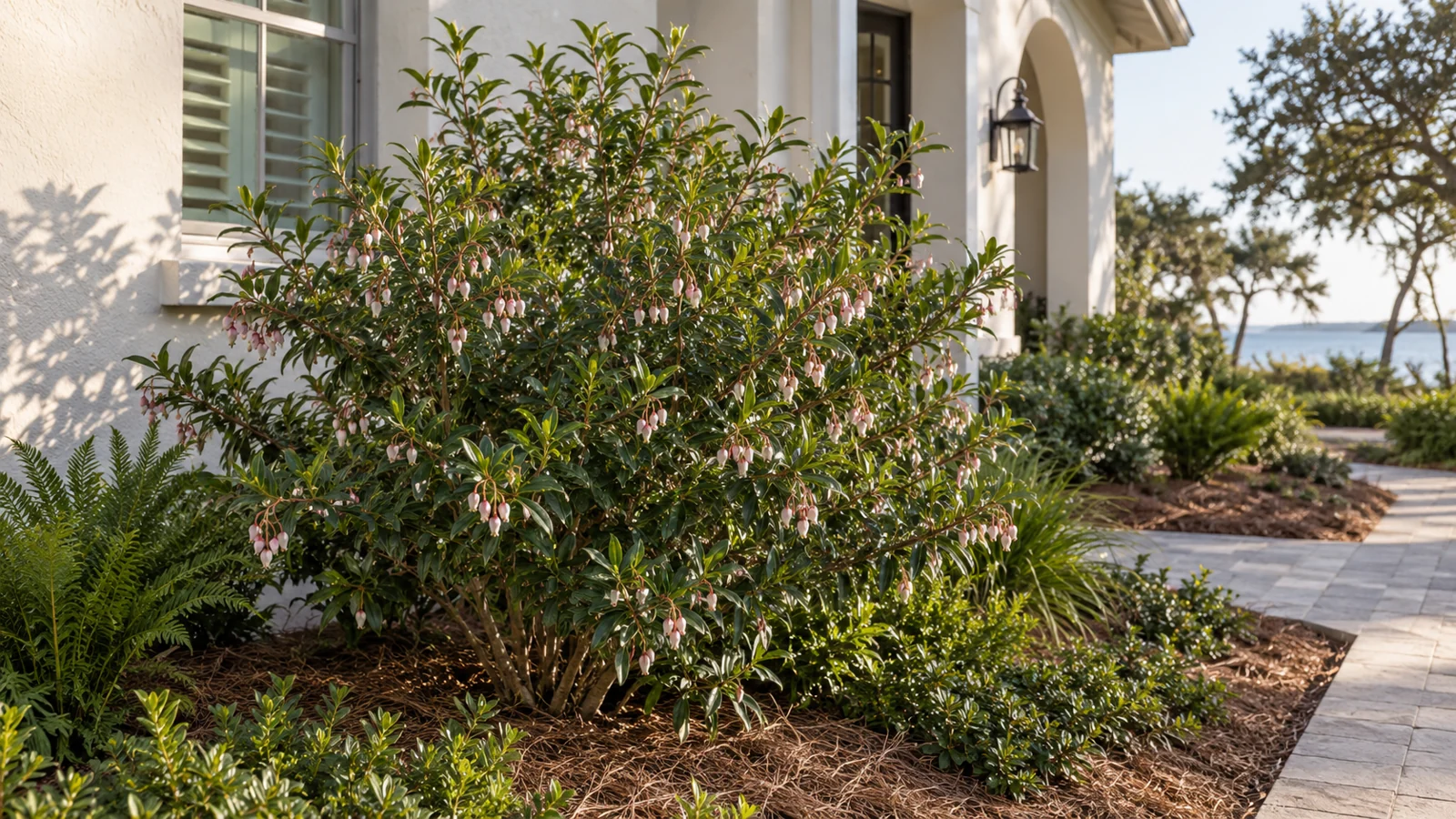
Fetterbush brings arching evergreen growth and small hanging flowers to a natural woodland-style planting. It offers a different character from a clipped foundation shrub: loose, spreading and most useful where its growing conditions and room to form a colony are already part of the plan.
Before you choose: Harmful if eaten. Spreads into thickets; keep it clear of paths, play spaces and areas where pets may chew plants.
Illustrative planting concept
Size and space
Mature range: 3–6 ft high × 3–6 ft wide.
NC State lists 3–6 ft for both height and spread. That describes an individual shrub’s typical form; spreading stems and roots can create a much broader colony over time. Keep the whole planting edge in the maintenance plan.
Installed example: 1.5 ft high × 1 ft wide. This is an illustrative size, not a pot-size or growth-timeline promise.
Part shade to dappled shade · Acidic, moist soil; tolerates seasonal freshwater wetness · Evergreen · small pink or white bell-like spring flowers
Where it works around Pensacola
Consider a sheltered, acidic, moist garden edge in the Pensacola region. This native is suited to a naturalistic planting with room for spreading shoots. Freshwater wetness tolerance does not mean it can handle saltwater flooding or resolve the site’s drainage design.
Native evergreen layer
Moist woodland edge
Naturalized border
Seasonal flower detail
Shaded rain-garden margin
Start with the soil and shade.
Check acidity, moisture and seasonal water patterns before planting. Match it to an appropriate growing area rather than trying to remake a hot, dry bed around a new plant.
Allow a natural colony or maintain the edge.
Spreading shoots can be useful in a broad naturalized border. Where a crisp edge matters, plan recurring maintenance and keep the planting away from narrow passageways.
Keep harmful foliage out of active spaces.
Place it away from areas where children or pets may sample foliage. A natural garden still needs thoughtful separation between planting and daily activity.
Design the water movement independently.
A moisture-tolerant shrub is one part of a planting design. Establish runoff routes and drainage needs first, then select plants for the conditions that remain.
Before it goes on the plan
Is it the same plant as Florida anise?
No. Fetterbush is Lyonia lucida, with small hanging urn-shaped flowers. Florida anise is Illicium floridanum and has a different identity and form.
Will it stay inside a three-foot circle?
No. Even when a young crown looks small, shoots can spread and form a thicket. Plan a broader natural area or a maintained planting edge.
Does native mean safe for pets to eat?
No. NC State lists this plant as poisonous. Native status describes its natural origin, not edibility or safety around chewing pets.
Pairing ideas
Florida Anise: Florida anise can provide a taller background in compatible moist, shaded conditions. Both need space and careful placement away from plants being eaten.
Henry’s Garnet Sweetspire: Sweetspire can share a moist, acidic border with partial light. Give both room to spread and expect the sweetspire to lose its leaves in winter.
{"key":"fetter","id":"PLT-LYON-LUCIDA","slug":"fetterbush-lyonia","name":"Fetterbush","botanical":"Lyonia lucida","eyebrow":"NATIVE EVERGREEN + MOIST WOODLAND EDGES","benefit":"Give a moist, shaded border lasting structure.","intro":"Fetterbush brings arching evergreen growth and small hanging flowers to a natural woodland-style planting. It offers a different character from a clipped foundation shrub: loose, spreading and most useful where its growing conditions and room to form a colony are already part of the plan.","h":[3,6],"w":[3,6],"install":[1.5,1],"color":"#6d8257","habit":"upright","light":"Part shade to dappled shade","lightTags":["part","shade"],"water":"Acidic, moist soil; tolerates seasonal freshwater wetness","season":"Evergreen · small pink or white bell-like spring flowers","care":"Manage spreading shoots; watch leaf spots","caution":"Harmful if eaten. Spreads into thickets; keep it clear of paths, play spaces and areas where pets may chew plants.","site":"Consider a sheltered, acidic, moist garden edge in the Pensacola region. This native is suited to a naturalistic planting with room for spreading shoots. Freshwater wetness tolerance does not mean it can handle saltwater flooding or resolve the site’s drainage design.","sizeNote":"NC State lists 3–6 ft for both height and spread. That describes an individual shrub’s typical form; spreading stems and roots can create a much broader colony over time. Keep the whole planting edge in the maintenance plan.","uses":["Native evergreen layer","Moist woodland edge","Naturalized border","Seasonal flower detail","Shaded rain-garden margin"],"checks":[["Start with the soil and shade.","Check acidity, moisture and seasonal water patterns before planting. Match it to an appropriate growing area rather than trying to remake a hot, dry bed around a new plant."],["Allow a natural colony or maintain the edge.","Spreading shoots can be useful in a broad naturalized border. Where a crisp edge matters, plan recurring maintenance and keep the planting away from narrow passageways."],["Keep harmful foliage out of active spaces.","Place it away from areas where children or pets may sample foliage. A natural garden still needs thoughtful separation between planting and daily activity."],["Design the water movement independently.","A moisture-tolerant shrub is one part of a planting design. Establish runoff routes and drainage needs first, then select plants for the conditions that remain."]],"faq":[["Is it the same plant as Florida anise?","No. Fetterbush is Lyonia lucida, with small hanging urn-shaped flowers. Florida anise is Illicium floridanum and has a different identity and form."],["Will it stay inside a three-foot circle?","No. Even when a young crown looks small, shoots can spread and form a thicket. Plan a broader natural area or a maintained planting edge."],["Does native mean safe for pets to eat?","No. NC State lists this plant as poisonous. Native status describes its natural origin, not edibility or safety around chewing pets."]],"sources":[["NC State Extension · native range, size, spreading habit and toxicity","https://plants.ces.ncsu.edu/plants/lyonia-lucida/"]],"wholeCaption":"Illustrative native form · open, arching evergreen growth","detailCaption":"Illustrative detail · small pink urn-shaped flowers and glossy leaves","native":true,"guideKind":"Native species guide","aliases":["shining fetterbush","shinyleaf","pink fetterbush","Lyonia lucida"],"goals":["color"],"images":{"context":{"id":"6a9fefaaa725fb36dd64f6ad","url":"https://cdn.prod.website-files.com/6a975baac0f352647862d847/6a9fefaaa725fb36dd64f6ad_landova-fetter-context-r07.webp","alt":"Illustrative planting concept with Fetterbush","width":1600,"height":900},"whole":{"id":"6a9fefab3c7f566bd6cc9852","url":"https://cdn.prod.website-files.com/6a975baac0f352647862d847/6a9fefab3c7f566bd6cc9852_landova-fetter-whole-r07.webp","alt":"Illustrative whole-plant form of Fetterbush","width":1448,"height":1086,"fit":"contain"},"detail":{"id":"6a9fefaec7d8ea3556dca130","url":"https://cdn.prod.website-files.com/6a975baac0f352647862d847/6a9fefaec7d8ea3556dca130_landova-fetter-detail-r07.webp","alt":"Illustrative foliage and seasonal detail of Fetterbush","width":1254,"height":1254}},"reviewDate":"2026-09-08","companions":[{"slug":"florida-anise","name":"Florida Anise","title":"Layer two native evergreen forms.","reason":"Florida anise can provide a taller background in compatible moist, shaded conditions. Both need space and careful placement away from plants being eaten.","image":{"id":"6a9f3484598f07756d53faf0","url":"https://cdn.prod.website-files.com/6a975baac0f352647862d847/6a9f3484598f07756d53faf0_landova-shrub-anise-context-r02.webp","alt":"Illustrative planting concept with Florida Anise"}},{"slug":"henrys-garnet-sweetspire","name":"Henry’s Garnet Sweetspire","title":"Add a deciduous seasonal layer.","reason":"Sweetspire can share a moist, acidic border with partial light. Give both room to spread and expect the sweetspire to lose its leaves in winter.","image":{"id":"6a9f5cd7d7f880ff25110b61","url":"https://cdn.prod.website-files.com/6a975baac0f352647862d847/6a9f5cd7d7f880ff25110b61_landova-henry-context-r05.webp","alt":"Illustrative planting concept with Henry’s Garnet Sweetspire"}}]}
LANDOVA / PLANTING DECISIONS
Choose plants with the whole space in mind.
Explore a planting goal, then compare the growing needs and mature size of individual plants.
LANDOVA is in beta
Join the launch waitlist.
We are not accepting paying clients yet. We expect to launch around January 2027 and may open sooner. Explore our free tools now, and sign up for launch updates and educational planning emails.
Thank you. Your waitlist signup has been received. We will email you with launch updates. No purchase or project booking has been made.
We could not save your signup. Please try again or email info@landovadesign.com.