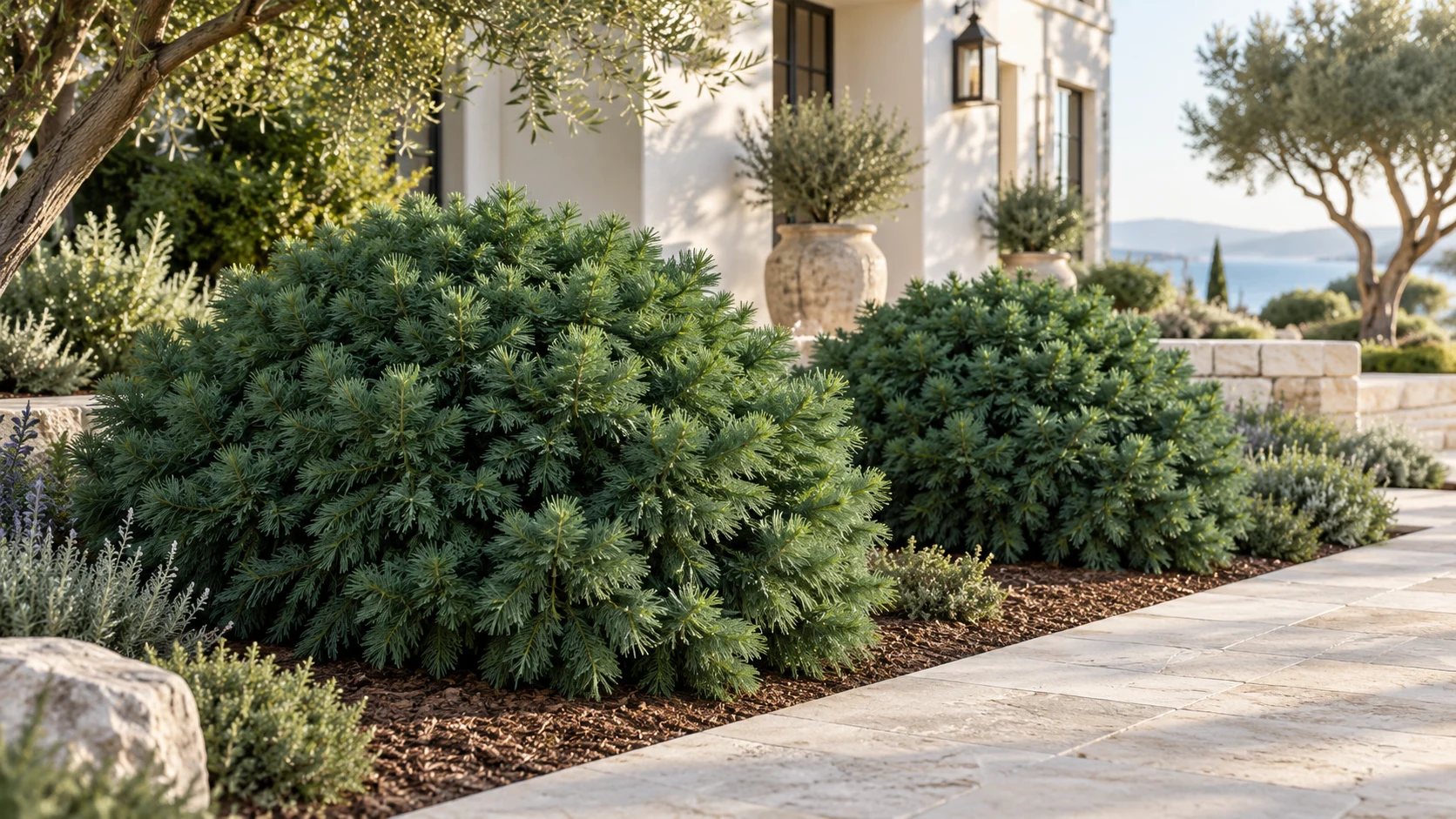
Fine foliage and a naturally rounded form offer a quiet contrast to stone, walls and broad-leaved shrubs. Give this slow-growing cedar a generous pocket of its own, with moisture and drainage considered together.
Illustrative planting concept
Size and space
Mature range: 2–4 ft high × 3–4 ft wide.
The comparison shows NC State’s typical 2–4 ft height and 3–4 ft width. This is not a lifelong ceiling: Monrovia notes that older plants can reach 4–8 ft tall. Leave expansion room and confirm the expected long-term size of local stock before placing it below a window.
Compare with a six-foot person: installed example 1.5 ft high by 2 ft wide. This example is not a fixed pot size or a growth timeline.
Sun to part shade; avoid extreme reflected heat · Moist, well-drained soil · Green foliage; possible winter bronzing
Where it works around Pensacola
A conditional choice for sheltered Pensacola-area beds. NC State lists this cultivar for warm climates, while grower climate ranges differ. Confirm performance with a local nursery, especially in exposed, hot or drought-prone locations.
A soft focal point in a broad bed
Texture beside larger-leaved shrubs
Repeated rounded accents
A view across a generous path
A sheltered garden with watering access
Is there room beyond today’s rounded shape?
Dwarf describes a smaller form of a very large tree; it does not mean miniature forever. Avoid locking the plant between paving and a wall where future growth can only be managed by repeated cutting.
Can the roots stay moist without sitting in water?
Plan for dry spells as well as heavy rain. Check drainage through the actual planting soil, and make watering accessible without relying on frequent overspray across paths or furniture.
How hot does the bed become?
A south-facing wall or large paved area can create a harsher location than an open garden bed. Use local nursery experience to assess this cultivar before making it a repeated feature across the whole property.
What will sit beside the fine foliage?
Give it visual breathing room. One broader-leaved neighbor can make the texture more noticeable than a crowded mix of many similar small shrubs. Keep each mature canopy readable.
Before it goes on the plan
Will it remain a two-foot ball?
No. Small nursery plants and early garden examples do not establish a final size. Published estimates vary with age; older specimens may grow substantially beyond the compact range shown here.
Does bronze foliage always mean the plant is dying?
Winter bronzing can be normal for this cultivar. Sudden patchy decline or browning outside that seasonal pattern needs a closer look at moisture, drainage and plant health.
Should I shear it into a perfect sphere?
Its appeal is a naturally billowing dome. Choose a position that lets the outline develop, and use only the pruning needed for damaged or misplaced growth.
Pairing ideas
Autumn Royalty Encore Azalea: Autumn Royalty can provide a different texture in an adjacent morning-sun pocket. Check that both receive suitable moisture and that the azalea will not cover the cedar as they grow.
Kaleidoscope Abelia: Explore Kaleidoscope in a brighter section of the same well-drained border, with separate mature footprints and watering matched to each plant.
{"key":"globosa","id":"PLT-CRYP-GLOBOSA-NANA","slug":"globosa-nana-japanese-cedar","name":"Globosa Nana Japanese Cedar","botanical":"Cryptomeria japonica 'Globosa Nana'","eyebrow":"A SOFT DOME / PLAN BEYOND THE NURSERY POT","benefit":"Bring a softer shape to the garden.","intro":"Fine foliage and a naturally rounded form offer a quiet contrast to stone, walls and broad-leaved shrubs. Give this slow-growing cedar a generous pocket of its own, with moisture and drainage considered together.","h":[2,4],"w":[3,4],"install":[1.5,2],"color":"#668373","habit":"Dense rounded evergreen conifer","light":"Sun to part shade; avoid extreme reflected heat","lightTags":["sun","part"],"water":"Moist, well-drained soil","season":"Green foliage; possible winter bronzing","care":"Preserve its natural dome; monitor moisture","site":"A conditional choice for sheltered Pensacola-area beds. NC State lists this cultivar for warm climates, while grower climate ranges differ. Confirm performance with a local nursery, especially in exposed, hot or drought-prone locations.","sizeNote":"The comparison shows NC State’s typical 2–4 ft height and 3–4 ft width. This is not a lifelong ceiling: Monrovia notes that older plants can reach 4–8 ft tall. Leave expansion room and confirm the expected long-term size of local stock before placing it below a window.","uses":["A soft focal point in a broad bed","Texture beside larger-leaved shrubs","Repeated rounded accents","A view across a generous path","A sheltered garden with watering access"],"checks":[["Is there room beyond today’s rounded shape?","Dwarf describes a smaller form of a very large tree; it does not mean miniature forever. Avoid locking the plant between paving and a wall where future growth can only be managed by repeated cutting."],["Can the roots stay moist without sitting in water?","Plan for dry spells as well as heavy rain. Check drainage through the actual planting soil, and make watering accessible without relying on frequent overspray across paths or furniture."],["How hot does the bed become?","A south-facing wall or large paved area can create a harsher location than an open garden bed. Use local nursery experience to assess this cultivar before making it a repeated feature across the whole property."],["What will sit beside the fine foliage?","Give it visual breathing room. One broader-leaved neighbor can make the texture more noticeable than a crowded mix of many similar small shrubs. Keep each mature canopy readable."]],"faq":[["Will it remain a two-foot ball?","No. Small nursery plants and early garden examples do not establish a final size. Published estimates vary with age; older specimens may grow substantially beyond the compact range shown here."],["Does bronze foliage always mean the plant is dying?","Winter bronzing can be normal for this cultivar. Sudden patchy decline or browning outside that seasonal pattern needs a closer look at moisture, drainage and plant health."],["Should I shear it into a perfect sphere?","Its appeal is a naturally billowing dome. Choose a position that lets the outline develop, and use only the pruning needed for damaged or misplaced growth."]],"sources":[["NC State Extension · Globosa Nana typical size and culture","https://plants.ces.ncsu.edu/plants/cryptomeria-japonica-globosa-nana/"],["Monrovia · older-plant size and grower guidance","https://www.monrovia.com/dwarf-japanese-cedar.html"],["Santa Rosa County Extension · Japanese cedar species context","https://sfyl.ifas.ufl.edu/media/sfylifasufledu/santa-rosa/docs/pdfs/demo-garden-5/Japanese-Cedar.pdf"]],"companions":[{"slug":"autumn-royalty-encore-azalea","name":"Autumn Royalty Encore Azalea","title":"A BROADER LEAF AND SEASONAL COLOR","reason":"Autumn Royalty can provide a different texture in an adjacent morning-sun pocket. Check that both receive suitable moisture and that the azalea will not cover the cedar as they grow.","image":{"id":"6a9f4088598f07756d573f47","url":"https://cdn.prod.website-files.com/6a975baac0f352647862d847/6a9f4088598f07756d573f47_landova-royalty-context.webp","alt":"Illustrative planting concept with Autumn Royalty Encore Azalea"}},{"slug":"kaleidoscope-abelia","name":"Kaleidoscope Abelia","title":"A WARMER FOLIAGE NOTE","reason":"Explore Kaleidoscope in a brighter section of the same well-drained border, with separate mature footprints and watering matched to each plant.","image":{"id":"6a9f348631acb08063518ae3","url":"https://cdn.prod.website-files.com/6a975baac0f352647862d847/6a9f348631acb08063518ae3_landova-shrub-kaleidoscope-context-r02.webp","alt":"Illustrative planting concept with Kaleidoscope Abelia"}}],"wholeCaption":"Illustrative view of the rounded, billowing form. An older specimen can grow beyond this compact appearance; review the long-term size note.","detailCaption":"Illustration of fine, curved needle-like foliage and branching. Seasonal color varies; use the linked reference photographs for identification.","wholeFit":"contain","images":{"context":{"id":"6a9f4a46c0f8604cca86ad59","url":"https://cdn.prod.website-files.com/6a975baac0f352647862d847/6a9f4a46c0f8604cca86ad59_landova-globosa-context-r04.webp","alt":"Illustrative planting concept with Globosa Nana Japanese Cedar"},"whole":{"id":"6a9f4a462bf2b5aadf0cc961","url":"https://cdn.prod.website-files.com/6a975baac0f352647862d847/6a9f4a462bf2b5aadf0cc961_landova-globosa-whole-r04.webp","alt":"Illustrative view of Globosa Nana Japanese Cedar overall form","fit":"contain"},"detail":{"id":"6a9f4a46eb5fedefe9313600","url":"https://cdn.prod.website-files.com/6a975baac0f352647862d847/6a9f4a46eb5fedefe9313600_landova-globosa-detail-r04.webp","alt":"Illustrative view of Globosa Nana Japanese Cedar foliage and seasonal detail"}},"caution":"Typical 2–4 ft height is not a lifelong ceiling; older plants can reach 4–8 ft."}
LANDOVA / PLANTING DECISIONS
Choose plants with the whole space in mind.
Explore a planting goal, then compare the growing needs and mature size of individual plants.
LANDOVA is in beta
Join the launch waitlist.
We are not accepting paying clients yet. We expect to launch around January 2027 and may open sooner. Explore our free tools now, and sign up for launch updates and educational planning emails.
Thank you. Your waitlist signup has been received. We will email you with launch updates. No purchase or project booking has been made.
We could not save your signup. Please try again or email info@landovadesign.com.