Longleaf Pine can give a spacious property the open, vertical character of a Gulf Coast woodland. Its tall trunk and tufted upper crown leave a very different impression from a low, spreading shade tree. Where a sound existing specimen already belongs, preserving it may shape the entire landscape more effectively than adding a new focal plant.
Before you choose: Longleaf is a very tall tree for generous landscapes, with needle and cone drop to consider. It is not an instant privacy screen or a small-bed pine. Include overhead lines, future structures and tree condition in the decision; wind resistance does not mean storm immunity.
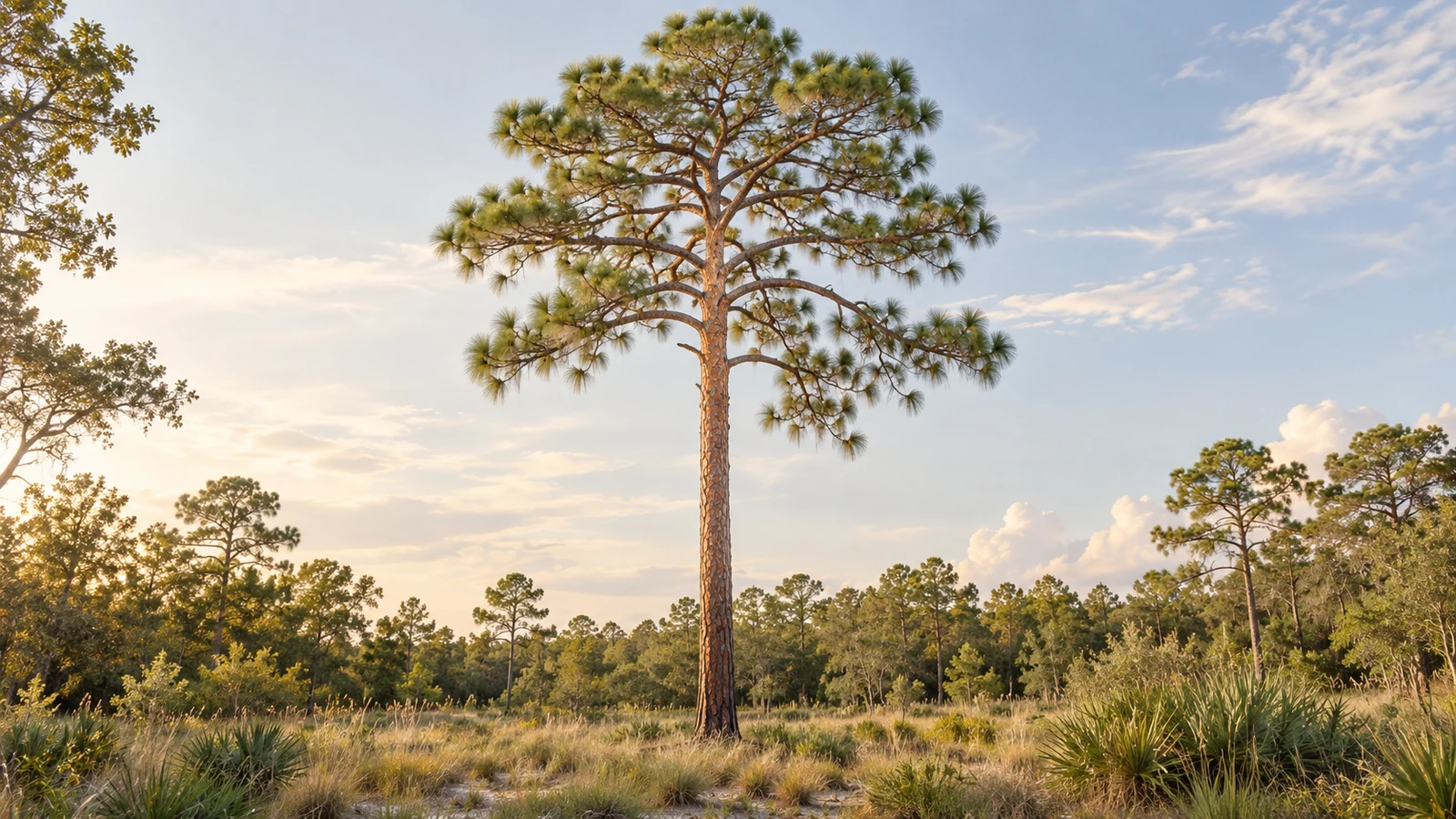
Illustrative planting concept
Size and space
Mature height: 60–125 ft. Mature spread: 30–40 ft.
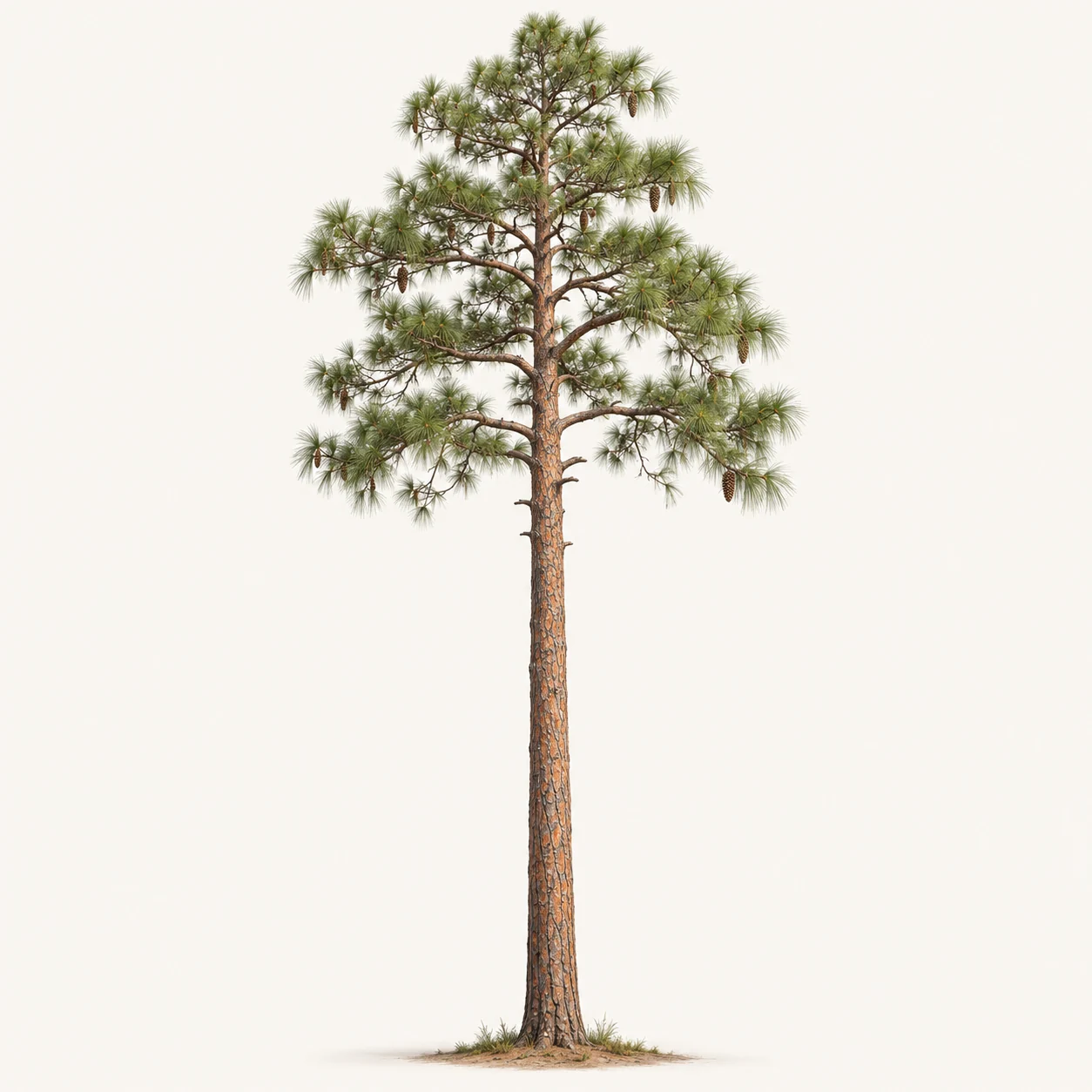
The diagram uses the current UF/IFAS range of 60–125 ft high and 30–40 ft wide. The installed view is an illustrative 6 ft nursery tree past the early grass stage, not a seedling or growth-timeline promise. The tall trunk and high crown are simplified; the canopy circle is not the full root-protection area.
Installed example: 6 ft high × 3 ft wide. This is an illustrative size, not a pot-size or growth-timeline promise.
Full sun · Well-drained soil; establish nursery stock carefully and protect existing roots · Evergreen long needles · large woody cones · needle drop beneath an open crown
Care: Protect the root area during site work and obtain qualified assessment of existing mature trees
Know the whole plant
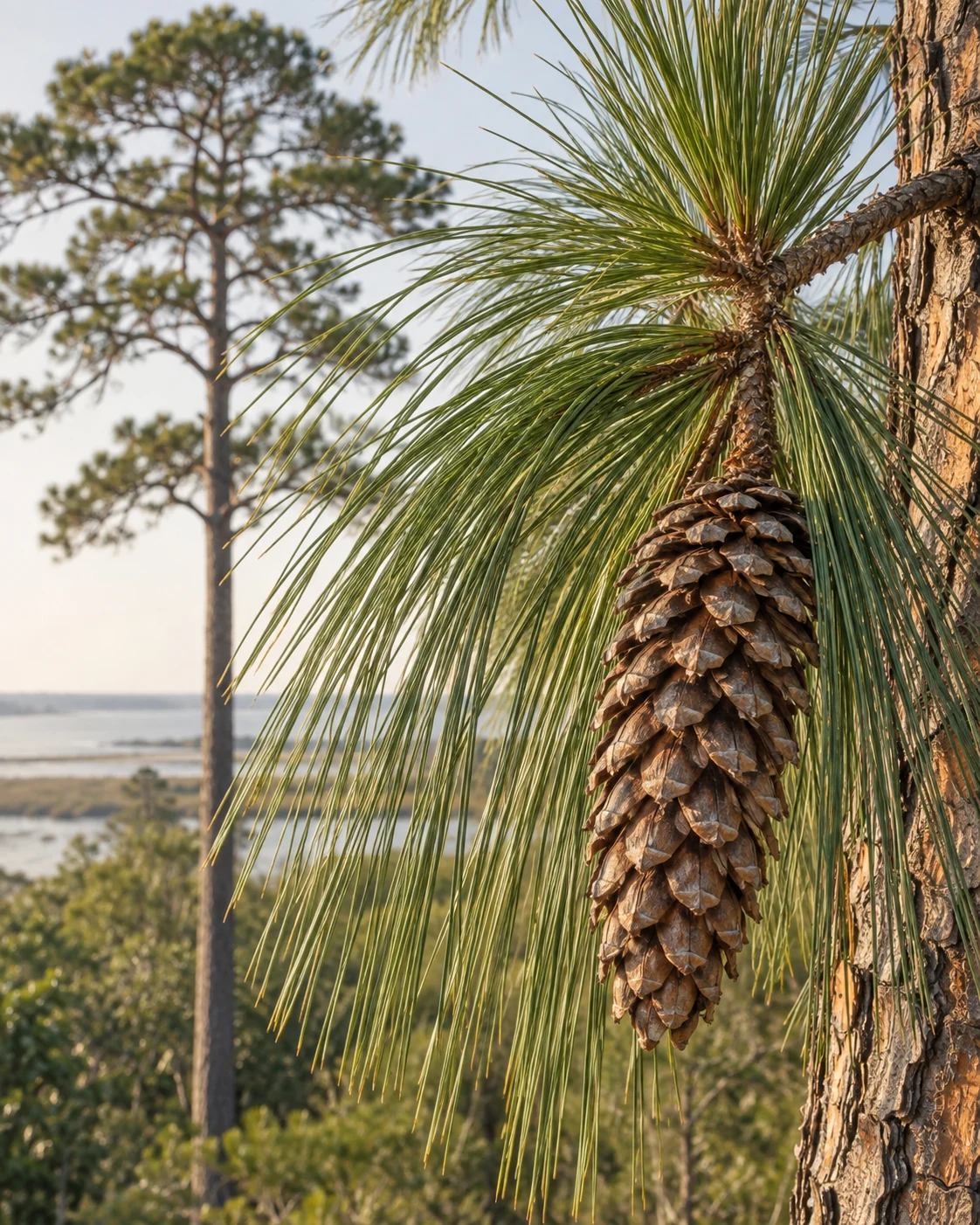
Illustrative mature Longleaf Pine with a long trunk and an open upper crown; young trees have a very different form.Illustrative long needle bundles and a woody cone; the image shows botanical character rather than an exact specimen measurement.
Where it works around Pensacola
Use this guide for spacious Pensacola properties, native woodland edges and decisions about preserving existing pines. Start with a site and tree assessment before arranging new construction around a mature specimen. For a new tree, choose appropriate nursery-grown stock rather than attempting to relocate a wild seedling with an established taproot.
A preserved native canopy tree
A spacious woodland-edge landscape
A tall vertical anchor on a large property
An open upper canopy over natural planting
A native pine for a long-term landscape plan
Can the property support the full height?
Review overhead utilities and future structures before deciding where the tree belongs. A narrow trunk does not mean a small long-term commitment.
Is there an existing tree worth preserving?
Have condition and root space assessed early. Bring that information into the site plan before grading, excavation or equipment access is arranged.
Where will needles and cones fall?
Think about rooflines, gutters, pool water and the ground where people walk or sit. Let cleanup needs influence placement while the plan is still flexible.
What stage is the nursery plant in?
Ask about stock size and establishment needs. Longleaf’s early grass-like stage is different from the tall tree shown here, so a generic pine growth expectation can be misleading.
Before it goes on the plan
Why does a young Longleaf look like a clump of grass?
Longleaf can spend several early years in a grass-like juvenile stage while developing roots. The duration varies; that early appearance does not describe its eventual height.
Is it suitable for a small courtyard?
Its mature scale and litter make it a choice to evaluate for much larger spaces. Use the full-height diagram and the property’s overhead constraints when comparing trees.
Can I build close to an existing pine?
That requires a site-specific tree and root assessment. Plan excavation, drainage changes and equipment routes with qualified guidance before construction starts.
Pairing ideas
Sparkleberry: Sparkleberry offers a different scale beneath or beside a compatible open canopy. Protect existing pine roots when establishing any lower planting.
Little Bluestem: Little Bluestem can suit a sunny, well-drained part of the composition. Check that the pine’s future shade will leave enough light and reserve room for seasonal growth.
{"key":"longleaf","id":"PLT-PINU-PALUSTRIS","slug":"longleaf-pine","name":"Longleaf Pine","botanical":"Pinus palustris","h":[60,125],"w":[30,40],"install":[6,3],"treeForm":"pine","color":"#6c8058","native":true,"type":"trees","categoryLabel":"Trees","reviewDate":"2026-09-08","guideKind":"Native large-landscape pine guide","eyebrow":"A HIGH OPEN CROWN + A STRONG REGIONAL IDENTITY","benefit":"Plan the garden around a tree with room above it.","intro":"Longleaf Pine can give a spacious property the open, vertical character of a Gulf Coast woodland. Its tall trunk and tufted upper crown leave a very different impression from a low, spreading shade tree. Where a sound existing specimen already belongs, preserving it may shape the entire landscape more effectively than adding a new focal plant.","light":"Full sun","lightTags":["sun"],"water":"Well-drained soil; establish nursery stock carefully and protect existing roots","season":"Evergreen long needles · large woody cones · needle drop beneath an open crown","care":"Protect the root area during site work and obtain qualified assessment of existing mature trees","caution":"Longleaf is a very tall tree for generous landscapes, with needle and cone drop to consider. It is not an instant privacy screen or a small-bed pine. Include overhead lines, future structures and tree condition in the decision; wind resistance does not mean storm immunity.","site":"Use this guide for spacious Pensacola properties, native woodland edges and decisions about preserving existing pines. Start with a site and tree assessment before arranging new construction around a mature specimen. For a new tree, choose appropriate nursery-grown stock rather than attempting to relocate a wild seedling with an established taproot.","sizeNote":"The diagram uses the current UF/IFAS range of 60–125 ft high and 30–40 ft wide. The installed view is an illustrative 6 ft nursery tree past the early grass stage, not a seedling or growth-timeline promise. The tall trunk and high crown are simplified; the canopy circle is not the full root-protection area.","uses":["A preserved native canopy tree","A spacious woodland-edge landscape","A tall vertical anchor on a large property","An open upper canopy over natural planting","A native pine for a long-term landscape plan"],"checks":[["Can the property support the full height?","Review overhead utilities and future structures before deciding where the tree belongs. A narrow trunk does not mean a small long-term commitment."],["Is there an existing tree worth preserving?","Have condition and root space assessed early. Bring that information into the site plan before grading, excavation or equipment access is arranged."],["Where will needles and cones fall?","Think about rooflines, gutters, pool water and the ground where people walk or sit. Let cleanup needs influence placement while the plan is still flexible."],["What stage is the nursery plant in?","Ask about stock size and establishment needs. Longleaf’s early grass-like stage is different from the tall tree shown here, so a generic pine growth expectation can be misleading."]],"faq":[["Why does a young Longleaf look like a clump of grass?","Longleaf can spend several early years in a grass-like juvenile stage while developing roots. The duration varies; that early appearance does not describe its eventual height."],["Is it suitable for a small courtyard?","Its mature scale and litter make it a choice to evaluate for much larger spaces. Use the full-height diagram and the property’s overhead constraints when comparing trees."],["Can I build close to an existing pine?","That requires a site-specific tree and root assessment. Plan excavation, drainage changes and equipment routes with qualified guidance before construction starts."]],"sources":[["UF/IFAS · Longleaf Pine dimensions, juvenile stage and care","https://ask.ifas.ufl.edu/publication/ST469"],["UF/IFAS Gardening Solutions · Longleaf Pine","https://gardeningsolutions.ifas.ufl.edu/plants/trees-and-shrubs/trees/longleaf-pine/"],["USDA Forest Service · Longleaf Pine ecology","https://www.fs.usda.gov/database/feis/plants/tree/pinpal/all.html"]],"wholeCaption":"Illustrative mature Longleaf Pine with a long trunk and an open upper crown; young trees have a very different form.","detailCaption":"Illustrative long needle bundles and a woody cone; the image shows botanical character rather than an exact specimen measurement.","aliases":["longleaf pine","long leaf pine","pinus palustris","woodland","native pine","large tree"],"goals":[],"images":{"context":{"id":"6aa0255cd2f508b8b1df34c1","url":"https://cdn.prod.website-files.com/6a975baac0f352647862d847/6aa0255cd2f508b8b1df34c1_landova-tree-longleaf-context.webp","alt":"Illustrative planting concept with Longleaf Pine","width":1600,"height":900},"whole":{"id":"6aa0255cfb5859d9790cf54a","url":"https://cdn.prod.website-files.com/6a975baac0f352647862d847/6aa0255cfb5859d9790cf54a_landova-tree-longleaf-whole.webp","alt":"Illustrative whole-plant form of Longleaf Pine","width":1254,"height":1254,"fit":"contain"},"detail":{"id":"6aa0255c03dcd1c846836fe9","url":"https://cdn.prod.website-files.com/6a975baac0f352647862d847/6aa0255c03dcd1c846836fe9_landova-tree-longleaf-detail.webp","alt":"Illustrative foliage and seasonal detail of Longleaf Pine","width":1122,"height":1402}},"companions":[{"slug":"sparkleberry","name":"Sparkleberry","title":"Explore a smaller woodland layer","reason":"Sparkleberry offers a different scale beneath or beside a compatible open canopy. Protect existing pine roots when establishing any lower planting.","image":{"id":"6aa0255d610ea1cad31b32e6","url":"https://cdn.prod.website-files.com/6a975baac0f352647862d847/6aa0255d610ea1cad31b32e6_landova-tree-sparkleberry-context.webp","alt":"Illustrative planting concept with Sparkleberry","width":1600,"height":900}},{"slug":"little-bluestem","name":"Little Bluestem","title":"Give a sunny outer edge meadow texture","reason":"Little Bluestem can suit a sunny, well-drained part of the composition. Check that the pine’s future shade will leave enough light and reserve room for seasonal growth.","image":{"id":"6aa00d166a78cbdca0ff1a4e","url":"https://cdn.prod.website-files.com/6a975baac0f352647862d847/6aa00d166a78cbdca0ff1a4e_landova-grass-bluestem-context.webp","alt":"Illustrative planting concept with Little Bluestem","width":1600,"height":900}}]}
LANDOVA / PLANTING DECISIONS
Choose plants with the whole space in mind.
Explore a planting goal, then compare the growing needs and mature size of individual plants.
LANDOVA is in beta
Join the launch waitlist.
We are not accepting paying clients yet. We expect to launch around January 2027 and may open sooner. Explore our free tools now, and sign up for launch updates and educational planning emails.
Thank you. Your waitlist signup has been received. We will email you with launch updates. No purchase or project booking has been made.
We could not save your signup. Please try again or email info@landovadesign.com.