Sparkleberry is a quiet focal plant: small glossy leaves, twisting trunks and delicate white bells give it interest beyond a single large bloom. Its irregular form can make a woodland edge feel composed without losing its natural character. Place it where the branching is visible and the surrounding planting gives it room to be noticed.
Before you choose: Sparkleberry can be an irregular shrub or a small tree, so inspect nursery form and availability before making it essential to a plan. Protect it from direct salt spray and salty flooding. Winter leaf retention varies; it should not be the sole source of dependable privacy.
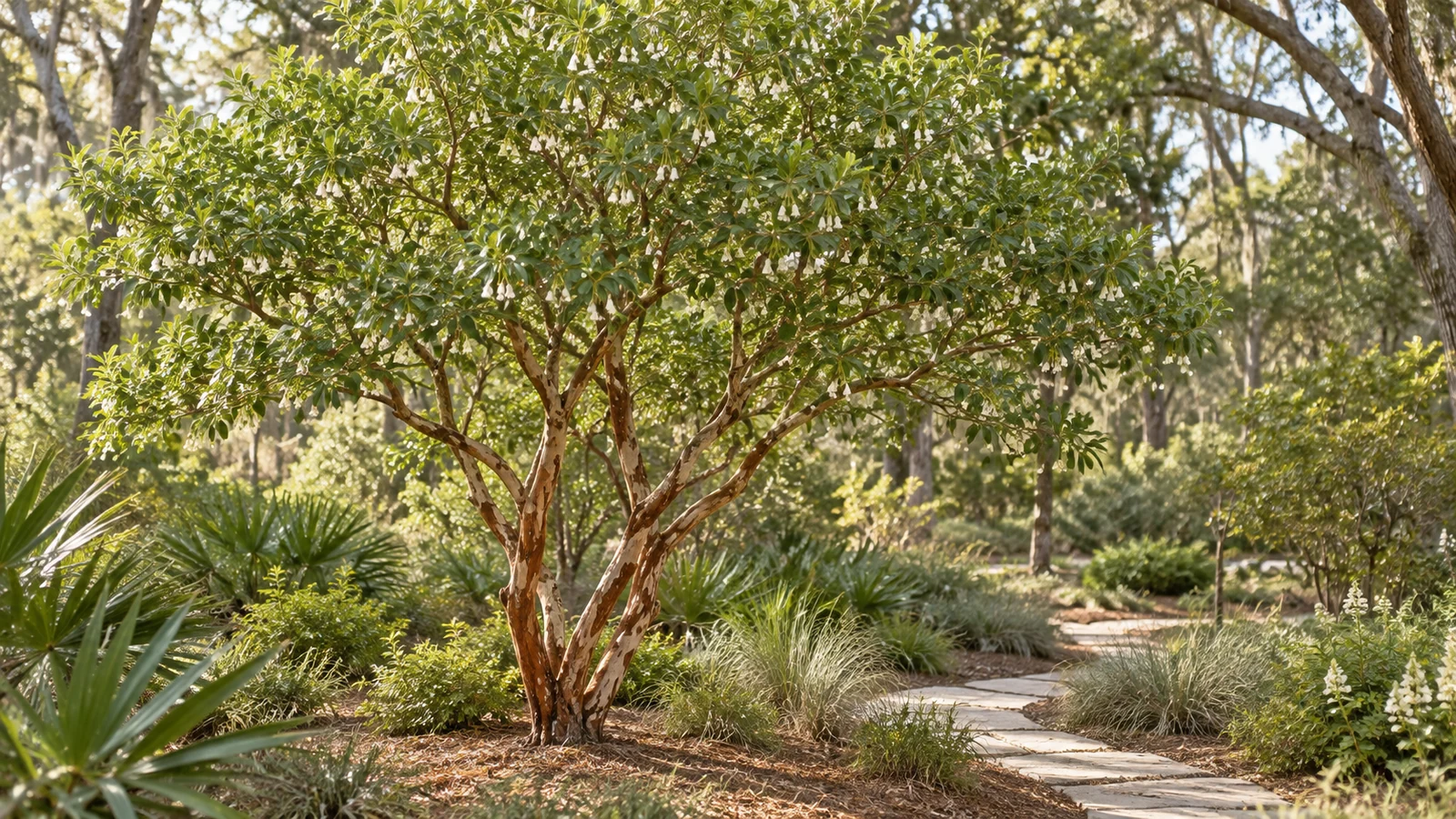
Illustrative planting concept
Size and space
Mature height: 15–25 ft. Mature spread: 4–15 ft.
The Florida Native Plant Society lists 15–25 ft high and 4–15 ft wide; UF/IFAS also notes an upper height of 18–25 ft. Form and training explain much of that width variation. The diagram uses the broad upper footprint so a young slender plant is not placed too tightly.
Installed example: 5 ft high × 3 ft wide. This is an illustrative size, not a pot-size or growth-timeline promise.
Full sun to part shade · Prefer acidic, sandy, well-drained soil; provide establishment water · Small white spring flowers · dark berries later in the year · seasonal leaf retention varies
Care: Choose tree or shrub form intentionally and guide competing stems while they are small
Know the whole plant
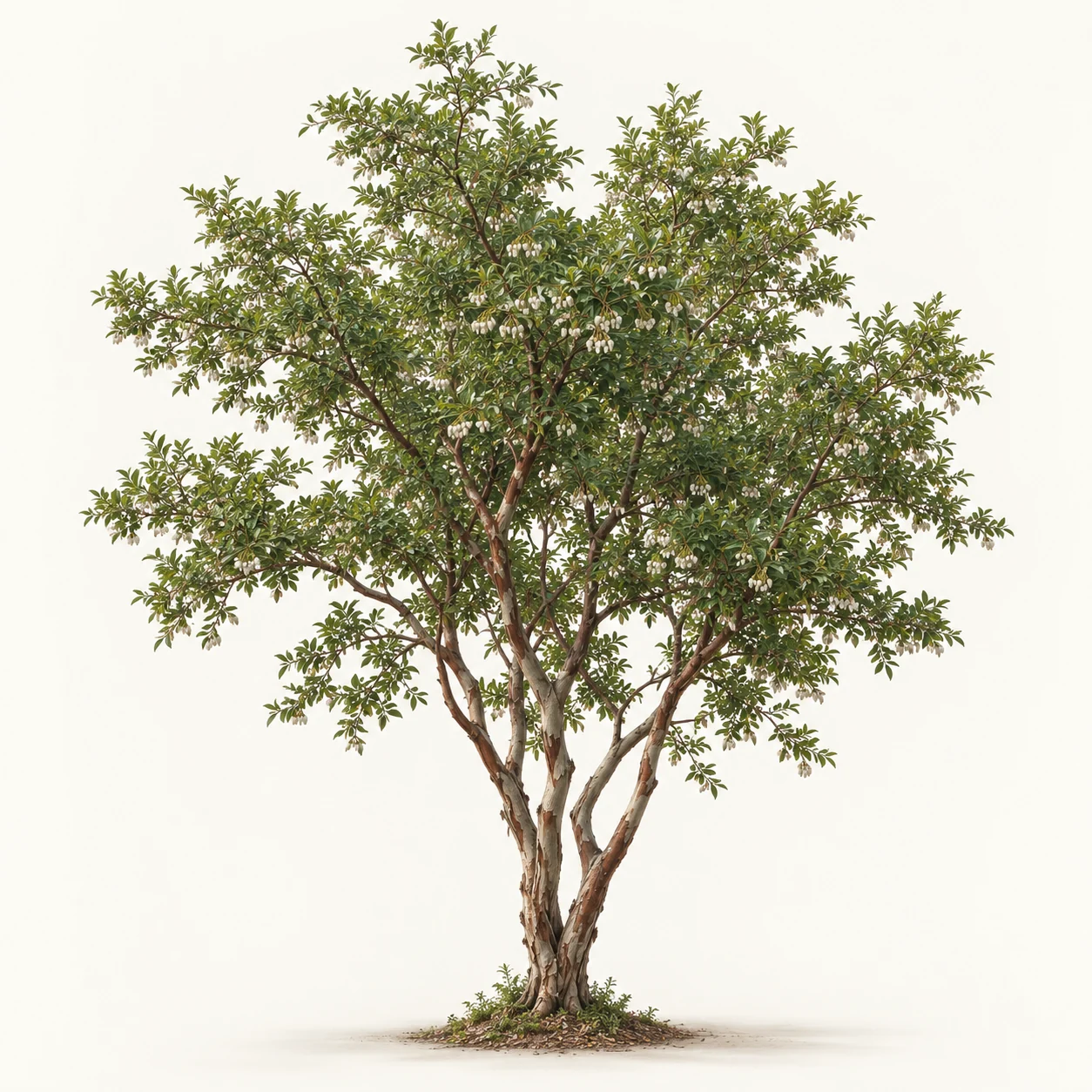
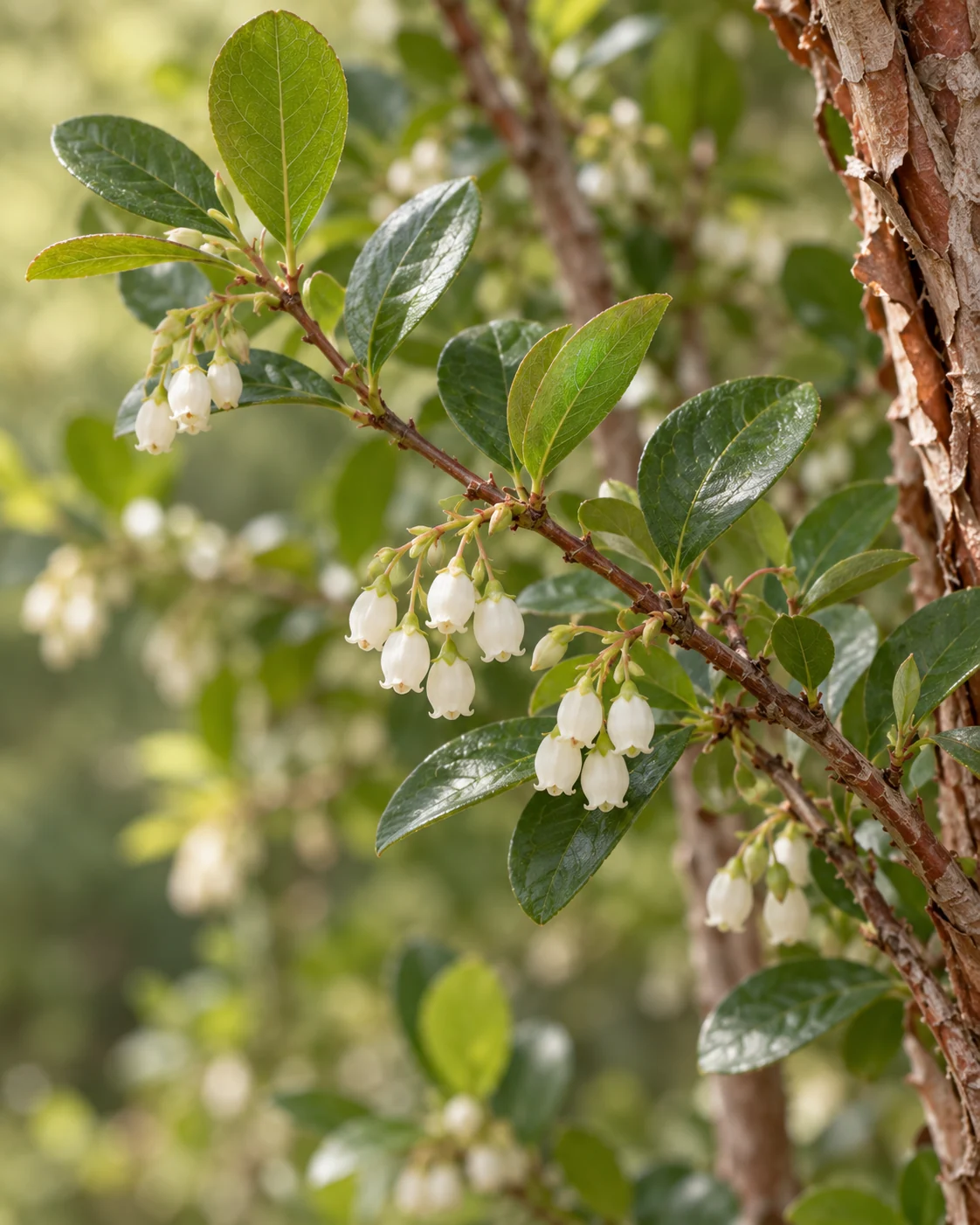
Illustrative Sparkleberry in green foliage with twisting stems; nursery training changes the balance of trunk and crown.Illustrative small white bell-shaped flowers and glossy leaves; the flower display is brief and seasonal.
Where it works around Pensacola
For a sheltered Pensacola garden with sandy, acidic soil, Sparkleberry can offer a native alternative to a more formal ornamental tree. Think about how it will be seen from the house or path when flowers are absent. The everyday green foliage and branching should carry the design as comfortably as the spring display.
A small native woodland focal tree
A sheltered garden edge near a patio
Spring flowers in a natural composition
A wildlife-oriented mixed planting
An understory choice beneath a suitable open canopy
Is the nursery plant a tree or a shrub?
Choose the branching arrangement you want at the start. A low irregular shrub and a trained small tree create different sightlines even when the botanical name is identical.
Will the soil suit it?
Check the bed’s soil and drainage, including imported fill. A native sandy-soil plant may behave differently in a heavily altered building site.
Can its details be appreciated?
Leave a clear view of the trunks and lower branches. Avoid surrounding a subtle plant with so many competing focal features that its character disappears.
What happens as larger trees grow?
If planting beneath a developing canopy, consider future light and root competition. Keep installation work gentle around established trees and allow a practical watering plan.
Before it goes on the plan
Is Sparkleberry a blueberry?
It belongs to Vaccinium, the same genus as blueberries, but it is usually chosen for landscape character and wildlife value. It should not be treated as an interchangeable fruit-production shrub.
Will it be evergreen here?
Leaf retention depends on climate and the individual plant. Expect seasonal change and plan another dependable evergreen layer if year-round screening is required.
Can it be trained as a small tree?
Yes. Nursery selection and early pruning can favor one or several trunks. Preserve the attractive natural branching rather than assuming every specimen will form an identical narrow crown.
Pairing ideas
Longleaf Pine: A suitable open pine canopy can create a setting for Sparkleberry. Preserve existing roots and assess the actual light and moisture before adding understory plants.
American Beautyberry: Beautyberry offers a bolder lower shrub form for a compatible location. Leave enough space that both plants retain visible branching and their own mature footprint.
{"key":"sparkleberry","id":"PLT-VACC-ARBOREUM","slug":"sparkleberry","name":"Sparkleberry","botanical":"Vaccinium arboreum","h":[15,25],"w":[4,15],"install":[5,3],"treeForm":"vase","color":"#708363","native":true,"type":"trees","categoryLabel":"Trees","reviewDate":"2026-09-08","guideKind":"Native small-tree and woodland guide","eyebrow":"TWISTING TRUNKS + SMALL WHITE BELLS","benefit":"Let a smaller native tree reward a closer look.","intro":"Sparkleberry is a quiet focal plant: small glossy leaves, twisting trunks and delicate white bells give it interest beyond a single large bloom. Its irregular form can make a woodland edge feel composed without losing its natural character. Place it where the branching is visible and the surrounding planting gives it room to be noticed.","light":"Full sun to part shade","lightTags":["sun","part"],"water":"Prefer acidic, sandy, well-drained soil; provide establishment water","season":"Small white spring flowers · dark berries later in the year · seasonal leaf retention varies","care":"Choose tree or shrub form intentionally and guide competing stems while they are small","caution":"Sparkleberry can be an irregular shrub or a small tree, so inspect nursery form and availability before making it essential to a plan. Protect it from direct salt spray and salty flooding. Winter leaf retention varies; it should not be the sole source of dependable privacy.","site":"For a sheltered Pensacola garden with sandy, acidic soil, Sparkleberry can offer a native alternative to a more formal ornamental tree. Think about how it will be seen from the house or path when flowers are absent. The everyday green foliage and branching should carry the design as comfortably as the spring display.","sizeNote":"The Florida Native Plant Society lists 15–25 ft high and 4–15 ft wide; UF/IFAS also notes an upper height of 18–25 ft. Form and training explain much of that width variation. The diagram uses the broad upper footprint so a young slender plant is not placed too tightly.","uses":["A small native woodland focal tree","A sheltered garden edge near a patio","Spring flowers in a natural composition","A wildlife-oriented mixed planting","An understory choice beneath a suitable open canopy"],"checks":[["Is the nursery plant a tree or a shrub?","Choose the branching arrangement you want at the start. A low irregular shrub and a trained small tree create different sightlines even when the botanical name is identical."],["Will the soil suit it?","Check the bed’s soil and drainage, including imported fill. A native sandy-soil plant may behave differently in a heavily altered building site."],["Can its details be appreciated?","Leave a clear view of the trunks and lower branches. Avoid surrounding a subtle plant with so many competing focal features that its character disappears."],["What happens as larger trees grow?","If planting beneath a developing canopy, consider future light and root competition. Keep installation work gentle around established trees and allow a practical watering plan."]],"faq":[["Is Sparkleberry a blueberry?","It belongs to Vaccinium, the same genus as blueberries, but it is usually chosen for landscape character and wildlife value. It should not be treated as an interchangeable fruit-production shrub."],["Will it be evergreen here?","Leaf retention depends on climate and the individual plant. Expect seasonal change and plan another dependable evergreen layer if year-round screening is required."],["Can it be trained as a small tree?","Yes. Nursery selection and early pruning can favor one or several trunks. Preserve the attractive natural branching rather than assuming every specimen will form an identical narrow crown."]],"sources":[["UF/IFAS Gardening Solutions · Sparkleberry form and seasonal character","https://gardeningsolutions.ifas.ufl.edu/plants/trees-and-shrubs/trees/sparkleberry/"],["Florida Native Plant Society · Sparkleberry dimensions and site needs","https://www.fnps.org/plant/vaccinium-arboreum"],["UF/IFAS Landscape Plants · Sparkleberry in the garden","https://hos.ifas.ufl.edu/woody/pages/vacarb/vacarb.shtml"]],"wholeCaption":"Illustrative Sparkleberry in green foliage with twisting stems; nursery training changes the balance of trunk and crown.","detailCaption":"Illustrative small white bell-shaped flowers and glossy leaves; the flower display is brief and seasonal.","aliases":["sparkleberry","farkleberry","vaccinium arboreum","white flowers","woodland","small native tree"],"goals":["color"],"images":{"context":{"id":"6aa0255d610ea1cad31b32e6","url":"https://cdn.prod.website-files.com/6a975baac0f352647862d847/6aa0255d610ea1cad31b32e6_landova-tree-sparkleberry-context.webp","alt":"Illustrative planting concept with Sparkleberry","width":1600,"height":900},"whole":{"id":"6aa0255d19e1f11215df7065","url":"https://cdn.prod.website-files.com/6a975baac0f352647862d847/6aa0255d19e1f11215df7065_landova-tree-sparkleberry-whole.webp","alt":"Illustrative whole-plant form of Sparkleberry","width":1254,"height":1254,"fit":"contain"},"detail":{"id":"6aa0255ea82142bd614bbdf7","url":"https://cdn.prod.website-files.com/6a975baac0f352647862d847/6aa0255ea82142bd614bbdf7_landova-tree-sparkleberry-detail.webp","alt":"Illustrative foliage and seasonal detail of Sparkleberry","width":1122,"height":1402}},"companions":[{"slug":"longleaf-pine","name":"Longleaf Pine","title":"Compare the woodland canopy above","reason":"A suitable open pine canopy can create a setting for Sparkleberry. Preserve existing roots and assess the actual light and moisture before adding understory plants.","image":{"id":"6aa0255cd2f508b8b1df34c1","url":"https://cdn.prod.website-files.com/6a975baac0f352647862d847/6aa0255cd2f508b8b1df34c1_landova-tree-longleaf-context.webp","alt":"Illustrative planting concept with Longleaf Pine","width":1600,"height":900}},{"slug":"american-beautyberry","name":"American Beautyberry","title":"Add a separate seasonal fruit layer","reason":"Beautyberry offers a bolder lower shrub form for a compatible location. Leave enough space that both plants retain visible branching and their own mature footprint.","image":{"id":"6a9f5cd67400c99880f6f542","url":"https://cdn.prod.website-files.com/6a975baac0f352647862d847/6a9f5cd67400c99880f6f542_landova-beauty-context-r05.webp","alt":"Illustrative planting concept with American Beautyberry"}}]}
LANDOVA / PLANTING DECISIONS
Choose plants with the whole space in mind.
Explore a planting goal, then compare the growing needs and mature size of individual plants.
LANDOVA is in beta
Join the launch waitlist.
We are not accepting paying clients yet. We expect to launch around January 2027 and may open sooner. Explore our free tools now, and sign up for launch updates and educational planning emails.
Thank you. Your waitlist signup has been received. We will email you with launch updates. No purchase or project booking has been made.
We could not save your signup. Please try again or email info@landovadesign.com.