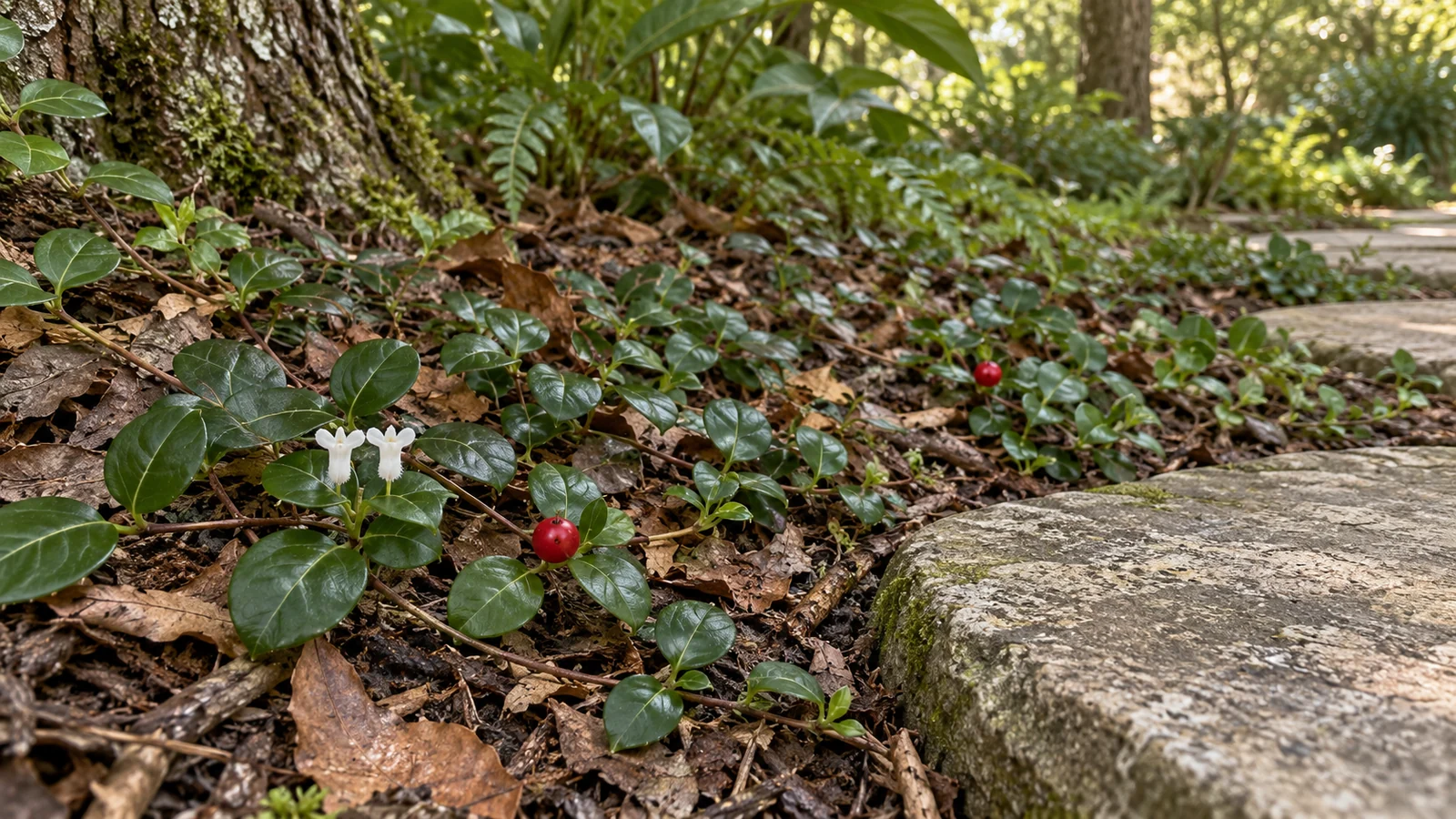
Bring fine evergreen detail to a quiet woodland pocket.
Partridgeberry is a delicate creeping native with tiny glossy leaves, pale midribs and stems that hug the ground. Paired white flowers and small red berries reward a close look. It is most useful in a small woodland-style planting where the subtle detail can be enjoyed from a nearby path, rather than across a broad open lawn.
Before you choose: This is a specialty shade option for a moist, humus-rich site. It grows slowly and can be difficult to establish; it is a poor choice for a hot, dry bed or quick large-area coverage. Protect the delicate stems from regular foot traffic and buy nursery-grown material.
Illustrative planting concept
Size and space
Typical height: 1–3 in. Mature spread: 12–16 in reference patch; can extend over time.
NC State lists plants at 1–3 in high and 12–16 in wide. The diagram uses the upper end of those dimensions for an individual patch. Creeping stems can root at nodes and extend over time, so the listed width is a reference footprint, not a lifetime boundary. Its very low height also means fallen leaves can easily obscure the planting.
Installed example: 1 in high × 6 in wide. This is an illustrative size, not a pot-size or growth-timeline promise.
Part shade to full shade · Consistently moist, humus-rich acidic soil with drainage · Evergreen leaves, small paired white flowers and seasonal red berries
Care: Establish a small nursery-grown patch; protect delicate stems and monitor moisture
Know the whole plant
Illustrative overall form of Partridgeberry; appearance varies with season and the nursery plant.Illustrative foliage and seasonal detail of Partridgeberry. Confirm the botanical name on the nursery label.
Where it works around Pensacola
Consider Partridgeberry for a sheltered Pensacola woodland pocket with shade, acidic organic soil and dependable moisture. Check the actual root zone beneath trees: shade does not guarantee moist soil. Begin with a small trial near a path where watering and gentle maintenance are practical. Avoid major tree-root disturbance while preparing planting pockets.
A small native woodland ground layer
A delicate evergreen shaded foreground
A moist humus-rich pocket beside a path
A close-view foliage and berry accent
A sheltered native plant collection
Does this resemble a woodland floor?
Look for shade, organic soil, moisture and drainage together. A thin dry strip under a roof overhang is not equivalent to a sheltered forest setting.
Can a small planting establish slowly?
Start where progress is easy to monitor and weeds can be removed gently. Do not rely on it to cover a large bare area in one season.
Will anyone step on the vines?
Place stepping stones or a separate path beside the planting. Keep maintenance access out of the delicate creeping stems.
Where is the material coming from?
Ask for nursery-propagated plants with the botanical name Mitchella repens. Leave wild colonies undisturbed and check availability before designing a large quantity.
Before it goes on the plan
Is it wintergreen?
No. Wintergreen, Gaultheria procumbens, is another plant sometimes confused with it. Confirm Mitchella repens rather than relying on a berry photo or common name.
Will it stay evergreen?
It is an evergreen species in a suitable site. Moisture stress and establishment problems can still reduce coverage, so evergreen does not mean maintenance-free.
Why are the flowers paired?
Two small flowers occur together and contribute to one berry. Fruit display varies with the plant and season; choose it for its fine creeping foliage as well as the occasional red berries.
Pairing ideas
Cast Iron Plant: Cast Iron Plant can provide a separate taller shade layer where drainage suits both. Keep its clumps back and maintain the moisture Partridgeberry needs.
Mine-No-Yuki Camellia: Mine-No-Yuki Camellia can form a taller backdrop in suitable acidic, draining soil. Keep the vine outside the trunk area and watch root competition for moisture.
{"key":"partridge","name":"Partridgeberry","botanical":"Mitchella repens","slug":"partridgeberry","id":"PLT-MITC-REPE","type":"groundcovers","h":[0.08333333333333333,0.25],"w":[1,1.3333333333333333],"install":[0.08333333333333333,0.5],"native":true,"groundGroup":"medium","light":"Part shade to full shade","lightTags":["part","shade"],"water":"Consistently moist, humus-rich acidic soil with drainage","season":"Evergreen leaves, small paired white flowers and seasonal red berries","care":"Establish a small nursery-grown patch; protect delicate stems and monitor moisture","benefit":"Bring fine evergreen detail to a quiet woodland pocket.","intro":"Partridgeberry is a delicate creeping native with tiny glossy leaves, pale midribs and stems that hug the ground. Paired white flowers and small red berries reward a close look. It is most useful in a small woodland-style planting where the subtle detail can be enjoyed from a nearby path, rather than across a broad open lawn.","caution":"This is a specialty shade option for a moist, humus-rich site. It grows slowly and can be difficult to establish; it is a poor choice for a hot, dry bed or quick large-area coverage. Protect the delicate stems from regular foot traffic and buy nursery-grown material.","sizeNote":"NC State lists plants at 1–3 in high and 12–16 in wide. The diagram uses the upper end of those dimensions for an individual patch. Creeping stems can root at nodes and extend over time, so the listed width is a reference footprint, not a lifetime boundary. Its very low height also means fallen leaves can easily obscure the planting.","site":"Consider Partridgeberry for a sheltered Pensacola woodland pocket with shade, acidic organic soil and dependable moisture. Check the actual root zone beneath trees: shade does not guarantee moist soil. Begin with a small trial near a path where watering and gentle maintenance are practical. Avoid major tree-root disturbance while preparing planting pockets.","uses":["A small native woodland ground layer","A delicate evergreen shaded foreground","A moist humus-rich pocket beside a path","A close-view foliage and berry accent","A sheltered native plant collection"],"checks":[["Does this resemble a woodland floor?","Look for shade, organic soil, moisture and drainage together. A thin dry strip under a roof overhang is not equivalent to a sheltered forest setting."],["Can a small planting establish slowly?","Start where progress is easy to monitor and weeds can be removed gently. Do not rely on it to cover a large bare area in one season."],["Will anyone step on the vines?","Place stepping stones or a separate path beside the planting. Keep maintenance access out of the delicate creeping stems."],["Where is the material coming from?","Ask for nursery-propagated plants with the botanical name Mitchella repens. Leave wild colonies undisturbed and check availability before designing a large quantity."]],"faq":[["Is it wintergreen?","No. Wintergreen, Gaultheria procumbens, is another plant sometimes confused with it. Confirm Mitchella repens rather than relying on a berry photo or common name."],["Will it stay evergreen?","It is an evergreen species in a suitable site. Moisture stress and establishment problems can still reduce coverage, so evergreen does not mean maintenance-free."],["Why are the flowers paired?","Two small flowers occur together and contribute to one berry. Fruit display varies with the plant and season; choose it for its fine creeping foliage as well as the occasional red berries."]],"sources":[["NC State Extension: Partridgeberry","https://plants.ces.ncsu.edu/plants/mitchella-repens/"],["Florida Native Plant Society: Partridgeberry","https://www.fnps.org/plant/mitchella-repens"]],"unit":"in","heightLabel":"Typical height","spreadLabel":"Mature spread","color":"#70815a","guideKind":"Native groundcover","eyebrow":"THE LOW LAYER / FORM + SEASON","aliases":["Partridgeberry","Mitchella repens","Partridge Berry"],"goals":["color"],"wholeCaption":"Illustrative overall form of Partridgeberry; appearance varies with season and the nursery plant.","detailCaption":"Illustrative foliage and seasonal detail of Partridgeberry. Confirm the botanical name on the nursery label.","heightText":"1–3 in","sizeSummary":"1–3 in high · reference patch 12–16 in wide","referenceNote":"The footprint uses the upper published individual width. Rooting stems can extend farther with time.","spreadText":"12–16 in reference patch; can extend over time","groundForm":"mat","images":{"context":{"id":"6aa066efd409e34addfe6bfd","url":"https://cdn.prod.website-files.com/6a975baac0f352647862d847/6aa066efd409e34addfe6bfd_landova-groundcover-partridge-context.webp","alt":"Illustrative planting concept with Partridgeberry","width":1600,"height":900},"whole":{"id":"6aa066ef0b8220ff69723344","url":"https://cdn.prod.website-files.com/6a975baac0f352647862d847/6aa066ef0b8220ff69723344_landova-groundcover-partridge-whole.webp","alt":"Illustrative whole-plant form of Partridgeberry","width":1448,"height":1086,"fit":"contain"},"detail":{"id":"6aa066ef506067cd39951ff1","url":"https://cdn.prod.website-files.com/6a975baac0f352647862d847/6aa066ef506067cd39951ff1_landova-groundcover-partridge-detail.webp","alt":"Illustrative foliage and seasonal detail of Partridgeberry","width":1254,"height":1254}},"companions":[{"slug":"cast-iron-plant","name":"Cast Iron Plant","title":"Place bolder foliage behind the small vine","reason":"Cast Iron Plant can provide a separate taller shade layer where drainage suits both. Keep its clumps back and maintain the moisture Partridgeberry needs.","image":{"id":"6aa052e4beb1621af788dce7","url":"https://cdn.prod.website-files.com/6a975baac0f352647862d847/6aa052e4beb1621af788dce7_landova-groundcover-castiron-context.webp","alt":"Illustrative planting concept with Cast Iron Plant","width":1600,"height":900}},{"slug":"mine-no-yuki-camellia","name":"Mine-No-Yuki Camellia","title":"Frame a sheltered woodland pocket","reason":"Mine-No-Yuki Camellia can form a taller backdrop in suitable acidic, draining soil. Keep the vine outside the trunk area and watch root competition for moisture.","image":{"id":"6a9f40877400c99880ee23a1","url":"https://cdn.prod.website-files.com/6a975baac0f352647862d847/6a9f40877400c99880ee23a1_landova-mine-context.webp","alt":"Illustrative planting concept with Mine-No-Yuki Camellia"}}]}
LANDOVA / PLANTING DECISIONS
Choose plants with the whole space in mind.
Explore a planting goal, then compare the growing needs and mature size of individual plants.
LANDOVA is in beta
Join the launch waitlist.
We are not accepting paying clients yet. We expect to launch around January 2027 and may open sooner. Explore our free tools now, and sign up for launch updates and educational planning emails.
Thank you. Your waitlist signup has been received. We will email you with launch updates. No purchase or project booking has been made.
We could not save your signup. Please try again or email info@landovadesign.com.