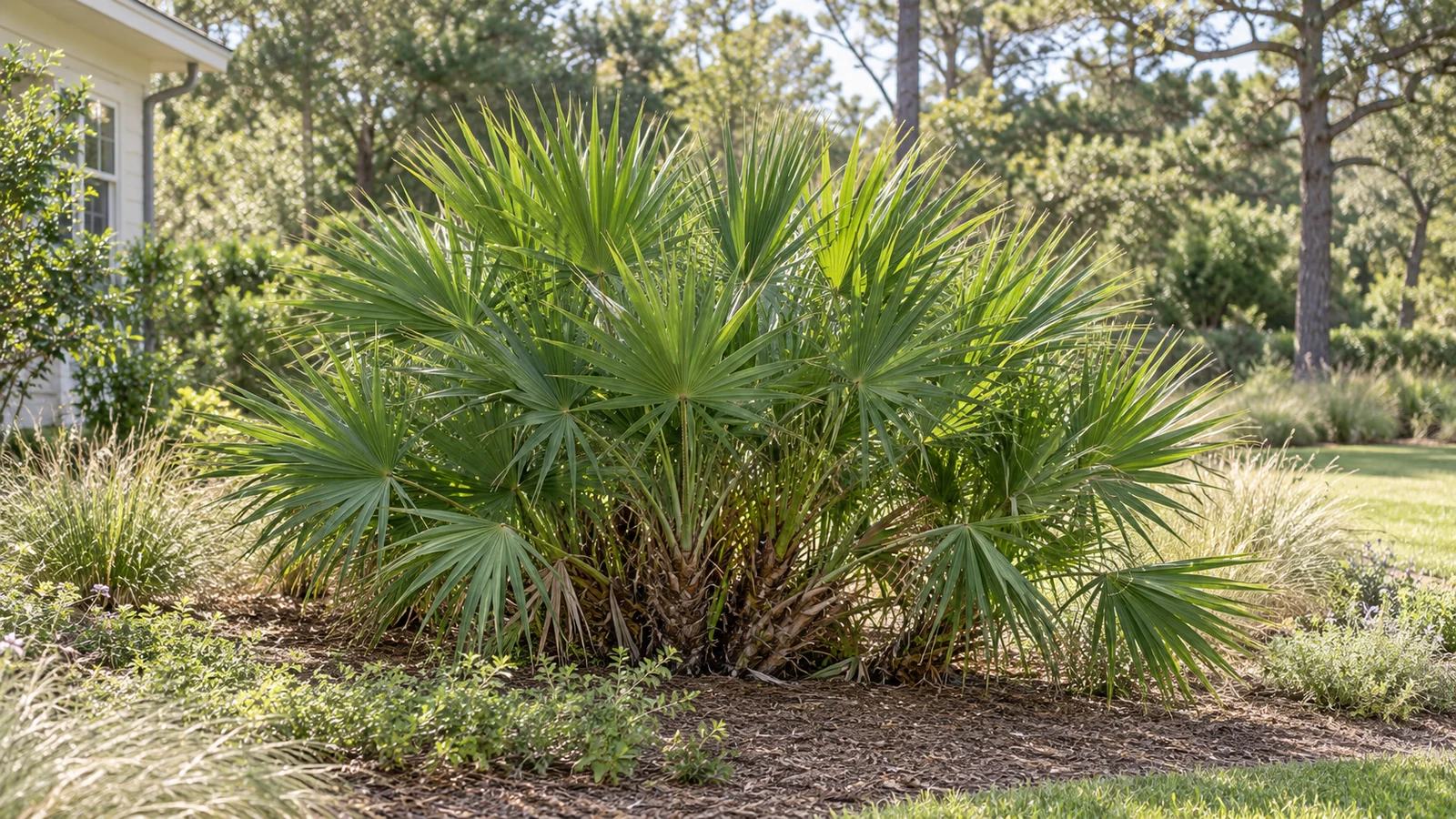
Build a broad, natural layer with Florida character.
Saw Palmetto brings the bold texture of a native Florida landscape into a residential planting. Its low, spreading stems and fan leaves make it useful in broad beds where the design can accommodate a developing colony. Green and silver forms offer different color effects within the same species.
Before you choose: Saw-toothed leaf stalks need separation from paths and play areas. This palm can spread beyond its starting clump and is not a good choice for a Firewise planting near a home. Decide the long-term location before planting; moving it later can be difficult.
Illustrative planting concept
Size and space
Total mature height: 5–10 ft. Mature frond spread: 4–12 ft.
UF/IFAS describes typical plants at 5–10 ft high and 4–10 ft wide, with another palm reference allowing 12 ft of spread. The diagram uses 5–10 × 4–12 ft to show a broad planning envelope. Creeping stems can extend a colony beyond one clump.
Installed example: 2 ft high × 3 ft wide. This is an illustrative size, not a pot-size or growth-timeline promise.
Full sun to part shade · Well-drained soil; very drought tolerant after establishment · Green or silver fan foliage · spring flowers · seasonal dark fruit
Care: Plan for creeping growth; remove dead fronds selectively
Know the whole plant
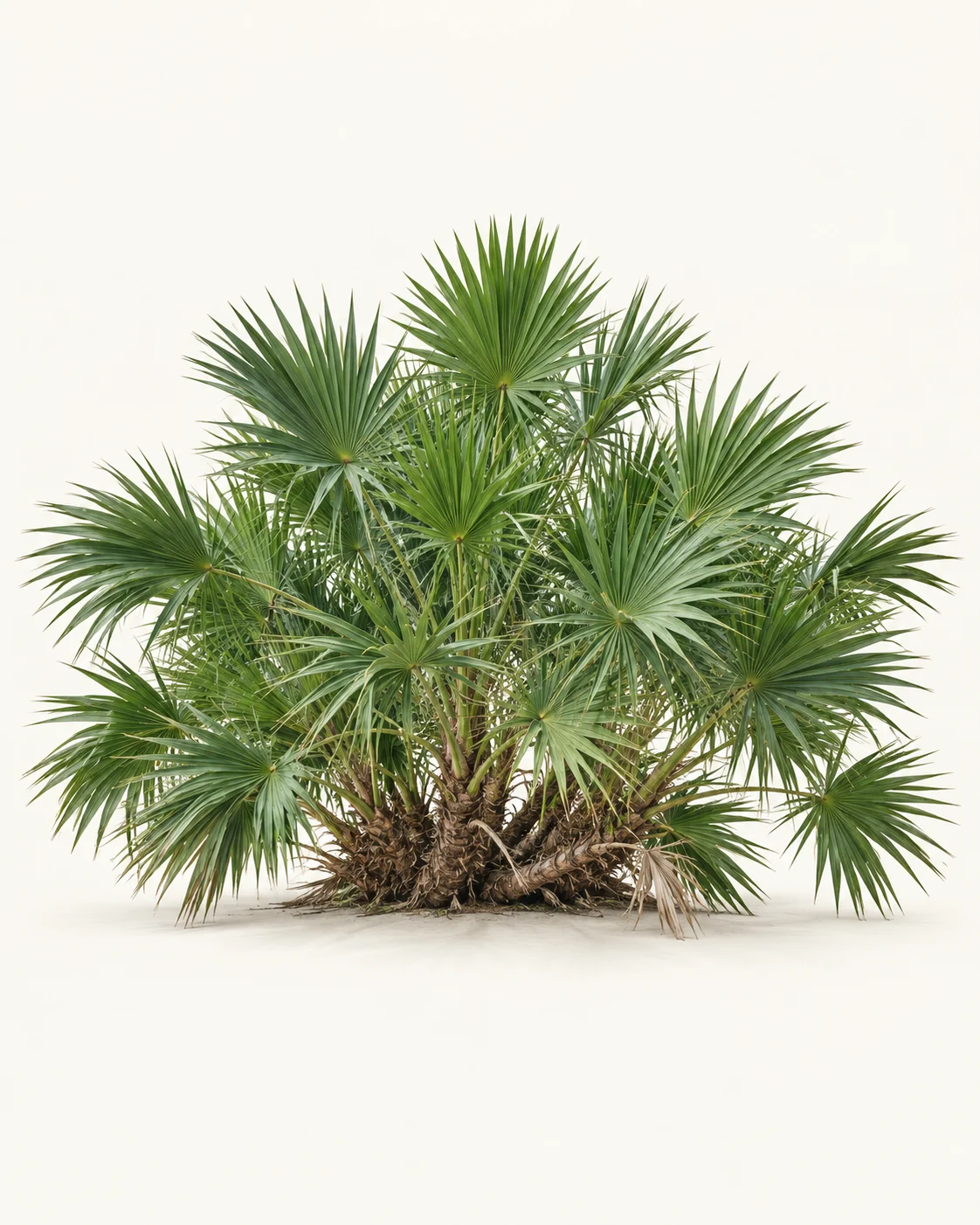
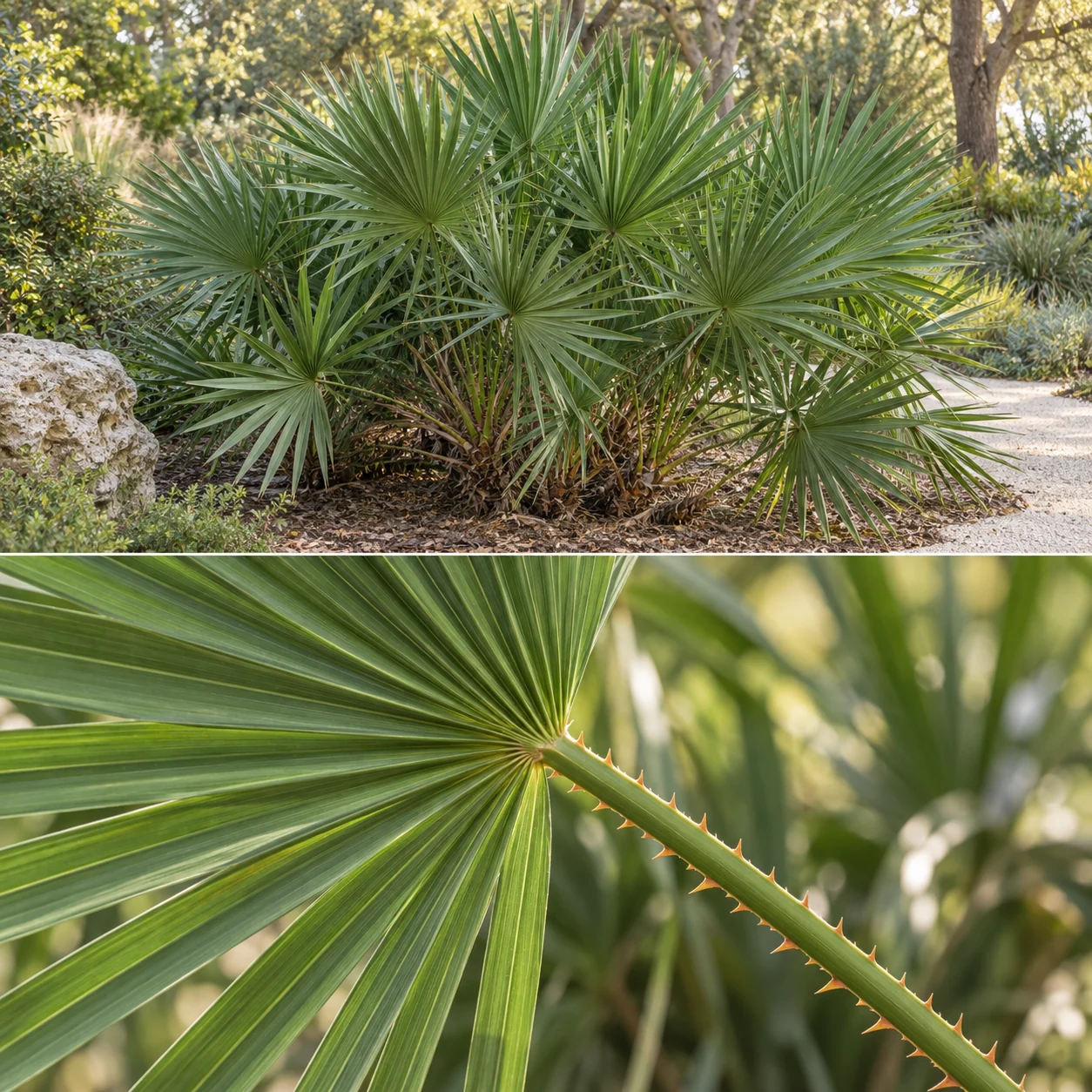
Illustrative whole-plant form of Saw Palmetto; fronds, stems and overall proportions vary with age and growing conditions.Illustrative foliage detail of Saw Palmetto. Use the botanical name and nursery label to confirm the plant.
Where it works around Pensacola
Use Saw Palmetto in a generous Pensacola native bed where its outward growth and sharp petioles will not interfere with everyday use. A larger outer garden border can suit it better than a tight foundation strip. Review fire exposure and the full planting context before using it close to structures.
A broad native landscape border
A textured outer garden layer
A green or silver foliage accent
Low naturalistic screening
A wildlife-oriented planting area
Is this a Firewise location?
Where defensible space or fire-resistant planting is a priority, choose a different plant. Do not place a flammable mass against the house.
Where will the colony expand?
Leave an area for spreading stems and future cleanup. A nursery pot shows only the starting footprint.
Are the leaf stalks clear of traffic?
Allow more than a narrow gap beside steps, driveways and gates. The saw-like teeth can catch skin and clothing.
Which foliage color is supplied?
Inspect the actual stock if silver foliage is part of the design. Green and silver forms belong to the same species, and labels can vary.
Before it goes on the plan
Are green and silver forms separate plants?
They are forms of Serenoa repens. Nursery names vary; choose the actual foliage color you want and confirm its expected growth.
Is it suitable for a small bed?
Only where the broad clump, creeping growth and safe clearance all fit. It is a low palm, but it can be a large landscape mass.
Can it handle a coastal address?
It tolerates salt spray better than many palms, but wind exposure, roots, drainage and flooding still need site-specific review. A coastal address alone is not enough to choose the location.
Pairing ideas
Pink Muhly Grass: Pink Muhly Grass can provide seasonal softness in its own well-drained sunny space, clear of the palmetto clump.
Dwarf Palmetto: Dwarf Palmetto has smooth petioles and usually a more contained stem habit. Compare conditions and space rather than substituting by appearance.
{"key":"saw","name":"Saw Palmetto","botanical":"Serenoa repens","slug":"saw-palmetto","id":"PLT-SERE-REPE","type":"palms","h":[5,10],"w":[4,12],"install":[2,3],"palmForm":"fan-clump","trunkRatio":0.15,"native":true,"light":"Full sun to part shade","lightTags":["sun","part"],"water":"Well-drained soil; very drought tolerant after establishment","season":"Green or silver fan foliage · spring flowers · seasonal dark fruit","care":"Plan for creeping growth; remove dead fronds selectively","benefit":"Build a broad, natural layer with Florida character.","intro":"Saw Palmetto brings the bold texture of a native Florida landscape into a residential planting. Its low, spreading stems and fan leaves make it useful in broad beds where the design can accommodate a developing colony. Green and silver forms offer different color effects within the same species.","caution":"Saw-toothed leaf stalks need separation from paths and play areas. This palm can spread beyond its starting clump and is not a good choice for a Firewise planting near a home. Decide the long-term location before planting; moving it later can be difficult.","sizeNote":"UF/IFAS describes typical plants at 5–10 ft high and 4–10 ft wide, with another palm reference allowing 12 ft of spread. The diagram uses 5–10 × 4–12 ft to show a broad planning envelope. Creeping stems can extend a colony beyond one clump.","site":"Use Saw Palmetto in a generous Pensacola native bed where its outward growth and sharp petioles will not interfere with everyday use. A larger outer garden border can suit it better than a tight foundation strip. Review fire exposure and the full planting context before using it close to structures.","uses":["A broad native landscape border","A textured outer garden layer","A green or silver foliage accent","Low naturalistic screening","A wildlife-oriented planting area"],"checks":[["Is this a Firewise location?","Where defensible space or fire-resistant planting is a priority, choose a different plant. Do not place a flammable mass against the house."],["Where will the colony expand?","Leave an area for spreading stems and future cleanup. A nursery pot shows only the starting footprint."],["Are the leaf stalks clear of traffic?","Allow more than a narrow gap beside steps, driveways and gates. The saw-like teeth can catch skin and clothing."],["Which foliage color is supplied?","Inspect the actual stock if silver foliage is part of the design. Green and silver forms belong to the same species, and labels can vary."]],"faq":[["Are green and silver forms separate plants?","They are forms of Serenoa repens. Nursery names vary; choose the actual foliage color you want and confirm its expected growth."],["Is it suitable for a small bed?","Only where the broad clump, creeping growth and safe clearance all fit. It is a low palm, but it can be a large landscape mass."],["Can it handle a coastal address?","It tolerates salt spray better than many palms, but wind exposure, roots, drainage and flooding still need site-specific review. A coastal address alone is not enough to choose the location."]],"sources":[["UF/IFAS: Saw Palmetto","https://gardeningsolutions.ifas.ufl.edu/plants/trees-and-shrubs/palms-and-cycads/saw-palmetto/"],["UF/IFAS: Saw Palmetto profile","https://ask.ifas.ufl.edu/publication/FP547"],["UF/IFAS: Palm selection table","https://ask.ifas.ufl.edu/publication/EP020"]],"unit":"ft","heightLabel":"Total mature height","spreadLabel":"Mature frond spread","color":"#70815a","guideKind":"Native palm","eyebrow":"EVERGREEN FORM + THOUGHTFUL PLACEMENT","wholeCaption":"Illustrative whole-plant form of Saw Palmetto; fronds, stems and overall proportions vary with age and growing conditions.","detailCaption":"Illustrative foliage detail of Saw Palmetto. Use the botanical name and nursery label to confirm the plant.","aliases":["Saw Palmetto","Serenoa repens","silver saw palmetto","green saw palmetto"],"goals":["privacy"],"palmSizeGroup":"small","images":{"context":{"id":"6aa03d85bfe8e2f3b77a7385","url":"https://cdn.prod.website-files.com/6a975baac0f352647862d847/6aa03d85bfe8e2f3b77a7385_landova-palm-saw-context.webp","alt":"Illustrative planting concept with Saw Palmetto","width":1600,"height":900},"whole":{"id":"6aa03d85784c76b20773c1ec","url":"https://cdn.prod.website-files.com/6a975baac0f352647862d847/6aa03d85784c76b20773c1ec_landova-palm-saw-whole.webp","alt":"Illustrative whole-plant form of Saw Palmetto","width":1122,"height":1402,"fit":"contain"},"detail":{"id":"6aa03d85f08181b5baeebd96","url":"https://cdn.prod.website-files.com/6a975baac0f352647862d847/6aa03d85f08181b5baeebd96_landova-palm-saw-detail.webp","alt":"Illustrative foliage and seasonal detail of Saw Palmetto","width":1254,"height":1254}},"companions":[{"slug":"pink-muhly-grass","name":"Pink Muhly Grass","title":"Compare a finer sunny texture","reason":"Pink Muhly Grass can provide seasonal softness in its own well-drained sunny space, clear of the palmetto clump.","image":{"id":"6aa00228430659e428d61061","url":"https://cdn.prod.website-files.com/6a975baac0f352647862d847/6aa00228430659e428d61061_landova-grass-muhly-context.webp","alt":"Illustrative planting concept with Pink Muhly Grass","width":1600,"height":900}},{"slug":"dwarf-palmetto","name":"Dwarf Palmetto","title":"Compare a moist-site palmetto","reason":"Dwarf Palmetto has smooth petioles and usually a more contained stem habit. Compare conditions and space rather than substituting by appearance.","image":{"id":"6aa03d82f08181b5baeebc1d","url":"https://cdn.prod.website-files.com/6a975baac0f352647862d847/6aa03d82f08181b5baeebc1d_landova-palm-dwarfpalmetto-context.webp","alt":"Illustrative planting concept with Dwarf Palmetto","width":1600,"height":900}}]}
LANDOVA / PLANTING DECISIONS
Choose plants with the whole space in mind.
Explore a planting goal, then compare the growing needs and mature size of individual plants.
LANDOVA is in beta
Join the launch waitlist.
We are not accepting paying clients yet. We expect to launch around January 2027 and may open sooner. Explore our free tools now, and sign up for launch updates and educational planning emails.
Thank you. Your waitlist signup has been received. We will email you with launch updates. No purchase or project booking has been made.
We could not save your signup. Please try again or email info@landovadesign.com.