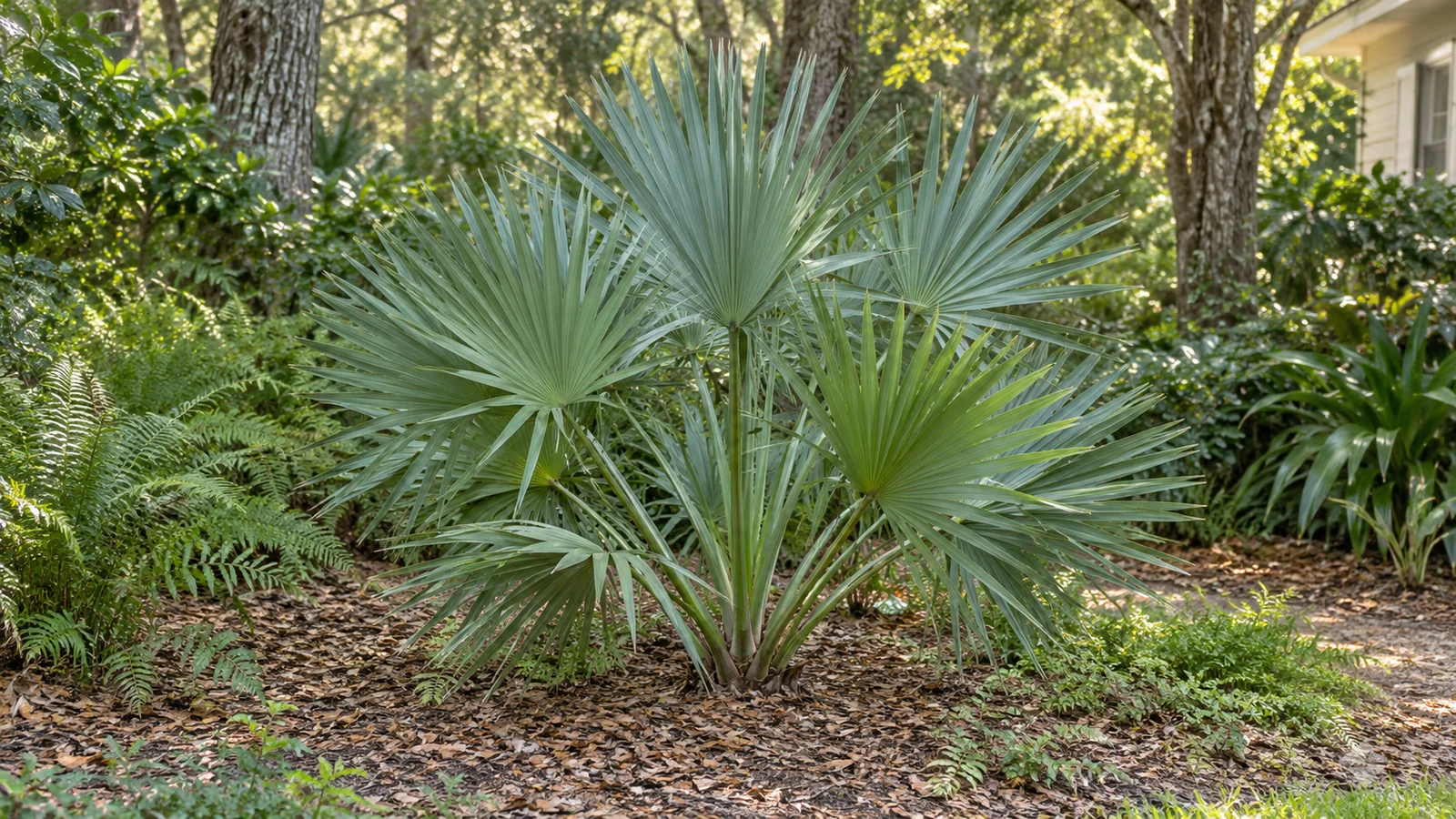
Dwarf Palmetto creates a strong leafy presence in a garden bed, with broad fans rising from a mostly hidden stem. It is worth considering for a moist, sheltered lower layer where a tall palm would change the scale of the property. Let the individual fans remain visible rather than crowding them between other plants.
Before you choose: Dwarf does not mean a two-foot plant forever. Species references span 2–10 ft in height, and some forms are larger than the familiar low clumps. Confirm the nursery form and reserve space for long leaf stalks and seasonal flower stems.
Illustrative planting concept
Size and space
Total mature height: 2–10 ft. Mature frond spread: 4–8 ft.
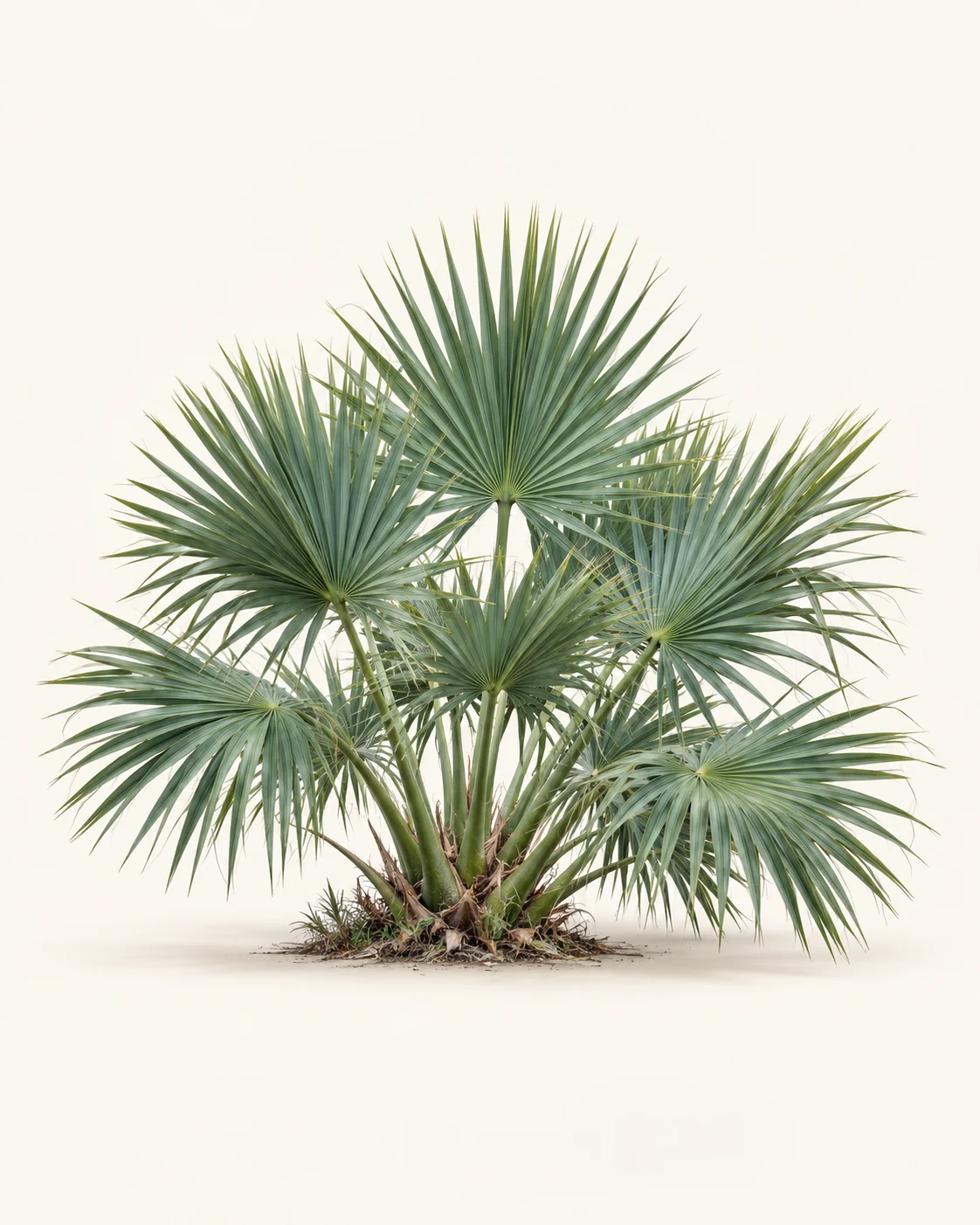
NC State lists 2–10 ft high and 4–6 ft wide; the UF/IFAS palm table includes an 8 × 8 ft plant. This broad 2–10 × 4–8 ft planning range accommodates that variation. The upper diagram is a larger example, not the expected size of every specimen.
Installed example: 2 ft high × 2 ft wide. This is an illustrative size, not a pot-size or growth-timeline promise.
Sun to part shade · Moist soil; tolerates wetter conditions better than many landscape palms · Evergreen fan leaves · seasonal flowers and dark fruit
Care: Slow growth; leave room for broad fans and flower stalks
Know the whole plant
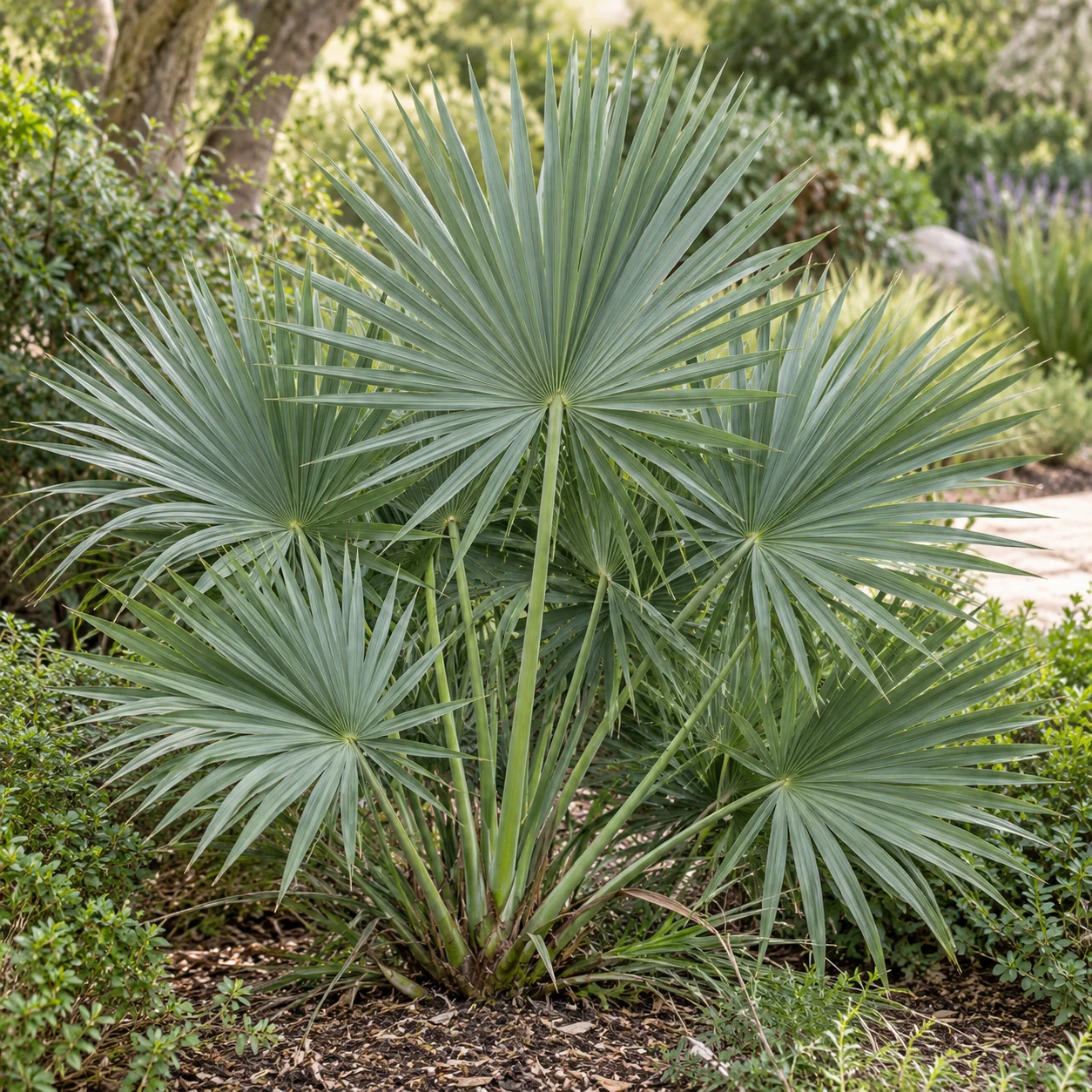
Illustrative whole-plant form of Dwarf Palmetto; fronds, stems and overall proportions vary with age and growing conditions.Illustrative foliage detail of Dwarf Palmetto. Use the botanical name and nursery label to confirm the plant.
Where it works around Pensacola
In Pensacola, explore Dwarf Palmetto for a moist woodland edge, a broad rain-garden border or a partially shaded bed. Its fans need their own clear area even without a tall trunk. Plan drainage from actual site conditions; tolerance of wet soil does not establish a safe location beside a foundation.
A low native palm focal point
A moist woodland-edge bed
A broad rain-garden border
Texture beside a shaded sitting area
A lower layer beneath a high canopy
Is this Sabal minor?
Young Cabbage Palms can also look low and trunkless. Confirm the botanical name so a future tall palm is not placed in a small bed.
Which form is being supplied?
Ask about the source and expected habit of the actual nursery stock. Compare larger local examples if the planting has a strict height limit.
Can its fans open fully?
The fronds need more space than the stem suggests. Keep them out of gates, window access and routine walking routes.
How does water move here?
A plant that accepts moist ground may fit a lower part of the garden, but it is not a drainage solution. Keep building and property runoff decisions in the site plan.
Before it goes on the plan
How is it different from Saw Palmetto?
Dwarf Palmetto has smooth leaf stalks and a mostly underground stem. Saw Palmetto has saw-toothed stalks and a more spreading, creeping habit.
Will it stay trunkless?
It is usually nearly trunkless. Form and provenance vary, and some selections can develop more visible stem, so inspect the exact nursery plant.
Can I put it in a narrow foundation strip?
Only if the full frond spread and maintenance access fit. The name dwarf describes its relationship to taller palms, not a promise that it belongs in a narrow strip.
Pairing ideas
Needle Palm: Needle Palm offers a denser clump but has sharp basal spines. Compare access and moisture requirements.
Soft Rush: Soft Rush can form a separate lower layer where moisture suits it, with open space around the palmetto fans.
{"key":"dwarfpalmetto","name":"Dwarf Palmetto","botanical":"Sabal minor","slug":"dwarf-palmetto","id":"PLT-SABA-MINO","type":"palms","h":[2,10],"w":[4,8],"install":[2,2],"palmForm":"fan-low","trunkRatio":0.08,"native":true,"light":"Sun to part shade","lightTags":["sun","part"],"water":"Moist soil; tolerates wetter conditions better than many landscape palms","season":"Evergreen fan leaves · seasonal flowers and dark fruit","care":"Slow growth; leave room for broad fans and flower stalks","benefit":"Add a bold palm texture without a tall trunk.","intro":"Dwarf Palmetto creates a strong leafy presence in a garden bed, with broad fans rising from a mostly hidden stem. It is worth considering for a moist, sheltered lower layer where a tall palm would change the scale of the property. Let the individual fans remain visible rather than crowding them between other plants.","caution":"Dwarf does not mean a two-foot plant forever. Species references span 2–10 ft in height, and some forms are larger than the familiar low clumps. Confirm the nursery form and reserve space for long leaf stalks and seasonal flower stems.","sizeNote":"NC State lists 2–10 ft high and 4–6 ft wide; the UF/IFAS palm table includes an 8 × 8 ft plant. This broad 2–10 × 4–8 ft planning range accommodates that variation. The upper diagram is a larger example, not the expected size of every specimen.","site":"In Pensacola, explore Dwarf Palmetto for a moist woodland edge, a broad rain-garden border or a partially shaded bed. Its fans need their own clear area even without a tall trunk. Plan drainage from actual site conditions; tolerance of wet soil does not establish a safe location beside a foundation.","uses":["A low native palm focal point","A moist woodland-edge bed","A broad rain-garden border","Texture beside a shaded sitting area","A lower layer beneath a high canopy"],"checks":[["Is this Sabal minor?","Young Cabbage Palms can also look low and trunkless. Confirm the botanical name so a future tall palm is not placed in a small bed."],["Which form is being supplied?","Ask about the source and expected habit of the actual nursery stock. Compare larger local examples if the planting has a strict height limit."],["Can its fans open fully?","The fronds need more space than the stem suggests. Keep them out of gates, window access and routine walking routes."],["How does water move here?","A plant that accepts moist ground may fit a lower part of the garden, but it is not a drainage solution. Keep building and property runoff decisions in the site plan."]],"faq":[["How is it different from Saw Palmetto?","Dwarf Palmetto has smooth leaf stalks and a mostly underground stem. Saw Palmetto has saw-toothed stalks and a more spreading, creeping habit."],["Will it stay trunkless?","It is usually nearly trunkless. Form and provenance vary, and some selections can develop more visible stem, so inspect the exact nursery plant."],["Can I put it in a narrow foundation strip?","Only if the full frond spread and maintenance access fit. The name dwarf describes its relationship to taller palms, not a promise that it belongs in a narrow strip."]],"sources":[["NC State Extension: Dwarf Palmetto","https://plants.ces.ncsu.edu/plants/sabal-minor/"],["UF/IFAS: Ornamental Palms for Central Florida","https://ask.ifas.ufl.edu/publication/EP020"]],"unit":"ft","heightLabel":"Total mature height","spreadLabel":"Mature frond spread","color":"#70815a","guideKind":"Native palm","eyebrow":"EVERGREEN FORM + THOUGHTFUL PLACEMENT","wholeCaption":"Illustrative whole-plant form of Dwarf Palmetto; fronds, stems and overall proportions vary with age and growing conditions.","detailCaption":"Illustrative foliage detail of Dwarf Palmetto. Use the botanical name and nursery label to confirm the plant.","aliases":["Dwarf Palmetto","Sabal minor","dwarf sabal","bush palmetto"],"goals":["pool"],"palmSizeGroup":"small","images":{"context":{"id":"6aa03d82f08181b5baeebc1d","url":"https://cdn.prod.website-files.com/6a975baac0f352647862d847/6aa03d82f08181b5baeebc1d_landova-palm-dwarfpalmetto-context.webp","alt":"Illustrative planting concept with Dwarf Palmetto","width":1600,"height":900},"whole":{"id":"6aa03d83f5ce7c0b5e6af66d","url":"https://cdn.prod.website-files.com/6a975baac0f352647862d847/6aa03d83f5ce7c0b5e6af66d_landova-palm-dwarfpalmetto-whole.webp","alt":"Illustrative whole-plant form of Dwarf Palmetto","width":1122,"height":1402,"fit":"contain"},"detail":{"id":"6aa03d83f5ce7c0b5e6af6c4","url":"https://cdn.prod.website-files.com/6a975baac0f352647862d847/6aa03d83f5ce7c0b5e6af6c4_landova-palm-dwarfpalmetto-detail.webp","alt":"Illustrative foliage and seasonal detail of Dwarf Palmetto","width":1254,"height":1254}},"companions":[{"slug":"needle-palm","name":"Needle Palm","title":"Compare another low native palm","reason":"Needle Palm offers a denser clump but has sharp basal spines. Compare access and moisture requirements.","image":{"id":"6aa03d830ee320cd00dfdfda","url":"https://cdn.prod.website-files.com/6a975baac0f352647862d847/6aa03d830ee320cd00dfdfda_landova-palm-needle-context.webp","alt":"Illustrative planting concept with Needle Palm","width":1600,"height":900}},{"slug":"soft-rush","name":"Soft Rush","title":"Explore a finer moist-area texture","reason":"Soft Rush can form a separate lower layer where moisture suits it, with open space around the palmetto fans.","image":{"id":"6aa00d1713cf571cf7f1bdb3","url":"https://cdn.prod.website-files.com/6a975baac0f352647862d847/6aa00d1713cf571cf7f1bdb3_landova-grass-softrush-context.webp","alt":"Illustrative planting concept with Soft Rush","width":1600,"height":900}}]}
LANDOVA / PLANTING DECISIONS
Choose plants with the whole space in mind.
Explore a planting goal, then compare the growing needs and mature size of individual plants.
LANDOVA is in beta
Join the launch waitlist.
We are not accepting paying clients yet. We expect to launch around January 2027 and may open sooner. Explore our free tools now, and sign up for launch updates and educational planning emails.
Thank you. Your waitlist signup has been received. We will email you with launch updates. No purchase or project booking has been made.
We could not save your signup. Please try again or email info@landovadesign.com.