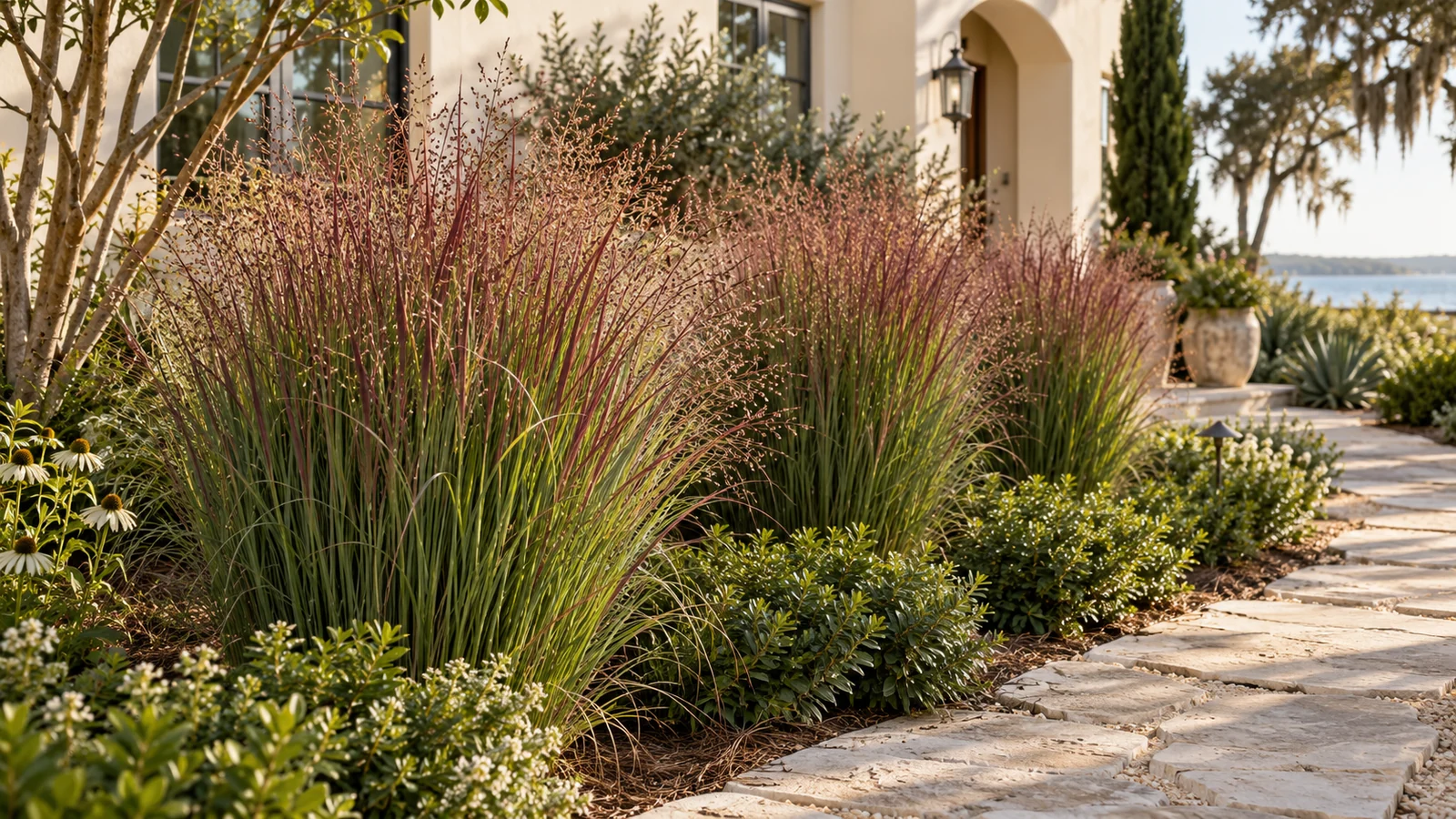
Shenandoah brings a more upright line to a garden of rounded shrubs. Green leaves develop red tones as the season progresses, while a light veil of seed heads catches the sun. Repeat a few clumps where their changing color can be seen from the house or an everyday walking route.
Before you choose: The red display changes with season and site. Shade, excess irrigation or fertilizer can make the clump lean; this is seasonal structure rather than a permanent evergreen screen.
Illustrative planting concept
Size and space
Mature height: 3–4 ft. Mature spread: 3 ft.
Santa Rosa County lists Shenandoah at 3–4 ft high and about 3 ft wide. The diagram uses that cultivar range. Other switchgrasses can be substantially taller, so a generic Panicum label is not an equivalent size specification. Allow extra space for stems that lean in weather.
Installed example: 1 ft high × 1 ft wide. This is an illustrative size, not a pot-size or growth-timeline promise.
Full sun preferred; tolerates part shade with a looser habit · Water to establish; adaptable soil with a moisture pattern suited to the planting · Green-to-red foliage · fine late-season panicles · tan winter stems
Care: Renew old growth before spring shoots; avoid pushing soft growth with excess fertilizer
Know the whole plant
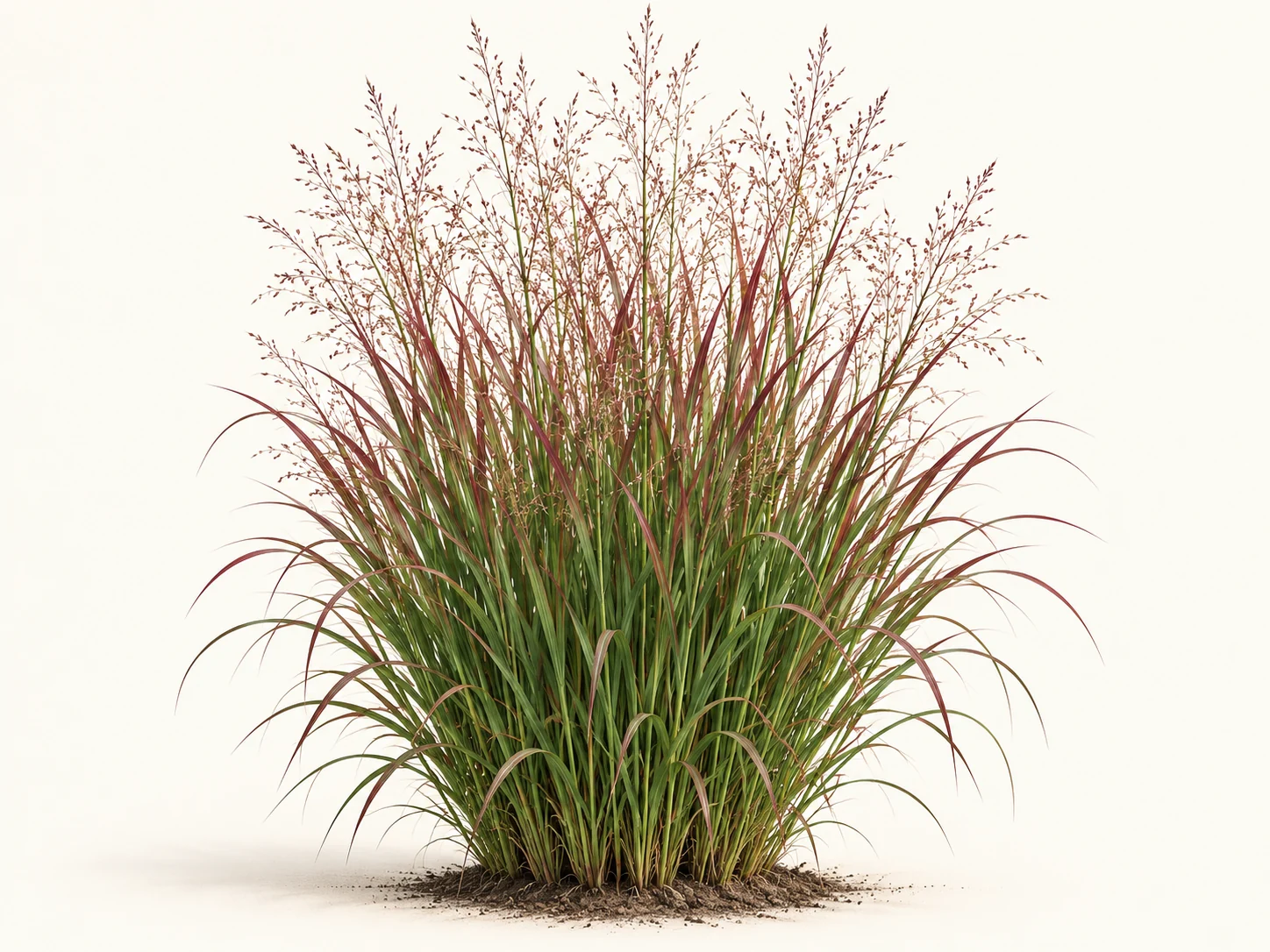
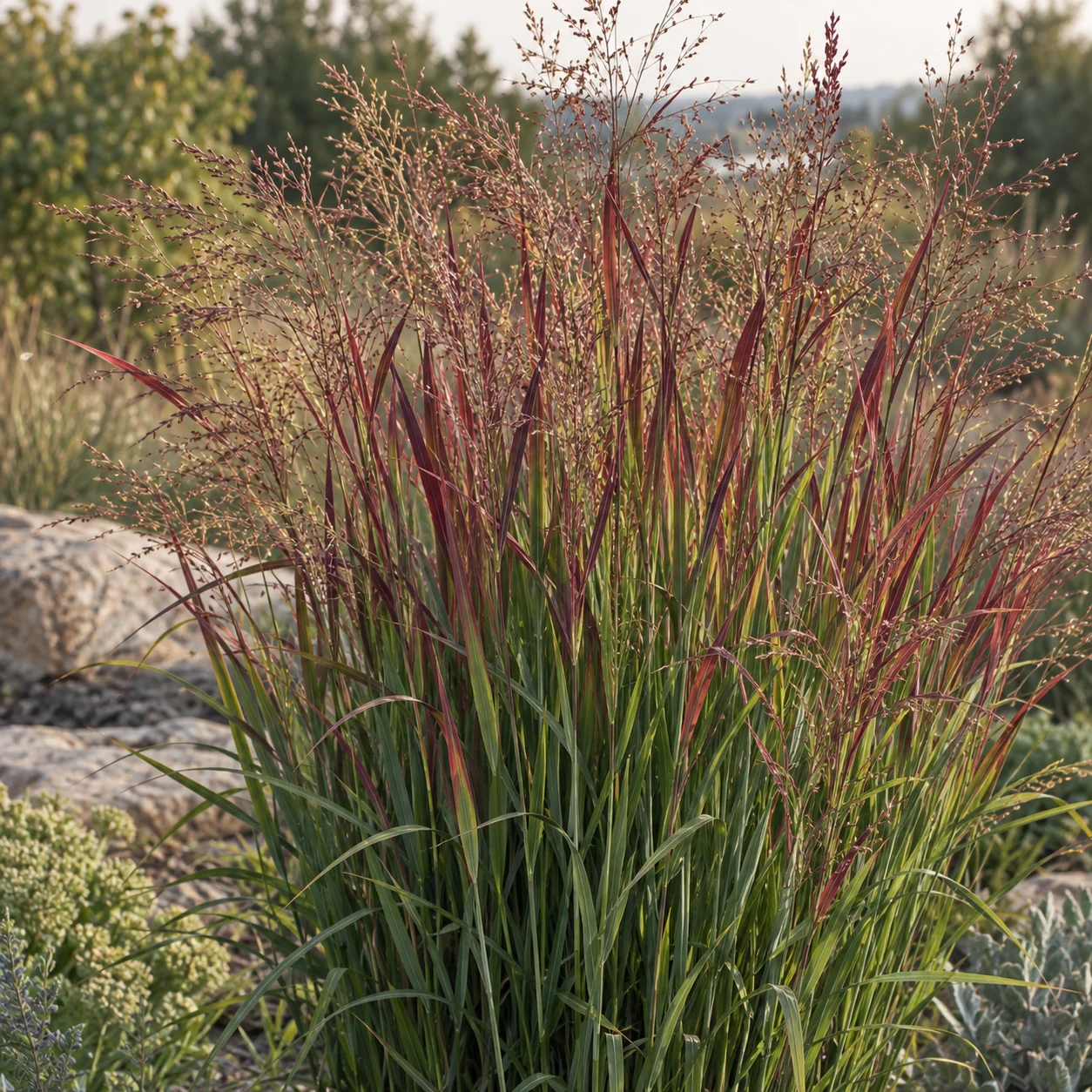
Illustrative upright Shenandoah clump with seasonal red tones; the whole plant does not stay red year-round.Illustrative red-tinted blades and fine open panicles, rather than dense feather plumes.
Where it works around Pensacola
Santa Rosa County Extension includes Shenandoah in its teaching-garden plant references, making it a useful regional starting point. For a Pensacola home, give the clump good light and a clear role in the bed. Check the irrigation zone before mixing it with plants that need a very different water schedule.
Repeated sunny border accents
Red seasonal foliage
A middle layer behind low plants
A native-species alternative to some maiden grasses
Winter texture in a naturalistic bed
Where will the red color be noticed?
Choose a repeated view from the patio, kitchen or approach. A few well-placed clumps can connect a planting more clearly than scattered single accents.
Does the bed still work in winter?
Keep an evergreen layer nearby if year-round green structure matters. Let the grass provide a seasonal change without asking it to hide equipment or screen a neighbor every month.
Is the irrigation shared appropriately?
Look at nearby emitters and turf sprinklers. Match watering to establishment and site conditions; do not place a grass in a constantly irrigated pocket simply because the empty space looks useful.
Can the mature clump stand freely?
Reserve its spread before setting the plant near paving. Leave enough access to gather and remove old growth without stepping through neighboring plants.
Before it goes on the plan
Will Shenandoah stay red all year?
No. Its color develops through the growing season, followed by winter dormancy. The timing and intensity vary with conditions.
Is this the same size as ordinary switchgrass?
No. This is a named selection. Use its 3–4 ft planning height and check any substitute against its own nursery description.
Should the dry stems stay through winter?
They can contribute texture and seed for wildlife where the layout allows. Plan seasonal cleanup before new shoots emerge, and keep dry growth clear of ignition sources.
Pairing ideas
Schilling’s Dwarf Yaupon Holly: A dwarf yaupon can hold the winter composition in a compatible sunny bed. Allow the holly its larger natural spread or an intentional maintained size.
Peach Drift Rose: Peach Drift can sit in front in a sunny, suitably drained bed. Keep separate mature spaces and allow the rose the irrigation and care it needs.
{"key":"shenandoah","id":"PLT-PANI-SHENANDOAH","slug":"shenandoah-switchgrass","name":"Shenandoah Switchgrass","botanical":"Panicum virgatum ‘Shenandoah’","eyebrow":"UPRIGHT RHYTHM + RED FALL COLOR","benefit":"Let one repeated color carry the season.","intro":"Shenandoah brings a more upright line to a garden of rounded shrubs. Green leaves develop red tones as the season progresses, while a light veil of seed heads catches the sun. Repeat a few clumps where their changing color can be seen from the house or an everyday walking route.","h":[3,4],"w":[3,3],"install":[1,1],"color":"#7e7958","habit":"upright","plantKind":"grass","light":"Full sun preferred; tolerates part shade with a looser habit","lightTags":["sun","part"],"water":"Water to establish; adaptable soil with a moisture pattern suited to the planting","season":"Green-to-red foliage · fine late-season panicles · tan winter stems","care":"Renew old growth before spring shoots; avoid pushing soft growth with excess fertilizer","caution":"The red display changes with season and site. Shade, excess irrigation or fertilizer can make the clump lean; this is seasonal structure rather than a permanent evergreen screen.","site":"Santa Rosa County Extension includes Shenandoah in its teaching-garden plant references, making it a useful regional starting point. For a Pensacola home, give the clump good light and a clear role in the bed. Check the irrigation zone before mixing it with plants that need a very different water schedule.","sizeNote":"Santa Rosa County lists Shenandoah at 3–4 ft high and about 3 ft wide. The diagram uses that cultivar range. Other switchgrasses can be substantially taller, so a generic Panicum label is not an equivalent size specification. Allow extra space for stems that lean in weather.","uses":["Repeated sunny border accents","Red seasonal foliage","A middle layer behind low plants","A native-species alternative to some maiden grasses","Winter texture in a naturalistic bed"],"checks":[["Where will the red color be noticed?","Choose a repeated view from the patio, kitchen or approach. A few well-placed clumps can connect a planting more clearly than scattered single accents."],["Does the bed still work in winter?","Keep an evergreen layer nearby if year-round green structure matters. Let the grass provide a seasonal change without asking it to hide equipment or screen a neighbor every month."],["Is the irrigation shared appropriately?","Look at nearby emitters and turf sprinklers. Match watering to establishment and site conditions; do not place a grass in a constantly irrigated pocket simply because the empty space looks useful."],["Can the mature clump stand freely?","Reserve its spread before setting the plant near paving. Leave enough access to gather and remove old growth without stepping through neighboring plants."]],"faq":[["Will Shenandoah stay red all year?","No. Its color develops through the growing season, followed by winter dormancy. The timing and intensity vary with conditions."],["Is this the same size as ordinary switchgrass?","No. This is a named selection. Use its 3–4 ft planning height and check any substitute against its own nursery description."],["Should the dry stems stay through winter?","They can contribute texture and seed for wildlife where the layout allows. Plan seasonal cleanup before new shoots emerge, and keep dry growth clear of ignition sources."]],"sources":[["UF/IFAS Santa Rosa County · Shenandoah demonstration-garden guide","https://sfyl.ifas.ufl.edu/media/sfylifasufledu/santa-rosa/docs/pdfs/demo-garden-3/Switchgrass.pdf"],["Hoffman Nursery · Shenandoah identity and seasonal habit","https://hoffmannursery.com/plants/details/panicum-virgatum-shenandoah"],["NC State Extension · switchgrass species context","https://plants.ces.ncsu.edu/plants/panicum-virgatum/"]],"wholeCaption":"Illustrative upright Shenandoah clump with seasonal red tones; the whole plant does not stay red year-round.","detailCaption":"Illustrative red-tinted blades and fine open panicles, rather than dense feather plumes.","native":true,"guideKind":"Native-species cultivar guide","aliases":["red switchgrass","Shenandoah","Panicum","burgundy","red","autumn","fall color"],"goals":["color"],"type":"grasses","categoryLabel":"Grasses + grasslike plants","reviewDate":"2026-09-08","images":{"context":{"id":"6aa00d1613cf571cf7f1bccd","url":"https://cdn.prod.website-files.com/6a975baac0f352647862d847/6aa00d1613cf571cf7f1bccd_landova-grass-shenandoah-context.webp","alt":"Illustrative planting concept with Shenandoah Switchgrass","width":1600,"height":900},"whole":{"id":"6aa00d16a12cce6406a8328d","url":"https://cdn.prod.website-files.com/6a975baac0f352647862d847/6aa00d16a12cce6406a8328d_landova-grass-shenandoah-whole.webp","alt":"Illustrative whole-plant form of Shenandoah Switchgrass","width":1448,"height":1086,"fit":"contain"},"detail":{"id":"6aa00d1613cf571cf7f1bd1a","url":"https://cdn.prod.website-files.com/6a975baac0f352647862d847/6aa00d1613cf571cf7f1bd1a_landova-grass-shenandoah-detail.webp","alt":"Illustrative foliage and seasonal detail of Shenandoah Switchgrass","width":1254,"height":1254}},"companions":[{"slug":"schillings-dwarf-yaupon-holly","name":"Schilling’s Dwarf Yaupon Holly","title":"Give seasonal color an evergreen anchor","reason":"A dwarf yaupon can hold the winter composition in a compatible sunny bed. Allow the holly its larger natural spread or an intentional maintained size.","image":{"id":"6a9f5cd31fbbc23ce58d34ef","url":"https://cdn.prod.website-files.com/6a975baac0f352647862d847/6a9f5cd31fbbc23ce58d34ef_landova-schilling-context-r05.webp","alt":"Illustrative planting concept with Schilling’s Dwarf Yaupon Holly"}},{"slug":"peach-drift-rose","name":"Peach Drift Rose","title":"Add a lower flowering layer","reason":"Peach Drift can sit in front in a sunny, suitably drained bed. Keep separate mature spaces and allow the rose the irrigation and care it needs.","image":{"id":"6a9f34882b8a6b9549e7d0cb","url":"https://cdn.prod.website-files.com/6a975baac0f352647862d847/6a9f34882b8a6b9549e7d0cb_landova-shrub-peach-context-r02.webp","alt":"Illustrative planting concept with Peach Drift Rose"}}]}
LANDOVA / PLANTING DECISIONS
Choose plants with the whole space in mind.
Explore a planting goal, then compare the growing needs and mature size of individual plants.
LANDOVA is in beta
Join the launch waitlist.
We are not accepting paying clients yet. We expect to launch around January 2027 and may open sooner. Explore our free tools now, and sign up for launch updates and educational planning emails.
Thank you. Your waitlist signup has been received. We will email you with launch updates. No purchase or project booking has been made.
We could not save your signup. Please try again or email info@landovadesign.com.