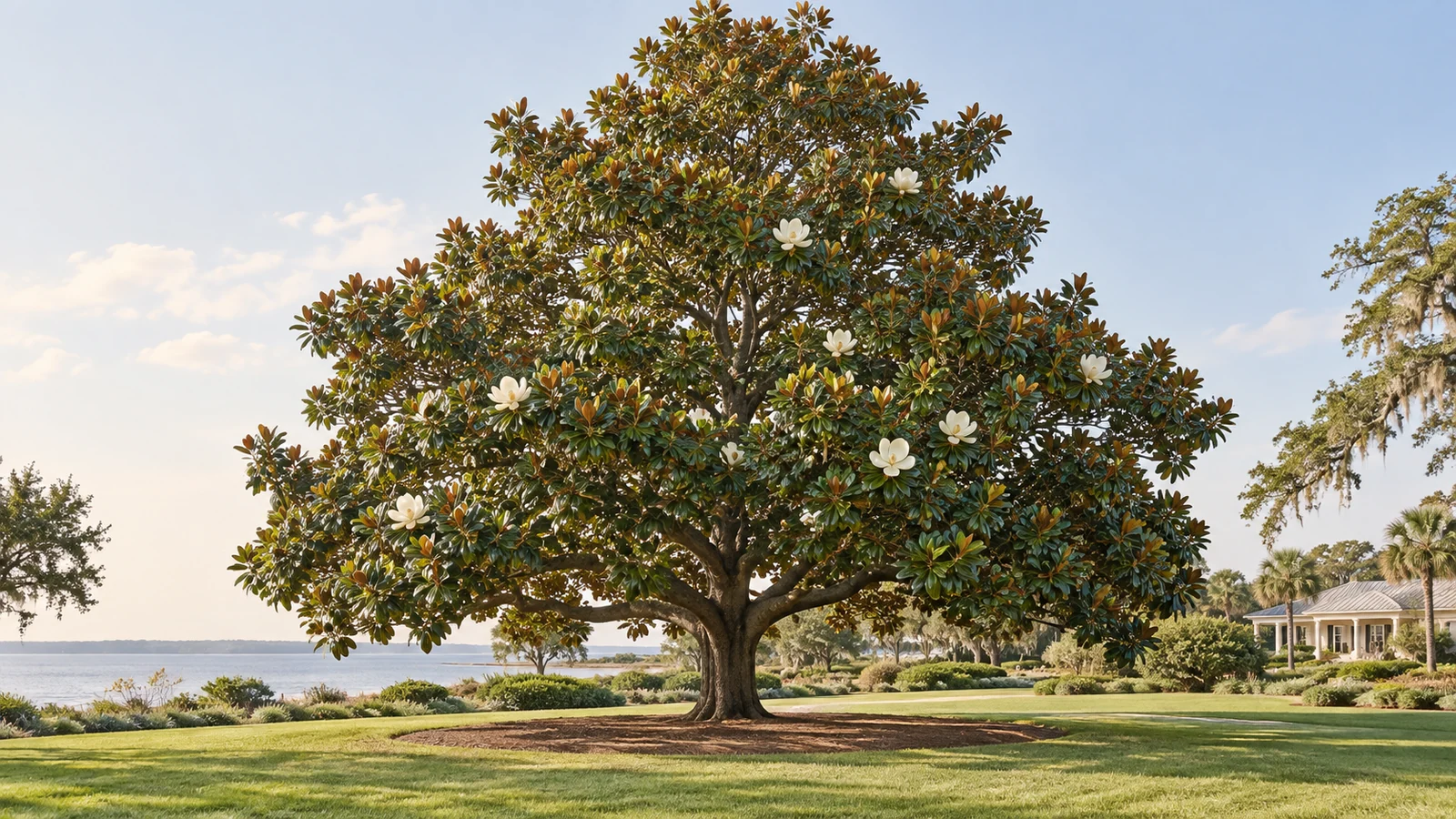
Give a Southern classic the space to become itself.
Southern Magnolia can make a garden feel settled long before the smaller details are chosen. Its substantial green crown provides a strong visual anchor, while creamy flowers bring a quieter seasonal accent. Let one well-placed tree organize the view from the house, with enough open ground for its low branches and future presence.
Before you choose: This is the full-size species, not Little Gem. Plan for a large tree, substantial shade and regular leaf cleanup. Dense low branches and wide-reaching roots make a small bed beside a pool, wall or future addition a poor starting point.
Illustrative planting concept
Size and space
Mature height: 60–80 ft. Mature spread: 30–40 ft.
UF/IFAS lists 60–80 ft high and 30–40 ft wide for the species. Seed-grown trees vary greatly in shape, and older trees can exceed the illustrated range. The canopy circle does not describe the full root system; involve an arborist before planning work around an existing magnolia.
Installed example: 8 ft high × 4 ft wide. This is an illustrative size, not a pot-size or growth-timeline promise.
Full sun to part shade · Moist, well-drained soil; allow a broad root area and provide establishment water · Evergreen foliage · creamy-white spring and summer flowers · leaf and seed-cone drop
Care: Preserve useful lower branches and protect the trunk and broad root area from construction and mowing
Know the whole plant
Illustrative full-size Southern Magnolia with a broad evergreen crown; seedlings and named cultivars differ in form.Illustrative creamy-white flower and leathery leaves with rusty undersides; flower size and leaf backing vary.
Where it works around Pensacola
For a Pensacola property with a generous planting area, consider Southern Magnolia as a lasting focal tree or a tall green backdrop. Think about the entire ground plane beneath it: a natural mulched area is often easier to live with than a tightly clipped lawn that must be maintained under low branches.
A substantial evergreen focal tree
A large garden backdrop
A broad shaded landscape anchor
A natural edge beyond the main lawn
A specimen to preserve during site planning
Can the lower branches stay?
Decide whether you want a full green tree to the ground or a raised canopy. Removing the low branches changes both the appearance and the way fallen leaves are seen.
What belongs under its shade?
Sketch the future shaded area over the whole site plan. Consider how it will affect nearby beds, lawn, windows and the places where you want winter or afternoon sun.
Where will the leaves collect?
Trace the likely cleanup route. A tree can be beautiful from the patio while still being placed far enough away that the patio is practical to maintain.
Could the property change around it?
Include future paving, drainage work and additions now. Give the tree a protected place in the long-term layout instead of assuming its roots will stop at the bed edge.
Before it goes on the plan
Is this the same as Little Gem?
Little Gem is a narrower named cultivar of Southern Magnolia and has its own guide. This page describes the much larger species; nursery labels should identify what you are buying.
Does evergreen mean it never drops leaves?
No. Older leaves are shed as new foliage develops, and flowers and seed cones also fall. Evergreen describes the continuing green canopy, not a cleanup-free tree.
Can every seedling make a dense screen?
No. Seed-grown form varies. If a particular crown shape or density is essential, confirm a named selection and its dimensions before committing the layout.
Pairing ideas
Little Gem Magnolia: Little Gem offers a different width and overall scale. Compare the two as alternatives for the space rather than crowding both into one small bed.
Oakleaf Hydrangea: Oakleaf Hydrangea can bring a separate seasonal layer where light and moisture suit it. Establish the edge outside sensitive roots and allow room for both plants.
{"key":"southernmagnolia","id":"PLT-MAGN-GRANDIFLORA","slug":"southern-magnolia","name":"Southern Magnolia","botanical":"Magnolia grandiflora","h":[60,80],"w":[30,40],"install":[8,4],"treeForm":"pyramidal","color":"#536747","native":true,"type":"trees","categoryLabel":"Trees","reviewDate":"2026-09-08","guideKind":"Native evergreen canopy guide","eyebrow":"LARGE WHITE FLOWERS + LASTING GREEN STRUCTURE","benefit":"Give a Southern classic the space to become itself.","intro":"Southern Magnolia can make a garden feel settled long before the smaller details are chosen. Its substantial green crown provides a strong visual anchor, while creamy flowers bring a quieter seasonal accent. Let one well-placed tree organize the view from the house, with enough open ground for its low branches and future presence.","light":"Full sun to part shade","lightTags":["sun","part"],"water":"Moist, well-drained soil; allow a broad root area and provide establishment water","season":"Evergreen foliage · creamy-white spring and summer flowers · leaf and seed-cone drop","care":"Preserve useful lower branches and protect the trunk and broad root area from construction and mowing","caution":"This is the full-size species, not Little Gem. Plan for a large tree, substantial shade and regular leaf cleanup. Dense low branches and wide-reaching roots make a small bed beside a pool, wall or future addition a poor starting point.","site":"For a Pensacola property with a generous planting area, consider Southern Magnolia as a lasting focal tree or a tall green backdrop. Think about the entire ground plane beneath it: a natural mulched area is often easier to live with than a tightly clipped lawn that must be maintained under low branches.","sizeNote":"UF/IFAS lists 60–80 ft high and 30–40 ft wide for the species. Seed-grown trees vary greatly in shape, and older trees can exceed the illustrated range. The canopy circle does not describe the full root system; involve an arborist before planning work around an existing magnolia.","uses":["A substantial evergreen focal tree","A large garden backdrop","A broad shaded landscape anchor","A natural edge beyond the main lawn","A specimen to preserve during site planning"],"checks":[["Can the lower branches stay?","Decide whether you want a full green tree to the ground or a raised canopy. Removing the low branches changes both the appearance and the way fallen leaves are seen."],["What belongs under its shade?","Sketch the future shaded area over the whole site plan. Consider how it will affect nearby beds, lawn, windows and the places where you want winter or afternoon sun."],["Where will the leaves collect?","Trace the likely cleanup route. A tree can be beautiful from the patio while still being placed far enough away that the patio is practical to maintain."],["Could the property change around it?","Include future paving, drainage work and additions now. Give the tree a protected place in the long-term layout instead of assuming its roots will stop at the bed edge."]],"faq":[["Is this the same as Little Gem?","Little Gem is a narrower named cultivar of Southern Magnolia and has its own guide. This page describes the much larger species; nursery labels should identify what you are buying."],["Does evergreen mean it never drops leaves?","No. Older leaves are shed as new foliage develops, and flowers and seed cones also fall. Evergreen describes the continuing green canopy, not a cleanup-free tree."],["Can every seedling make a dense screen?","No. Seed-grown form varies. If a particular crown shape or density is essential, confirm a named selection and its dimensions before committing the layout."]],"sources":[["UF/IFAS · Southern Magnolia dimensions and landscape care","https://ask.ifas.ufl.edu/publication/ST371"],["UF/IFAS Escambia County · choosing a Southern Magnolia location","https://blogs.ifas.ufl.edu/escambiaco/2025/05/20/video-choosing-the-best-location-for-a-southern-magnolia/"]],"wholeCaption":"Illustrative full-size Southern Magnolia with a broad evergreen crown; seedlings and named cultivars differ in form.","detailCaption":"Illustrative creamy-white flower and leathery leaves with rusty undersides; flower size and leaf backing vary.","aliases":["southern magnolia","bull bay","white flowers","evergreen","large shade"],"goals":["privacy","color"],"images":{"context":{"id":"6aa02556104d5b0342dcca68","url":"https://cdn.prod.website-files.com/6a975baac0f352647862d847/6aa02556104d5b0342dcca68_landova-tree-southernmagnolia-context.webp","alt":"Illustrative planting concept with Southern Magnolia","width":1600,"height":900},"whole":{"id":"6aa0255687f75551d4f714f1","url":"https://cdn.prod.website-files.com/6a975baac0f352647862d847/6aa0255687f75551d4f714f1_landova-tree-southernmagnolia-whole.webp","alt":"Illustrative whole-plant form of Southern Magnolia","width":1254,"height":1254,"fit":"contain"},"detail":{"id":"6aa0255687f75551d4f7154a","url":"https://cdn.prod.website-files.com/6a975baac0f352647862d847/6aa0255687f75551d4f7154a_landova-tree-southernmagnolia-detail.webp","alt":"Illustrative foliage and seasonal detail of Southern Magnolia","width":1122,"height":1402}},"companions":[{"slug":"little-gem-magnolia","name":"Little Gem Magnolia","title":"Compare a narrower magnolia","reason":"Little Gem offers a different width and overall scale. Compare the two as alternatives for the space rather than crowding both into one small bed.","image":{"id":"6aa017101aed9274d5fb17e5","url":"https://cdn.prod.website-files.com/6a975baac0f352647862d847/6aa017101aed9274d5fb17e5_landova-tree-littlegem-context.webp","alt":"Illustrative planting concept with Little Gem Magnolia","width":1600,"height":900}},{"slug":"oakleaf-hydrangea","name":"Oakleaf Hydrangea","title":"Explore a layered garden edge","reason":"Oakleaf Hydrangea can bring a separate seasonal layer where light and moisture suit it. Establish the edge outside sensitive roots and allow room for both plants.","image":{"id":"6a9f5cd62a41d062f4f88b9c","url":"https://cdn.prod.website-files.com/6a975baac0f352647862d847/6a9f5cd62a41d062f4f88b9c_landova-oakleaf-context-r05.webp","alt":"Illustrative planting concept with Oakleaf Hydrangea"}}]}
LANDOVA / PLANTING DECISIONS
Choose plants with the whole space in mind.
Explore a planting goal, then compare the growing needs and mature size of individual plants.
LANDOVA is in beta
Join the launch waitlist.
We are not accepting paying clients yet. We expect to launch around January 2027 and may open sooner. Explore our free tools now, and sign up for launch updates and educational planning emails.
Thank you. Your waitlist signup has been received. We will email you with launch updates. No purchase or project booking has been made.
We could not save your signup. Please try again or email info@landovadesign.com.