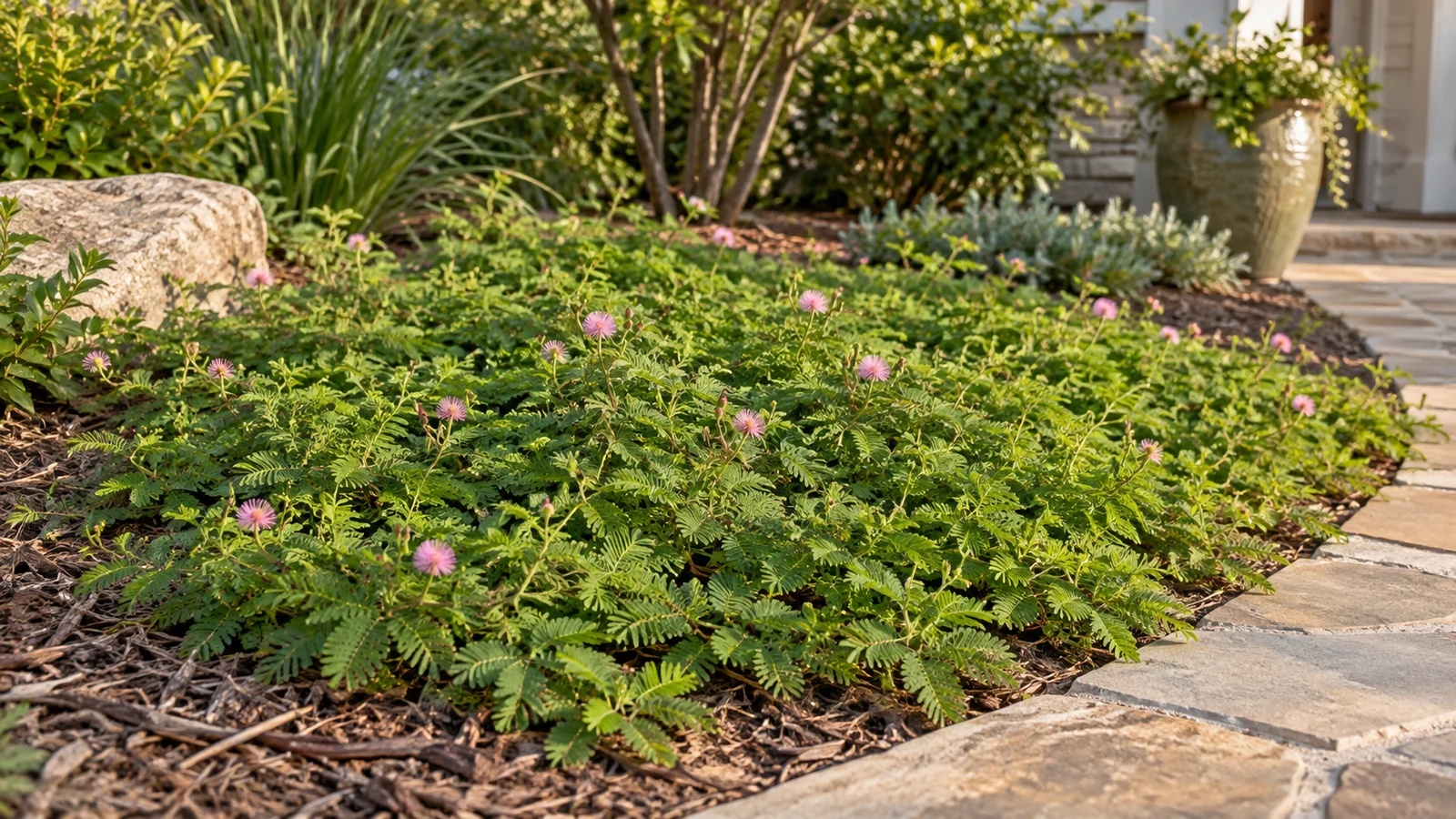
Bring a soft, flowering native layer to sunny ground.
Sunshine Mimosa makes a fine-textured carpet of small leaflets and pink powderpuff flowers. The foliage folds when touched, adding a small moment of interest beside a garden path. It suits a natural-looking planting where a spreading native can occupy its own area and where a perfectly uniform green surface is not the goal.
Before you choose: This is a vigorous spreading plant, not a compact six-inch clump. Expect runners beyond the original planting and a thinner or dormant appearance during cooler weather. Use a path for regular walking; light foot traffic is different from a busy play lawn.
Illustrative planting concept
Size and space
Typical height: 3–6 in. Spreading habit: Spreading colony; keep a managed boundary.
The foliage is typically 3–6 in high. Underground and surface growth can create a colony far beyond the initial plant; FNPS records very extensive spread. The three-foot diagram is an example patch only, never a mature limit or a planting-quantity calculation.
Installed example: 2 in high × 8 in wide. This is an illustrative size, not a pot-size or growth-timeline promise.
Full sun to part shade · Water to establish; adaptable soil with drainage, drought tolerant once rooted · Pink powderpuff flowers from spring into fall; winter thinning or dormancy
Care: Manage runners and bed edges; occasional light mowing is possible
Know the whole plant
Illustrative overall form of Sunshine Mimosa; the nursery plant, season and growing conditions will affect its appearance.Illustrative foliage and seasonal detail of Sunshine Mimosa. Confirm the botanical name on the nursery label.
Where it works around Pensacola
Consider Sunshine Mimosa for a sunny Pensacola bed or an informal area beside a walk. Give it room to knit together while keeping a clear boundary around slower plants. Assess winter appearance before using it across the entire front of a property. Establishment still takes watering and attention to weeds.
A flowering native bed cover
An informal sunny path edge
A pollinator-focused garden patch
A low layer beside ornamental grasses
A lightly used lawn-alternative trial area
Where can it spread?
Choose a visible, reachable boundary and inspect it regularly. Do not tuck fast runners among small plants that need open soil around their crowns.
How much walking happens here?
An occasional step may be acceptable. Put stepping stones or a proper path on the everyday route to the gate, bins or seating.
What happens in winter?
Foliage can thin or disappear in cool weather. Pair the area visually with evergreen structure if the front garden needs year-round definition.
Is this exposed to saltwater?
Native does not mean floodproof. Avoid saltwater inundation and direct salt spray; inland coastal gardens and beachfront beds are different settings.
Before it goes on the plan
Is it the invasive mimosa tree?
No. This guide is for the low native Mimosa strigillosa, also called powderpuff mimosa. It is a different plant from the tree Albizia julibrissin.
Will it replace every lawn?
No. Begin with a suitable, lightly used area. Its spreading habit, flowers and seasonal thinning create a different surface from maintained turf.
Can I mow it?
Occasional mowing can help manage the patch. Set the approach around the desired foliage and flowers; regular close mowing changes its character and does not remove the need to control edges.
Pairing ideas
Pink Muhly Grass: Pink Muhly suits a sunny, draining bed. Keep mimosa runners clear of its crown and reserve the grass’s full spread.
Schilling’s Dwarf Yaupon Holly: Dwarf Yaupon adds taller structure in sun or part shade. Keep its much larger mature footprint and maintenance access clear.
{"key":"mimosa","name":"Sunshine Mimosa","botanical":"Mimosa strigillosa","slug":"sunshine-mimosa","id":"PLT-MIMO-STRI","type":"groundcovers","h":[0.25,0.5],"w":[3,3],"install":[0.2,0.7],"native":true,"groundGroup":"small","light":"Full sun to part shade","lightTags":["sun","part"],"water":"Water to establish; adaptable soil with drainage, drought tolerant once rooted","season":"Pink powderpuff flowers from spring into fall; winter thinning or dormancy","care":"Manage runners and bed edges; occasional light mowing is possible","benefit":"Bring a soft, flowering native layer to sunny ground.","intro":"Sunshine Mimosa makes a fine-textured carpet of small leaflets and pink powderpuff flowers. The foliage folds when touched, adding a small moment of interest beside a garden path. It suits a natural-looking planting where a spreading native can occupy its own area and where a perfectly uniform green surface is not the goal.","caution":"This is a vigorous spreading plant, not a compact six-inch clump. Expect runners beyond the original planting and a thinner or dormant appearance during cooler weather. Use a path for regular walking; light foot traffic is different from a busy play lawn.","sizeNote":"The foliage is typically 3–6 in high. Underground and surface growth can create a colony far beyond the initial plant; FNPS records very extensive spread. The three-foot diagram is an example patch only, never a mature limit or a planting-quantity calculation.","site":"Consider Sunshine Mimosa for a sunny Pensacola bed or an informal area beside a walk. Give it room to knit together while keeping a clear boundary around slower plants. Assess winter appearance before using it across the entire front of a property. Establishment still takes watering and attention to weeds.","uses":["A flowering native bed cover","An informal sunny path edge","A pollinator-focused garden patch","A low layer beside ornamental grasses","A lightly used lawn-alternative trial area"],"checks":[["Where can it spread?","Choose a visible, reachable boundary and inspect it regularly. Do not tuck fast runners among small plants that need open soil around their crowns."],["How much walking happens here?","An occasional step may be acceptable. Put stepping stones or a proper path on the everyday route to the gate, bins or seating."],["What happens in winter?","Foliage can thin or disappear in cool weather. Pair the area visually with evergreen structure if the front garden needs year-round definition."],["Is this exposed to saltwater?","Native does not mean floodproof. Avoid saltwater inundation and direct salt spray; inland coastal gardens and beachfront beds are different settings."]],"faq":[["Is it the invasive mimosa tree?","No. This guide is for the low native Mimosa strigillosa, also called powderpuff mimosa. It is a different plant from the tree Albizia julibrissin."],["Will it replace every lawn?","No. Begin with a suitable, lightly used area. Its spreading habit, flowers and seasonal thinning create a different surface from maintained turf."],["Can I mow it?","Occasional mowing can help manage the patch. Set the approach around the desired foliage and flowers; regular close mowing changes its character and does not remove the need to control edges."]],"sources":[["UF/IFAS: Powderpuff Mimosa","https://gardeningsolutions.ifas.ufl.edu/plants/ornamentals/powderpuff-mimosa/"],["Florida Native Plant Society: Sunshine Mimosa","https://www.fnps.org/plant/mimosa-strigillosa"]],"unit":"in","heightLabel":"Typical height","spreadLabel":"Spreading habit","color":"#70815a","guideKind":"Native groundcover","eyebrow":"THE LOW LAYER / FORM + SEASON","aliases":["Sunshine Mimosa","Mimosa strigillosa","Powderpuff Mimosa"],"goals":["color"],"wholeCaption":"Illustrative overall form of Sunshine Mimosa; the nursery plant, season and growing conditions will affect its appearance.","detailCaption":"Illustrative foliage and seasonal detail of Sunshine Mimosa. Confirm the botanical name on the nursery label.","patch":true,"patchWidth":3,"spreadText":"Spreading colony; keep a managed boundary","sizeBasis":"Patch example","heightText":"3–6 in","sizeSummary":"3–6 in high · spreading colony","groundForm":"mat","images":{"context":{"id":"6aa052e283ad46bebb79ffbb","url":"https://cdn.prod.website-files.com/6a975baac0f352647862d847/6aa052e283ad46bebb79ffbb_landova-groundcover-mimosa-context.webp","alt":"Illustrative planting concept with Sunshine Mimosa","width":1600,"height":900},"whole":{"id":"6aa052e2638be7add470317a","url":"https://cdn.prod.website-files.com/6a975baac0f352647862d847/6aa052e2638be7add470317a_landova-groundcover-mimosa-whole.webp","alt":"Illustrative whole-plant form of Sunshine Mimosa","width":1448,"height":1086,"fit":"contain"},"detail":{"id":"6aa052e2ca5bad632633cc26","url":"https://cdn.prod.website-files.com/6a975baac0f352647862d847/6aa052e2ca5bad632633cc26_landova-groundcover-mimosa-detail.webp","alt":"Illustrative foliage and seasonal detail of Sunshine Mimosa","width":1254,"height":1254}},"companions":[{"slug":"pink-muhly-grass","name":"Pink Muhly Grass","title":"Add an airy upright layer","reason":"Pink Muhly suits a sunny, draining bed. Keep mimosa runners clear of its crown and reserve the grass’s full spread.","image":{"id":"6aa00228430659e428d61061","url":"https://cdn.prod.website-files.com/6a975baac0f352647862d847/6aa00228430659e428d61061_landova-grass-muhly-context.webp","alt":"Illustrative planting concept with Pink Muhly Grass","width":1600,"height":900}},{"slug":"schillings-dwarf-yaupon-holly","name":"Schilling’s Dwarf Yaupon Holly","title":"Give the patch an evergreen anchor","reason":"Dwarf Yaupon adds taller structure in sun or part shade. Keep its much larger mature footprint and maintenance access clear.","image":{"id":"6a9f5cd31fbbc23ce58d34ef","url":"https://cdn.prod.website-files.com/6a975baac0f352647862d847/6a9f5cd31fbbc23ce58d34ef_landova-schilling-context-r05.webp","alt":"Illustrative planting concept with Schilling’s Dwarf Yaupon Holly"}}]}
LANDOVA / PLANTING DECISIONS
Choose plants with the whole space in mind.
Explore a planting goal, then compare the growing needs and mature size of individual plants.
LANDOVA is in beta
Join the launch waitlist.
We are not accepting paying clients yet. We expect to launch around January 2027 and may open sooner. Explore our free tools now, and sign up for launch updates and educational planning emails.
Thank you. Your waitlist signup has been received. We will email you with launch updates. No purchase or project booking has been made.
We could not save your signup. Please try again or email info@landovadesign.com.