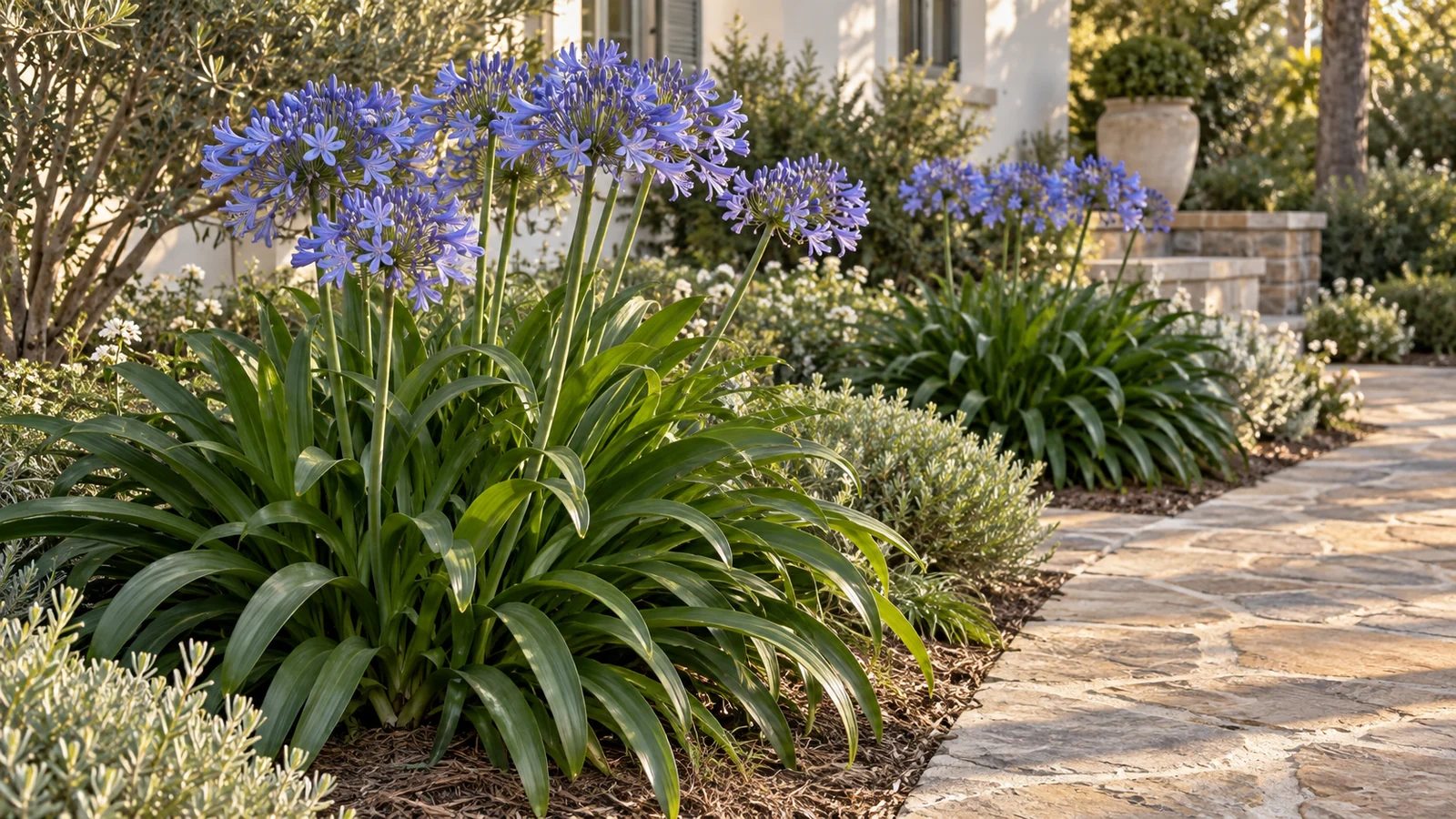
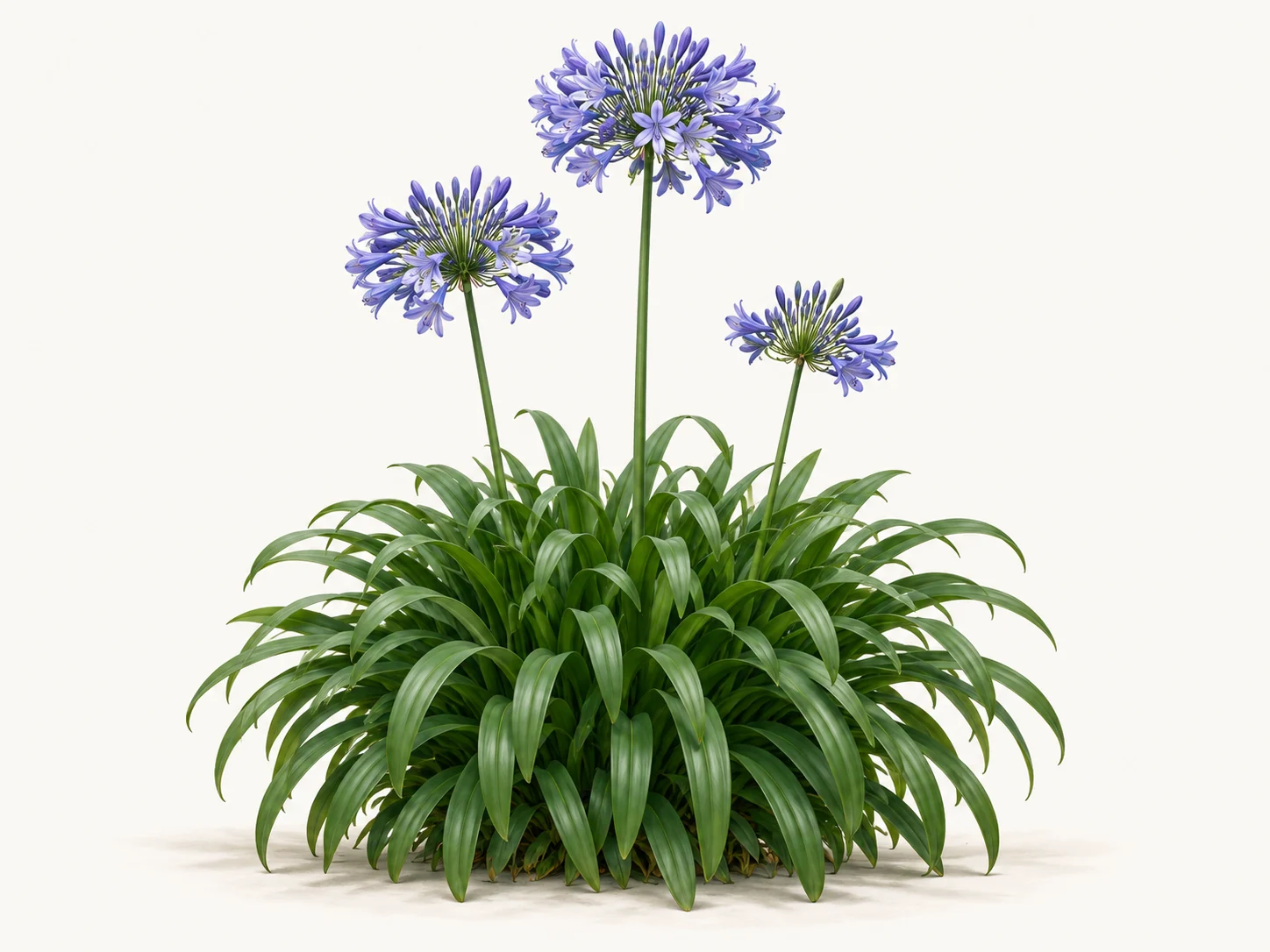
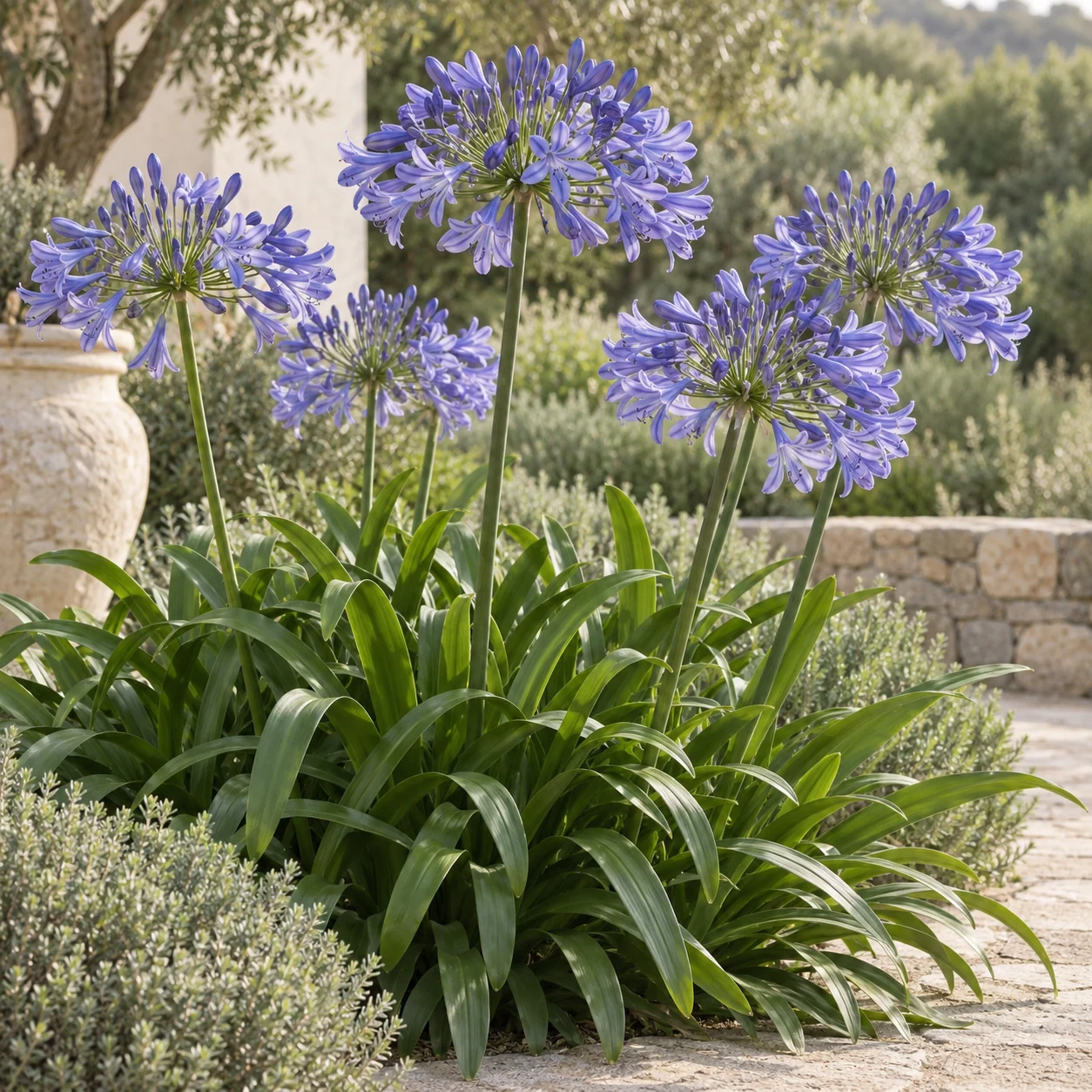
Agapanthus combines a fountain of strap-like leaves with tall, leafless stalks topped by rounded clusters of flowers. Blue and lavender forms can cool the appearance of a sunny border, while white selections create a quieter effect. The illustrations show a representative blue-flowered garden form. Its broad leaf texture makes a useful contrast with fine grasses and small-leafed shrubs.
Before you choose: Choose a named garden selection with suitable local performance. Agapanthus sold under different species names or as dwarf cultivars can vary widely. Pensacola cold may damage foliage or interrupt an evergreen appearance, and humid conditions make disease resistance worth discussing with the grower. Do not assume every blue-flowered pot is the same plant.
Illustrative planting concept
Size and space
Height in flower: 2–4 ft. Typical spread: About 2 ft per plant; clumps expand.
UF/IFAS describes Agapanthus orientalis at 2–4 ft high in flower and up to about 2 ft wide per plant. The diagram uses that individual reference. Established clumps can expand through a larger bed, so two feet is not a permanent boundary. Dwarf cultivars and other agapanthus groups require their own dimensions.
Installed example: 0.5 ft high × 0.5 ft wide. This is an illustrative size, not a pot-size or growth-timeline promise.
Full sun for best flowering; some part shade · Moist, organic, well-drained soil; water through establishment and dry spells · Blue, lavender or white summer flower globes; winter appearance varies with cold
Care: Remove tired stalks and leaves; manage expanding clumps and confirm local cultivar performance
Know the whole plant
Illustrative overall form of Agapanthus. The nursery selection, season and site affect appearance.Illustrative foliage and seasonal detail of Agapanthus; confirm the botanical name and selection on the nursery label.
Where it works around Pensacola
Place Agapanthus in a sunny Pensacola bed with organic matter, useful drainage and room to inspect the crown. Give the flower stalks an open background so their round heads are easy to see. A repeated group can connect an entry and patio, provided each location has suitable conditions. Leave space around the leaves for access rather than using trimming to force a large clump into a narrow strip.
A blue or white summer accent
A repeated flowering clump near an entry
A broad-leaf contrast beside fine foliage
A focal container with drainage
A flowering layer in front of separate evergreen structure
Which agapanthus selection is this?
Record the botanical name, cultivar and expected dimensions. Nursery model names and familiar common names are not enough to establish mature size.
Can the clump broaden without blocking access?
Allow more than the starting plant diameter. Keep paths and nearby crowns clear as the planting fills out.
What does the grower report locally?
Ask about flowering, winter foliage and disease resistance in a humid Gulf Coast setting. A cultivar successful elsewhere may behave differently here.
Will flower stalks clear the view?
The tallest dimension includes blooms above the leaf mound. Check windows and sightlines against flower height as well as foliage height.
Before it goes on the plan
Is every agapanthus two feet tall?
No. UF/IFAS describes common garden plants reaching two to four feet in flower, while dwarf selections and other groups can differ. Use the actual cultivar’s information.
Is the two-foot width a final limit?
No. It is an individual-plant reference. Clumps can expand and need management, so leave flexibility rather than placing them tightly against permanent edges.
Can I choose white flowers instead of blue?
Yes, if the named selection suits the site. Confirm its size, cold response and local performance separately; changing flower color can also mean changing cultivar.
Pairing ideas
Society Garlic: Society Garlic offers smaller lilac umbels and finer leaves. Keep the two clumps separate and check whether its scent suits the area.
African Iris: African Iris creates a different leaf silhouette. Allow room for both and confirm the nursery species.
Schilling’s Dwarf Yaupon Holly: Dwarf Yaupon can frame the seasonal blooms from a separate larger footprint without shading the flower stalks.
{"key":"agapanthus","name":"Agapanthus","botanical":"Agapanthus orientalis","slug":"agapanthus","id":"PLT-AGAP-ORIE","type":"accents","h":[2,4],"w":[2,2],"install":[0.5,0.5],"native":false,"accentGroup":"perennial","accentForm":"strap-bloom","light":"Full sun for best flowering; some part shade","lightTags":["sun","part"],"water":"Moist, organic, well-drained soil; water through establishment and dry spells","season":"Blue, lavender or white summer flower globes; winter appearance varies with cold","care":"Remove tired stalks and leaves; manage expanding clumps and confirm local cultivar performance","benefit":"Lift rounded summer flowers above broad arching leaves.","intro":"Agapanthus combines a fountain of strap-like leaves with tall, leafless stalks topped by rounded clusters of flowers. Blue and lavender forms can cool the appearance of a sunny border, while white selections create a quieter effect. The illustrations show a representative blue-flowered garden form. Its broad leaf texture makes a useful contrast with fine grasses and small-leafed shrubs.","caution":"Choose a named garden selection with suitable local performance. Agapanthus sold under different species names or as dwarf cultivars can vary widely. Pensacola cold may damage foliage or interrupt an evergreen appearance, and humid conditions make disease resistance worth discussing with the grower. Do not assume every blue-flowered pot is the same plant.","sizeNote":"UF/IFAS describes Agapanthus orientalis at 2–4 ft high in flower and up to about 2 ft wide per plant. The diagram uses that individual reference. Established clumps can expand through a larger bed, so two feet is not a permanent boundary. Dwarf cultivars and other agapanthus groups require their own dimensions.","site":"Place Agapanthus in a sunny Pensacola bed with organic matter, useful drainage and room to inspect the crown. Give the flower stalks an open background so their round heads are easy to see. A repeated group can connect an entry and patio, provided each location has suitable conditions. Leave space around the leaves for access rather than using trimming to force a large clump into a narrow strip.","uses":["A blue or white summer accent","A repeated flowering clump near an entry","A broad-leaf contrast beside fine foliage","A focal container with drainage","A flowering layer in front of separate evergreen structure"],"checks":[["Which agapanthus selection is this?","Record the botanical name, cultivar and expected dimensions. Nursery model names and familiar common names are not enough to establish mature size."],["Can the clump broaden without blocking access?","Allow more than the starting plant diameter. Keep paths and nearby crowns clear as the planting fills out."],["What does the grower report locally?","Ask about flowering, winter foliage and disease resistance in a humid Gulf Coast setting. A cultivar successful elsewhere may behave differently here."],["Will flower stalks clear the view?","The tallest dimension includes blooms above the leaf mound. Check windows and sightlines against flower height as well as foliage height."]],"faq":[["Is every agapanthus two feet tall?","No. UF/IFAS describes common garden plants reaching two to four feet in flower, while dwarf selections and other groups can differ. Use the actual cultivar’s information."],["Is the two-foot width a final limit?","No. It is an individual-plant reference. Clumps can expand and need management, so leave flexibility rather than placing them tightly against permanent edges."],["Can I choose white flowers instead of blue?","Yes, if the named selection suits the site. Confirm its size, cold response and local performance separately; changing flower color can also mean changing cultivar."]],"sources":[["UF/IFAS: Agapanthus","https://gardeningsolutions.ifas.ufl.edu/plants/ornamentals/agapanthus/"]],"unit":"ft","heightLabel":"Height in flower","spreadLabel":"Typical spread","heightText":"2–4 ft","spreadText":"About 2 ft per plant; clumps expand","sizeSummary":"2–4 ft in flower · about 2 ft per plant; clumps expand","color":"#70815a","bloomColor":"#8b8fc6","guideKind":"Flowering + accent plant","eyebrow":"FLOWERS + FOLIAGE / FORM + SEASON","aliases":["Agapanthus","Agapanthus orientalis","African Lily","Lily of the Nile"],"goals":["color"],"wholeCaption":"Illustrative overall form of Agapanthus. The nursery selection, season and site affect appearance.","detailCaption":"Illustrative foliage and seasonal detail of Agapanthus; confirm the botanical name and selection on the nursery label.","images":{"context":{"id":"6aa093e181279d0609fe2fb2","url":"https://cdn.prod.website-files.com/6a975baac0f352647862d847/6aa093e181279d0609fe2fb2_landova-accent-agapanthus-context.webp","alt":"Illustrative planting concept with Agapanthus","width":1600,"height":900},"whole":{"id":"6aa093e248fc6fa8103ffa7d","url":"https://cdn.prod.website-files.com/6a975baac0f352647862d847/6aa093e248fc6fa8103ffa7d_landova-accent-agapanthus-whole.webp","alt":"Illustrative whole-plant form of Agapanthus","width":1448,"height":1086,"fit":"contain"},"detail":{"id":"6aa093e262e8d1112249910b","url":"https://cdn.prod.website-files.com/6a975baac0f352647862d847/6aa093e262e8d1112249910b_landova-accent-agapanthus-detail.webp","alt":"Illustrative foliage and seasonal detail of Agapanthus","width":1254,"height":1254}},"companions":[{"slug":"society-garlic","name":"Society Garlic","title":"Echo the flower form at a lighter scale","reason":"Society Garlic offers smaller lilac umbels and finer leaves. Keep the two clumps separate and check whether its scent suits the area.","image":{"id":"6aa093dee788bb371fe2c6d5","url":"https://cdn.prod.website-files.com/6a975baac0f352647862d847/6aa093dee788bb371fe2c6d5_landova-accent-society-context.webp","alt":"Illustrative planting concept with Society Garlic","width":1600,"height":900}},{"slug":"african-iris","name":"African Iris","title":"Combine arching straps with upright fans","reason":"African Iris creates a different leaf silhouette. Allow room for both and confirm the nursery species.","image":{"id":"6aa093df62e8d11122498edb","url":"https://cdn.prod.website-files.com/6a975baac0f352647862d847/6aa093df62e8d11122498edb_landova-accent-iris-context.webp","alt":"Illustrative planting concept with African Iris","width":1600,"height":900}},{"slug":"schillings-dwarf-yaupon-holly","name":"Schilling’s Dwarf Yaupon Holly","title":"Provide a simple evergreen background","reason":"Dwarf Yaupon can frame the seasonal blooms from a separate larger footprint without shading the flower stalks.","image":{"id":"6a9f5cd31fbbc23ce58d34ef","url":"https://cdn.prod.website-files.com/6a975baac0f352647862d847/6a9f5cd31fbbc23ce58d34ef_landova-schilling-context-r05.webp","alt":"Illustrative planting concept with Schilling’s Dwarf Yaupon Holly"}}]}
LANDOVA / PLANTING DECISIONS
Choose plants with the whole space in mind.
Explore a planting goal, then compare the growing needs and mature size of individual plants.
LANDOVA is in beta
Join the launch waitlist.
We are not accepting paying clients yet. We expect to launch around January 2027 and may open sooner. Explore our free tools now, and sign up for launch updates and educational planning emails.
Thank you. Your waitlist signup has been received. We will email you with launch updates. No purchase or project booking has been made.
We could not save your signup. Please try again or email info@landovadesign.com.