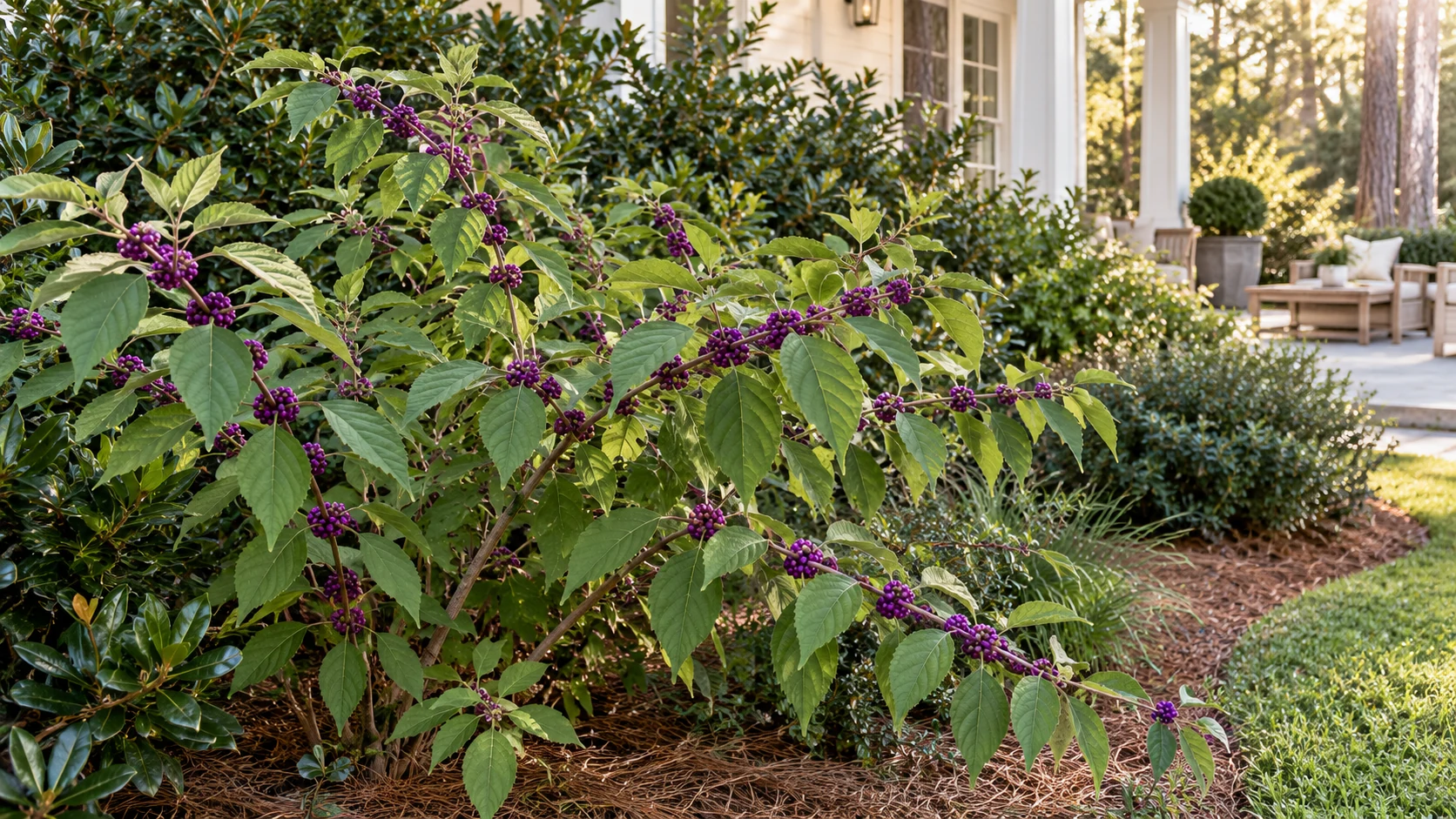
Purple berries strung around arching stems make beautyberry a memorable part of the garden. Its loose shape is most convincing when the design lets it relax, with evergreen structure nearby for the months when its leaves are gone.
Illustrative planting concept
Size and space
Mature range: 3–8 ft high × 4–8 ft wide.
Allow 3–8 ft of height and 4–8 ft of width for the species. Its arching stems create a broad, open outline. A young plant or recently pruned shrub will look much smaller than a full growing-season specimen.
Compare with a six-foot person: installed example 2 ft high by 2 ft wide. This example is not a fixed pot size or a growth timeline.
Sun to part shade · Water to establish; adaptable once rooted · Deciduous · purple berries in late summer and fall
Where it works around Pensacola
A locally familiar native for sheltered Pensacola gardens, especially informal borders and woodland edges. Place it where you can enjoy the seasonal fruit without putting sprawling branches or cleanup into the busiest outdoor spaces.
A seasonal focal point
An informal native border
A woodland-edge planting
A wildlife garden
A colorful layer in front of an evergreen screen
Let the branches belong
Make the bed deep enough for a natural arch. If every stem has to be cut back from a walkway, the chosen position is fighting the plant’s best feature.
Design the winter view too
Beautyberry loses its leaves. Keep another layer in the plan where year-round privacy, a finished porch view or screening of equipment matters.
Choose a good place for wildlife
Keep fruiting branches and seasonal litter away from pool edges and narrow paths. Place the display where birds can visit without adding cleanup to your main lounging area.
Leave future work accessible
A loose planting bed can hide irrigation valves and utility access over time. Reserve those service routes before filling the open spaces with more shrubs.
Before it goes on the plan
Will the berries be there all year?
No. The purple display is seasonal and wildlife may remove fruit. Use it as one chapter of the garden rather than the only source of color.
Can it be my only privacy screen?
It is better treated as an informal seasonal layer because it loses its leaves. Pair it with a correctly spaced evergreen if winter screening is important.
How much shaping does it need?
Let it keep a relaxed form. Renewal pruning can be done during dormancy because flowers and fruit develop on new growth; routine tight shearing works against its character.
Pairing ideas
Pride of Houston Yaupon Holly: Pride of Houston yaupon can anchor the winter view behind beautyberry. Give this much larger holly its own mature canopy space.
Schilling’s Dwarf Yaupon Holly: Schilling’s Dwarf adds a calmer evergreen outline nearby. Keep the two mature footprints distinct so beautyberry can arch freely.
{"key":"beauty","id":"PLT-CALL-AMERICANA","slug":"american-beautyberry","name":"American Beautyberry","botanical":"Callicarpa americana","eyebrow":"A native seasonal highlight","benefit":"Give autumn something worth noticing.","intro":"Purple berries strung around arching stems make beautyberry a memorable part of the garden. Its loose shape is most convincing when the design lets it relax, with evergreen structure nearby for the months when its leaves are gone.","h":[3,8],"w":[4,8],"install":[2,2],"color":"#648146","habit":"round","light":"Sun to part shade","lightTags":["sun","part"],"water":"Water to establish; adaptable once rooted","season":"Deciduous · purple berries in late summer and fall","care":"Occasional renewal pruning; watch for seedlings","site":"A locally familiar native for sheltered Pensacola gardens, especially informal borders and woodland edges. Place it where you can enjoy the seasonal fruit without putting sprawling branches or cleanup into the busiest outdoor spaces.","sizeNote":"Allow 3–8 ft of height and 4–8 ft of width for the species. Its arching stems create a broad, open outline. A young plant or recently pruned shrub will look much smaller than a full growing-season specimen.","uses":["A seasonal focal point","An informal native border","A woodland-edge planting","A wildlife garden","A colorful layer in front of an evergreen screen"],"checks":[["Let the branches belong","Make the bed deep enough for a natural arch. If every stem has to be cut back from a walkway, the chosen position is fighting the plant’s best feature."],["Design the winter view too","Beautyberry loses its leaves. Keep another layer in the plan where year-round privacy, a finished porch view or screening of equipment matters."],["Choose a good place for wildlife","Keep fruiting branches and seasonal litter away from pool edges and narrow paths. Place the display where birds can visit without adding cleanup to your main lounging area."],["Leave future work accessible","A loose planting bed can hide irrigation valves and utility access over time. Reserve those service routes before filling the open spaces with more shrubs."]],"faq":[["Will the berries be there all year?","No. The purple display is seasonal and wildlife may remove fruit. Use it as one chapter of the garden rather than the only source of color."],["Can it be my only privacy screen?","It is better treated as an informal seasonal layer because it loses its leaves. Pair it with a correctly spaced evergreen if winter screening is important."],["How much shaping does it need?","Let it keep a relaxed form. Renewal pruning can be done during dormancy because flowers and fruit develop on new growth; routine tight shearing works against its character."]],"sources":[["Species size + seasonal care · UF/IFAS","https://ask.ifas.ufl.edu/publication/FP090"],["Local plant context · UF/IFAS Escambia","https://blogs.ifas.ufl.edu/escambiaco/2020/08/19/weekly-what-is-it-american-beautyberry/"]],"companions":[{"slug":"yaupon-holly-pride-of-houston","name":"Pride of Houston Yaupon Holly","title":"A permanent green backdrop","reason":"Pride of Houston yaupon can anchor the winter view behind beautyberry. Give this much larger holly its own mature canopy space.","image":{"id":"6a9f29174f259866ad352562","url":"https://cdn.prod.website-files.com/6a975baac0f352647862d847/6a9f29174f259866ad352562_landova-shrub-yaupon-context.webp","alt":"Illustrative planting concept with Pride of Houston Yaupon Holly"}},{"slug":"schillings-dwarf-yaupon-holly","name":"Schilling’s Dwarf Yaupon Holly","title":"A lower green contrast","reason":"Schilling’s Dwarf adds a calmer evergreen outline nearby. Keep the two mature footprints distinct so beautyberry can arch freely.","image":{"id":"6a9f5cd31fbbc23ce58d34ef","url":"https://cdn.prod.website-files.com/6a975baac0f352647862d847/6a9f5cd31fbbc23ce58d34ef_landova-schilling-context-r05.webp","alt":"Illustrative planting concept with Schilling’s Dwarf Yaupon Holly"}}],"wholeFit":"contain","wholeCaption":"Illustrative whole-plant study. Use the measured comparison for installed and mature size.","detailCaption":"Illustrative foliage and seasonal detail; appearance varies by season and growing conditions.","native":true,"guideKind":"Native species guide","images":{"context":{"id":"6a9f5cd67400c99880f6f542","url":"https://cdn.prod.website-files.com/6a975baac0f352647862d847/6a9f5cd67400c99880f6f542_landova-beauty-context-r05.webp","alt":"Illustrative planting concept with American Beautyberry"},"whole":{"id":"6a9f5cd6d04082dbc5fdc98f","url":"https://cdn.prod.website-files.com/6a975baac0f352647862d847/6a9f5cd6d04082dbc5fdc98f_landova-beauty-whole-r05.webp","alt":"Illustrative view of American Beautyberry overall form","fit":"contain"},"detail":{"id":"6a9f5cd6de5d336681c9e7ab","url":"https://cdn.prod.website-files.com/6a975baac0f352647862d847/6a9f5cd6de5d336681c9e7ab_landova-beauty-detail-r05.webp","alt":"Illustrative view of American Beautyberry foliage and seasonal detail"}},"caution":"Arching branches need room. Winter leaf loss and seasonal fruit belong in the placement decision."}
LANDOVA / PLANTING DECISIONS
Choose plants with the whole space in mind.
Explore a planting goal, then compare the growing needs and mature size of individual plants.
LANDOVA is in beta
Join the launch waitlist.
We are not accepting paying clients yet. We expect to launch around January 2027 and may open sooner. Explore our free tools now, and sign up for launch updates and educational planning emails.
Thank you. Your waitlist signup has been received. We will email you with launch updates. No purchase or project booking has been made.
We could not save your signup. Please try again or email info@landovadesign.com.