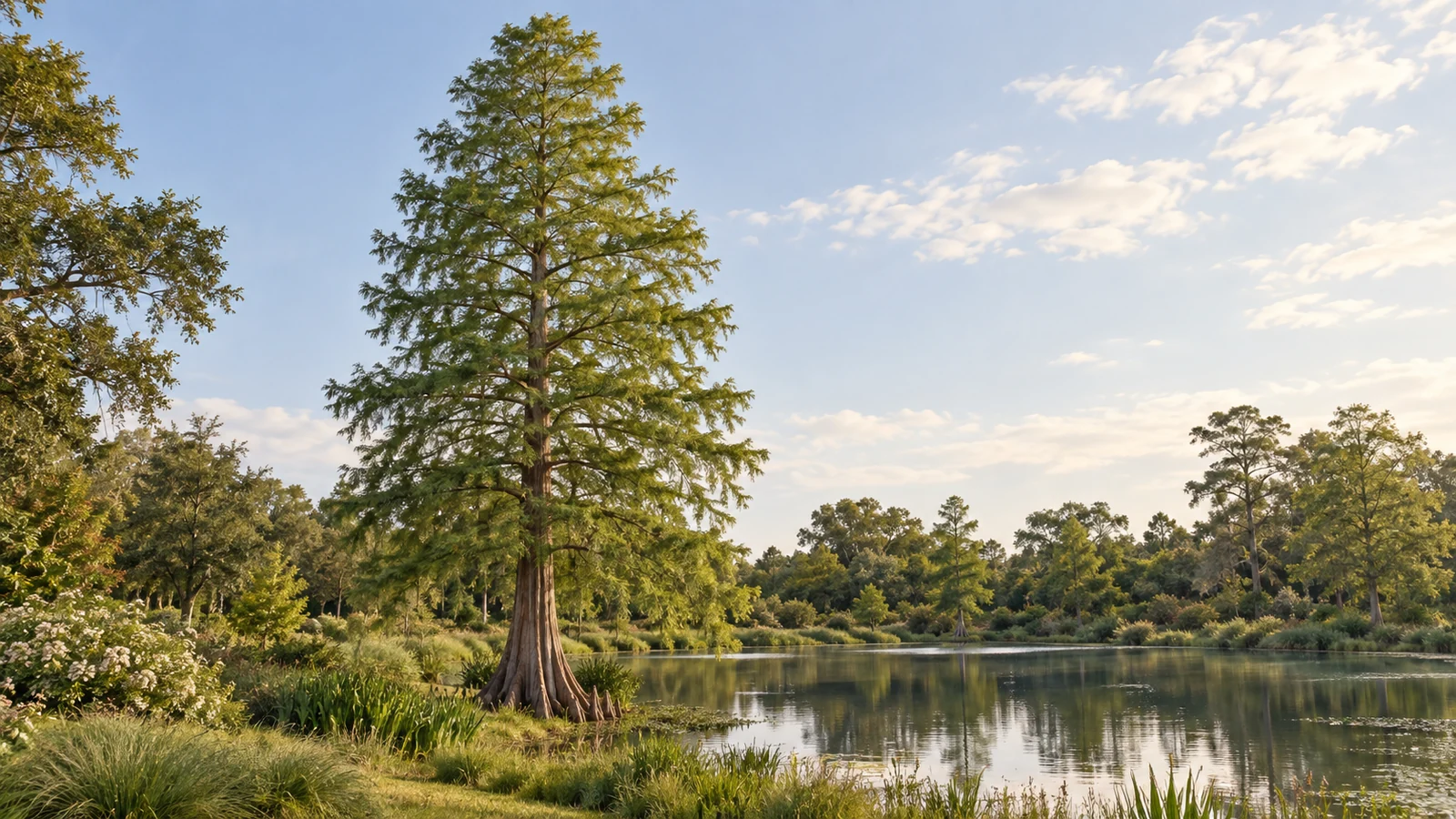
Bring a tall, soft outline to a generous landscape.
Bald Cypress combines a clear upright trunk with fine green foliage that feels lighter than a dense broad-leaved canopy. It can give a spacious landscape a strong vertical feature, especially where a freshwater setting belongs in the plan. Its seasonal change is part of the appeal: this conifer loses its foliage rather than staying green all winter.
Before you choose: This is a large tree, not a fix for a drainage problem. Root knees can appear, especially in wet settings. Keep routes, lawn use, utilities and freshwater versus saltwater conditions in the placement decision.
Illustrative planting concept
Size and space
Mature height: 60–80 ft. Mature spread: 25–35 ft.
The UF/IFAS landscape guide lists 60–80 ft high and 25–35 ft wide. Older trees can exceed 100 ft and develop a broader top, so these dimensions are a planning range rather than a lifetime limit. Knees and roots are not represented by the canopy circle.
Installed example: 8 ft high × 3 ft wide. This is an illustrative size, not a pot-size or growth-timeline promise.
Full sun to part shade · Adaptable from moist, well-drained soil to freshwater wet sites; assess soil and drainage · Feathery green summer foliage · copper fall tones · bare winter branches
Care: Protect the root area and guide young structure; account for knees and seasonal foliage drop
Know the whole plant
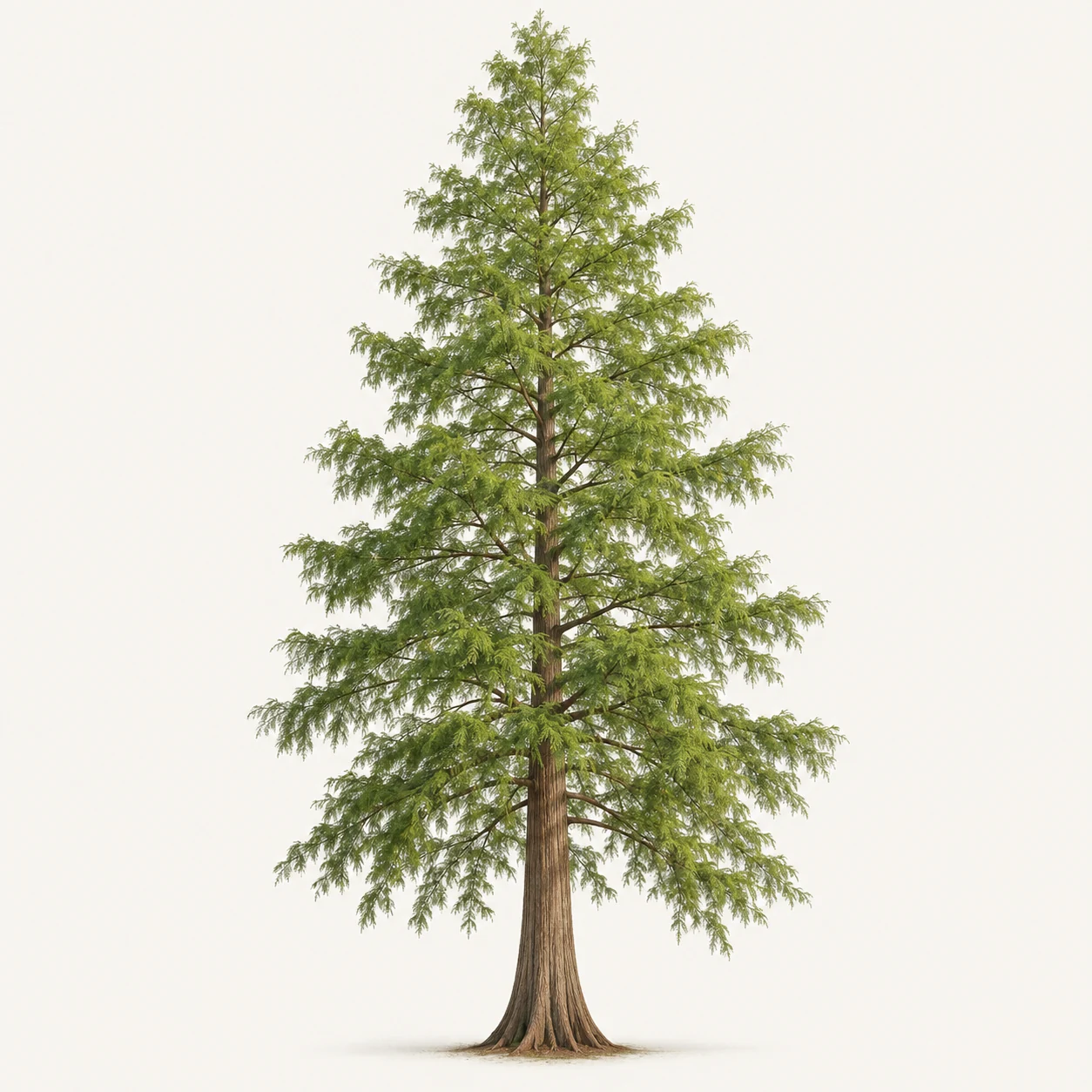
Illustrative green summer form with a tall trunk and feathery crown; winter foliage loss is normal.Illustrative flat feathery branchlets and small round cones, distinct from pine needles.
Where it works around Pensacola
A broad Pensacola garden or a thoughtfully planned freshwater margin may suit Bald Cypress. Begin with the moisture pattern and the long-term height, then place outdoor rooms and access around the tree. Avoid assuming that a wet-tolerant species makes every flooded or salty location suitable.
A vertical feature on a large property
A freshwater garden margin
Light-textured seasonal shade
A native tree in a planned moist landscape
Copper fall interest with winter branching
Is the water freshwater and understood?
Identify runoff, normal soil moisture and any saltwater exposure before selecting the tree. Water tolerance is one plant trait; it does not replace drainage planning.
Will knees conflict with the way the space is used?
Wet sites can produce root projections. Allow room around routes, mowing areas and garden edges so a mature tree can coexist with everyday use.
Does the winter view still work?
Bald Cypress drops its foliage. If a view needs dependable winter screening, provide an appropriate evergreen layer elsewhere in the composition.
Is there room for the older tree?
Keep tall future growth and a widening trunk in the plan. Evaluate overhead constraints and access for maintenance before planting near permanent structures.
Before it goes on the plan
Is Bald Cypress evergreen?
No. It is a deciduous conifer, turning warm tones and dropping its soft foliage seasonally. Bare branches in winter are part of its normal character.
Does it have to stand in water?
No. UF/IFAS describes use in moist and drier landscape settings as well as wet sites. Match soil, establishment water and long-term conditions to the tree.
Will it always make knees?
Knees are more associated with wet settings and are less common on drier sites. Do not promise that a particular planting will never develop them.
Pairing ideas
Dwarf Fakahatchee Grass: Dwarf Fakahatchee can provide a lower native layer where light and moisture are compatible. Reserve its own mature space outside access routes.
Soft Rush: Soft Rush can echo the vertical form in a freshwater planting. Plan moisture and spreading room before combining the two.
{"key":"baldcypress","id":"PLT-TAXO-DISTICHUM","slug":"bald-cypress","name":"Bald Cypress","botanical":"Taxodium distichum","h":[60,80],"w":[25,35],"install":[8,3],"treeForm":"pyramidal","color":"#7e9069","native":true,"type":"trees","categoryLabel":"Trees","reviewDate":"2026-09-08","guideKind":"Native deciduous conifer guide","eyebrow":"FEATHERY SHADE + STRONG VERTICAL FORM","benefit":"Bring a tall, soft outline to a generous landscape.","intro":"Bald Cypress combines a clear upright trunk with fine green foliage that feels lighter than a dense broad-leaved canopy. It can give a spacious landscape a strong vertical feature, especially where a freshwater setting belongs in the plan. Its seasonal change is part of the appeal: this conifer loses its foliage rather than staying green all winter.","light":"Full sun to part shade","lightTags":["sun","part"],"water":"Adaptable from moist, well-drained soil to freshwater wet sites; assess soil and drainage","season":"Feathery green summer foliage · copper fall tones · bare winter branches","care":"Protect the root area and guide young structure; account for knees and seasonal foliage drop","caution":"This is a large tree, not a fix for a drainage problem. Root knees can appear, especially in wet settings. Keep routes, lawn use, utilities and freshwater versus saltwater conditions in the placement decision.","site":"A broad Pensacola garden or a thoughtfully planned freshwater margin may suit Bald Cypress. Begin with the moisture pattern and the long-term height, then place outdoor rooms and access around the tree. Avoid assuming that a wet-tolerant species makes every flooded or salty location suitable.","sizeNote":"The UF/IFAS landscape guide lists 60–80 ft high and 25–35 ft wide. Older trees can exceed 100 ft and develop a broader top, so these dimensions are a planning range rather than a lifetime limit. Knees and roots are not represented by the canopy circle.","uses":["A vertical feature on a large property","A freshwater garden margin","Light-textured seasonal shade","A native tree in a planned moist landscape","Copper fall interest with winter branching"],"checks":[["Is the water freshwater and understood?","Identify runoff, normal soil moisture and any saltwater exposure before selecting the tree. Water tolerance is one plant trait; it does not replace drainage planning."],["Will knees conflict with the way the space is used?","Wet sites can produce root projections. Allow room around routes, mowing areas and garden edges so a mature tree can coexist with everyday use."],["Does the winter view still work?","Bald Cypress drops its foliage. If a view needs dependable winter screening, provide an appropriate evergreen layer elsewhere in the composition."],["Is there room for the older tree?","Keep tall future growth and a widening trunk in the plan. Evaluate overhead constraints and access for maintenance before planting near permanent structures."]],"faq":[["Is Bald Cypress evergreen?","No. It is a deciduous conifer, turning warm tones and dropping its soft foliage seasonally. Bare branches in winter are part of its normal character."],["Does it have to stand in water?","No. UF/IFAS describes use in moist and drier landscape settings as well as wet sites. Match soil, establishment water and long-term conditions to the tree."],["Will it always make knees?","Knees are more associated with wet settings and are less common on drier sites. Do not promise that a particular planting will never develop them."]],"sources":[["UF/IFAS · Baldcypress dimensions and site conditions","https://ask.ifas.ufl.edu/publication/ST620"],["NC State Extension · Bald Cypress character and growth","https://plants.ces.ncsu.edu/plants/taxodium-distichum/"],["UF/IFAS · North Florida tree-selection context","https://edis.ifas.ufl.edu/publication/EP451"]],"wholeCaption":"Illustrative green summer form with a tall trunk and feathery crown; winter foliage loss is normal.","detailCaption":"Illustrative flat feathery branchlets and small round cones, distinct from pine needles.","aliases":["bald cypress","baldcypress","Taxodium","cypress","native","wet soil","fall color"],"goals":["color"],"images":{"context":{"id":"6aa017134b9a34a04dc63b0e","url":"https://cdn.prod.website-files.com/6a975baac0f352647862d847/6aa017134b9a34a04dc63b0e_landova-tree-baldcypress-context.webp","alt":"Illustrative planting concept with Bald Cypress","width":1600,"height":900},"whole":{"id":"6aa0171356131552997866aa","url":"https://cdn.prod.website-files.com/6a975baac0f352647862d847/6aa0171356131552997866aa_landova-tree-baldcypress-whole.webp","alt":"Illustrative whole-plant form of Bald Cypress","width":1254,"height":1254,"fit":"contain"},"detail":{"id":"6aa01713dd068929e154fc27","url":"https://cdn.prod.website-files.com/6a975baac0f352647862d847/6aa01713dd068929e154fc27_landova-tree-baldcypress-detail.webp","alt":"Illustrative foliage and seasonal detail of Bald Cypress","width":1122,"height":1402}},"companions":[{"slug":"dwarf-fakahatchee-grass","name":"Dwarf Fakahatchee Grass","title":"Repeat the softer texture below","reason":"Dwarf Fakahatchee can provide a lower native layer where light and moisture are compatible. Reserve its own mature space outside access routes.","image":{"id":"6aa002296f67b3d818b2c1dc","url":"https://cdn.prod.website-files.com/6a975baac0f352647862d847/6aa002296f67b3d818b2c1dc_landova-grass-fakahatchee-context.webp","alt":"Illustrative planting concept with Dwarf Fakahatchee Grass","width":1600,"height":900}},{"slug":"soft-rush","name":"Soft Rush","title":"Add upright stems at a moist garden edge","reason":"Soft Rush can echo the vertical form in a freshwater planting. Plan moisture and spreading room before combining the two.","image":{"id":"6aa00d1713cf571cf7f1bdb3","url":"https://cdn.prod.website-files.com/6a975baac0f352647862d847/6aa00d1713cf571cf7f1bdb3_landova-grass-softrush-context.webp","alt":"Illustrative planting concept with Soft Rush","width":1600,"height":900}}]}
LANDOVA / PLANTING DECISIONS
Choose plants with the whole space in mind.
Explore a planting goal, then compare the growing needs and mature size of individual plants.
LANDOVA is in beta
Join the launch waitlist.
We are not accepting paying clients yet. We expect to launch around January 2027 and may open sooner. Explore our free tools now, and sign up for launch updates and educational planning emails.
Thank you. Your waitlist signup has been received. We will email you with launch updates. No purchase or project booking has been made.
We could not save your signup. Please try again or email info@landovadesign.com.