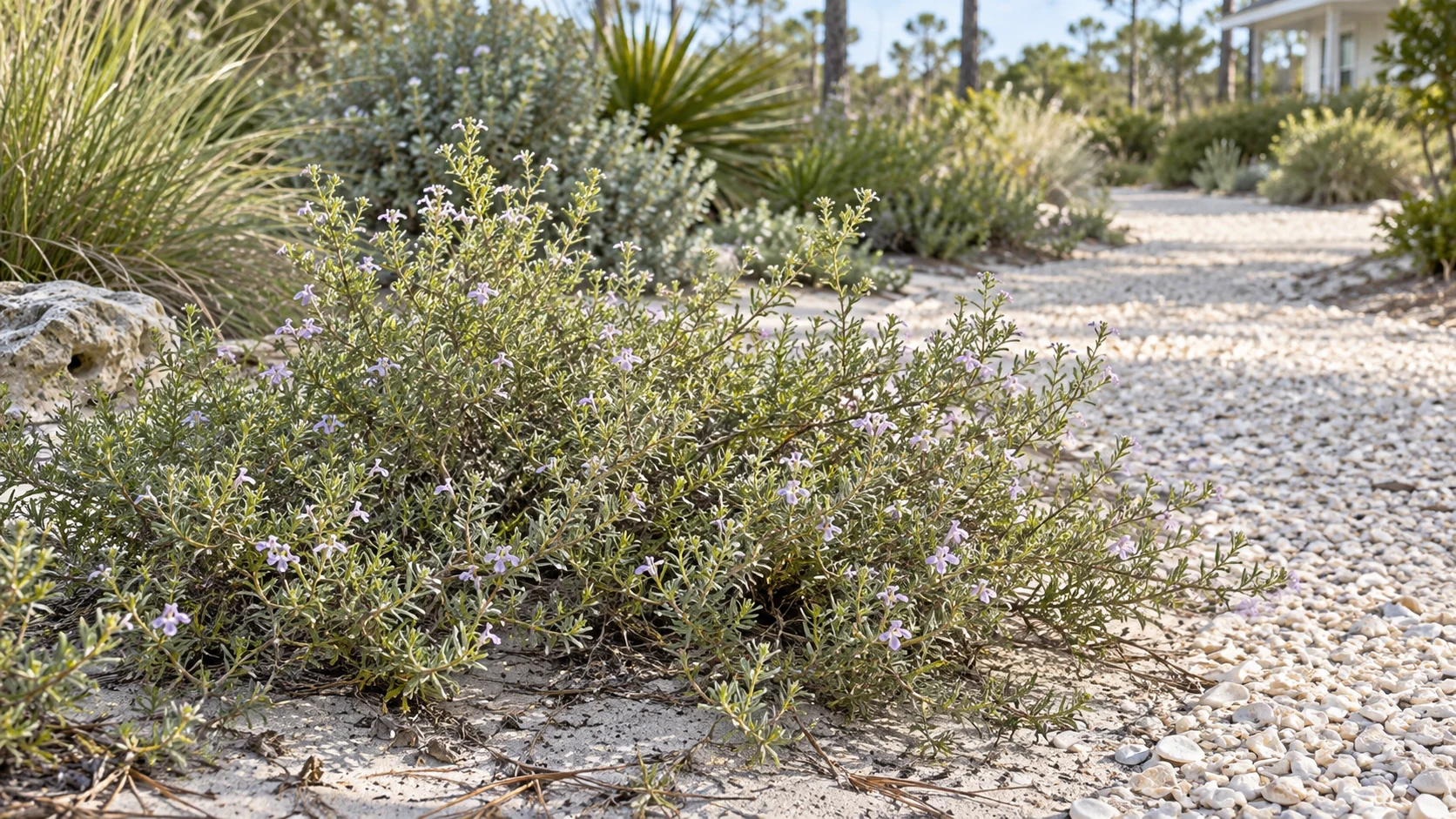
Soft gray-green foliage and small lavender flowers bring detail to a sunny, sandy garden. This native shrub works best when the design respects its dry setting rather than treating every bed as part of the same irrigation zone.
Illustrative planting concept
Size and space
Mature range: 2–3 ft high × 2–3 ft wide.
Plan for 2–3 ft high and wide. The open, spreading form is part of its character. The installed 1 × 1 ft example illustrates an early planting size, not a standard pot or a promised growth rate.
Compare with a six-foot person: installed example 1 ft high by 1 ft wide. This example is not a fixed pot size or a growth timeline.
Full sun · Freely draining sand; water to establish, then avoid routine overwatering. · Evergreen fine foliage; lavender flowers mainly in spring, with a variable extended season.
Where it works around Pensacola
Conradina canescens belongs to the northern Gulf Coast’s sandy landscapes. Use it in an open, sunny Pensacola-area bed. FNPS allows some salty wind but excludes direct spray and saltwater flooding; a coastal name does not make it a front-line beach barrier.
Sunny sandy border
Fine foliage contrast
Low native planting
Dry garden accent
Pollinator garden edge
Does this bed share lawn sprinklers?
Check where irrigation actually lands. Place a dry-bed shrub where it can be watered separately from thirsty planting and turf.
Where will shade develop?
Mark the mature canopy of nearby trees and shrubs. A sunny spot at installation may become a shaded corner as the rest of the landscape grows.
Will the edge still feel generous?
Set the shrub far enough back that its eventual spread belongs in the bed. Preserve the walking width instead of planning to trim away the plant’s natural form.
Is the sand truly free draining?
Check conditions after rain and beneath the surface. A sandy top layer over compacted fill does not establish that the whole root area drains well.
Before it goes on the plan
Is it culinary rosemary?
No. This guide covers Conradina canescens, a native ornamental shrub. Do not substitute it for kitchen rosemary.
Can it grow beside moisture-loving shrubs?
They may share a garden, but use separate planting positions and water management. The wettest part of the bed belongs to a different selection.
Should it look like a dense lavender hedge?
No. Expect an airy woody mound with tiny flowers among the foliage, rather than tall flower spikes or a tightly clipped solid block.
Pairing ideas
Atlantic St. John’s Wort: Atlantic St. John’s Wort adds yellow flowers to another sunny, freely draining position. Leave both plants their own mature space.
Pineapple Guava: Pineapple Guava can provide a distant evergreen backdrop. Keep the rosemary outside its future shade and wetter root-zone care.
{"key":"rosemary","id":"PLT-CONR-CANESCENS","slug":"coastal-false-rosemary","name":"Coastal False Rosemary","botanical":"Conradina canescens","eyebrow":"Fine texture for an open sandy bed","benefit":"Make a dry corner feel intentional.","intro":"Soft gray-green foliage and small lavender flowers bring detail to a sunny, sandy garden. This native shrub works best when the design respects its dry setting rather than treating every bed as part of the same irrigation zone.","h":[2,3],"w":[2,3],"install":[1,1],"color":"#8c998b","habit":"round","light":"Full sun","lightTags":["sun"],"water":"Freely draining sand; water to establish, then avoid routine overwatering.","season":"Evergreen fine foliage; lavender flowers mainly in spring, with a variable extended season.","care":"Keep the setting open and drainage sharp; avoid crowding by larger plants.","site":"Conradina canescens belongs to the northern Gulf Coast’s sandy landscapes. Use it in an open, sunny Pensacola-area bed. FNPS allows some salty wind but excludes direct spray and saltwater flooding; a coastal name does not make it a front-line beach barrier.","sizeNote":"Plan for 2–3 ft high and wide. The open, spreading form is part of its character. The installed 1 × 1 ft example illustrates an early planting size, not a standard pot or a promised growth rate.","uses":["Sunny sandy border","Fine foliage contrast","Low native planting","Dry garden accent","Pollinator garden edge"],"checks":[["Does this bed share lawn sprinklers?","Check where irrigation actually lands. Place a dry-bed shrub where it can be watered separately from thirsty planting and turf."],["Where will shade develop?","Mark the mature canopy of nearby trees and shrubs. A sunny spot at installation may become a shaded corner as the rest of the landscape grows."],["Will the edge still feel generous?","Set the shrub far enough back that its eventual spread belongs in the bed. Preserve the walking width instead of planning to trim away the plant’s natural form."],["Is the sand truly free draining?","Check conditions after rain and beneath the surface. A sandy top layer over compacted fill does not establish that the whole root area drains well."]],"faq":[["Is it culinary rosemary?","No. This guide covers Conradina canescens, a native ornamental shrub. Do not substitute it for kitchen rosemary."],["Can it grow beside moisture-loving shrubs?","They may share a garden, but use separate planting positions and water management. The wettest part of the bed belongs to a different selection."],["Should it look like a dense lavender hedge?","No. Expect an airy woody mound with tiny flowers among the foliage, rather than tall flower spikes or a tightly clipped solid block."]],"sources":[["Florida Native Plant Society","https://www.fnps.org/plant/conradina-canescens"],["UF/IFAS False Rosemary","https://ask.ifas.ufl.edu/publication/SG167"]],"companions":[{"slug":"atlantic-st-johns-wort","name":"Atlantic St. John’s Wort","title":"Repeat the low native layer","reason":"Atlantic St. John’s Wort adds yellow flowers to another sunny, freely draining position. Leave both plants their own mature space.","image":{"id":"6a9fefd33c7f566bd6ccb150","url":"https://cdn.prod.website-files.com/6a975baac0f352647862d847/6a9fefd33c7f566bd6ccb150_landova-hypericum-context-r07.webp","alt":"Illustrative planting concept with Atlantic St. John’s Wort"}},{"slug":"pineapple-guava","name":"Pineapple Guava","title":"Build a taller backdrop","reason":"Pineapple Guava can provide a distant evergreen backdrop. Keep the rosemary outside its future shade and wetter root-zone care.","image":{"id":"6a9fefd103e01d08cca8eeb2","url":"https://cdn.prod.website-files.com/6a975baac0f352647862d847/6a9fefd103e01d08cca8eeb2_landova-guava-context-r07.webp","alt":"Illustrative planting concept with Pineapple Guava"}}],"wholeCaption":"Illustrative open, spreading shrub form; foliage remains the main visual texture.","detailCaption":"Illustrative tiny lavender two-lipped flowers and narrow gray-green leaves.","wholeFit":"contain","native":true,"guideKind":"Native species guide","aliases":["false rosemary","beach rosemary"],"images":{"context":{"id":"6a9fefd2b5d71773d64bf03b","url":"https://cdn.prod.website-files.com/6a975baac0f352647862d847/6a9fefd2b5d71773d64bf03b_landova-rosemary-context-r07.webp","alt":"Illustrative planting concept with Coastal False Rosemary"},"whole":{"id":"6a9fefd2a13f2e13b48030bb","url":"https://cdn.prod.website-files.com/6a975baac0f352647862d847/6a9fefd2a13f2e13b48030bb_landova-rosemary-whole-r07.webp","alt":"Illustrative view of Coastal False Rosemary overall form","fit":"contain"},"detail":{"id":"6a9fefd33c7f566bd6ccb126","url":"https://cdn.prod.website-files.com/6a975baac0f352647862d847/6a9fefd33c7f566bd6ccb126_landova-rosemary-detail-r07.webp","alt":"Illustrative view of Coastal False Rosemary foliage and seasonal detail"}},"caution":"Needs sun and freely draining sand. Keep it out of direct salt spray and wet irrigation zones."}
LANDOVA / PLANTING DECISIONS
Choose plants with the whole space in mind.
Explore a planting goal, then compare the growing needs and mature size of individual plants.
LANDOVA is in beta
Join the launch waitlist.
We are not accepting paying clients yet. We expect to launch around January 2027 and may open sooner. Explore our free tools now, and sign up for launch updates and educational planning emails.
Thank you. Your waitlist signup has been received. We will email you with launch updates. No purchase or project booking has been made.
We could not save your signup. Please try again or email info@landovadesign.com.