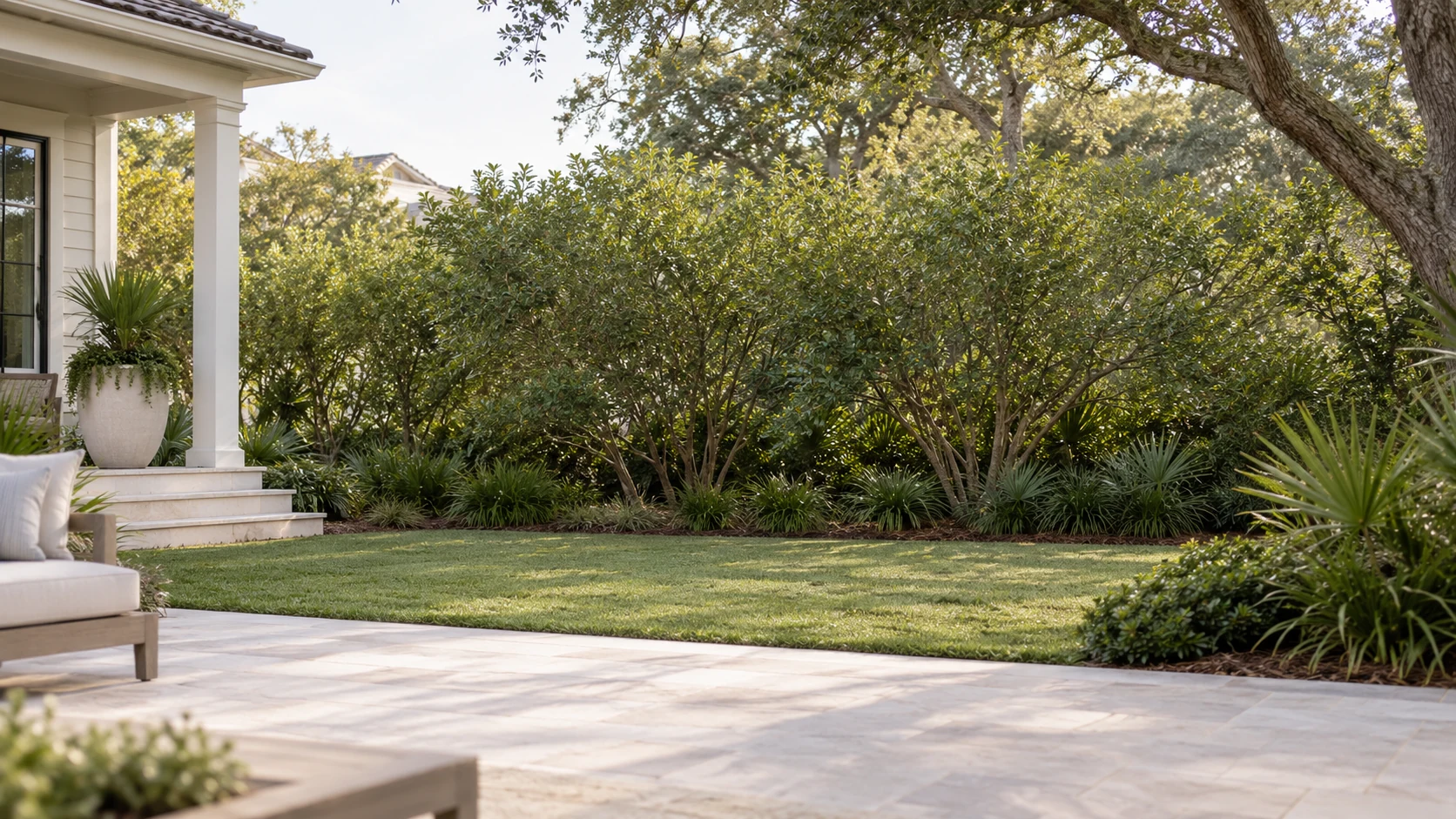
Florida privet can give a boundary a relaxed, leafy character. Start with the depth of the bed and the view you want to soften: this is a substantial native shrub, and its seasonal leaf loss matters if privacy is the main goal.
Illustrative planting concept
Size and space
Mature range: 5–15 ft high × 5–10 ft wide.
FNPS lists 5–15 ft high by 5–10 ft wide. The 6 × 4 ft maintained example needs recurring pruning; it is not the natural limit. Seasonal leaf loss can reveal views that are hidden in summer.
Compare with a six-foot person: installed example 3 ft high by 2 ft wide. This example is not a fixed pot size or a growth timeline.
Full sun to part sun · Water while establishing; allow drainage between wet periods. · Small early-spring flowers and seasonal dark fruit; may lose leaves in winter.
Maintained hedge example: 6 ft high by 4 ft wide. This illustrative size requires ongoing pruning; it is not the natural mature size or a root boundary.
Where it works around Pensacola
Consider a roomy boundary in Pensacola or coastal Alabama. FNPS lists tolerance of salty wind and some spray, but not brackish or saltwater flooding. Check the actual exposure before choosing it for an open waterfront edge.
Loose native boundary
Mixed screening bed
Bird-friendly garden
Large background layer
Roomy coastal courtyard
Does privacy have to last all year?
Check the winter view from both properties before relying on one shrub species. Combine seasonal and evergreen layers where uninterrupted screening matters.
How deep is the planting bed?
Draw the mature canopy beside the fence, then keep room on the garden side for pruning access. A thin strip can turn a natural screen into a permanent trimming job.
Where will the fruit fall?
Keep the fruiting branches over planting beds rather than pale paving or the pool deck. Think about the cleanup route as well as the view.
Which privet is on the order?
Specify Forestiera segregata on the plant schedule. A common name alone is not enough to ensure the nursery supplies this native shrub.
Before it goes on the plan
Is this the same as Sunshine Ligustrum?
No. They are different plants with different sizes and habits. Use the botanical name to keep the selection clear.
Can it stay at hedge height?
It can be managed by pruning, but the design should include the upkeep and enough working room. The smaller diagram shows a maintained example.
Can it take coastal flooding?
Do not use salt-spray tolerance as evidence of flood tolerance. This guide excludes brackish and saltwater inundation.
Pairing ideas
Pineapple Guava: Compare Pineapple Guava where year-round foliage is important; both need a deep bed, with placement matched to drainage and exposure.
Schilling’s Dwarf Yaupon Holly: Schilling’s Dwarf Yaupon can form a lower layer in a compatible sunny bed. Keep its own mature spread outside the privet canopy.
{"key":"privet","id":"PLT-FORE-SEGREGATA","slug":"florida-privet","name":"Florida Privet","botanical":"Forestiera segregata","eyebrow":"A native boundary with breathing room","benefit":"Build a softer edge to the yard.","intro":"Florida privet can give a boundary a relaxed, leafy character. Start with the depth of the bed and the view you want to soften: this is a substantial native shrub, and its seasonal leaf loss matters if privacy is the main goal.","h":[5,15],"w":[5,10],"install":[3,2],"maintained":[6,4],"color":"#657352","habit":"upright","light":"Full sun to part sun","lightTags":["sun","part"],"water":"Water while establishing; allow drainage between wet periods.","season":"Small early-spring flowers and seasonal dark fruit; may lose leaves in winter.","care":"Allow a loose form; check seedlings and prune for access when needed.","site":"Consider a roomy boundary in Pensacola or coastal Alabama. FNPS lists tolerance of salty wind and some spray, but not brackish or saltwater flooding. Check the actual exposure before choosing it for an open waterfront edge.","sizeNote":"FNPS lists 5–15 ft high by 5–10 ft wide. The 6 × 4 ft maintained example needs recurring pruning; it is not the natural limit. Seasonal leaf loss can reveal views that are hidden in summer.","uses":["Loose native boundary","Mixed screening bed","Bird-friendly garden","Large background layer","Roomy coastal courtyard"],"checks":[["Does privacy have to last all year?","Check the winter view from both properties before relying on one shrub species. Combine seasonal and evergreen layers where uninterrupted screening matters."],["How deep is the planting bed?","Draw the mature canopy beside the fence, then keep room on the garden side for pruning access. A thin strip can turn a natural screen into a permanent trimming job."],["Where will the fruit fall?","Keep the fruiting branches over planting beds rather than pale paving or the pool deck. Think about the cleanup route as well as the view."],["Which privet is on the order?","Specify Forestiera segregata on the plant schedule. A common name alone is not enough to ensure the nursery supplies this native shrub."]],"faq":[["Is this the same as Sunshine Ligustrum?","No. They are different plants with different sizes and habits. Use the botanical name to keep the selection clear."],["Can it stay at hedge height?","It can be managed by pruning, but the design should include the upkeep and enough working room. The smaller diagram shows a maintained example."],["Can it take coastal flooding?","Do not use salt-spray tolerance as evidence of flood tolerance. This guide excludes brackish and saltwater inundation."]],"sources":[["Florida Native Plant Society","https://www.fnps.org/plant/forestiera-segregata"],["Georgia DNR plant account","https://www.georgiabiodiversity.com/portal/profile?es_id=21613&group=all"]],"companions":[{"slug":"pineapple-guava","name":"Pineapple Guava","title":"Compare an evergreen screen","reason":"Compare Pineapple Guava where year-round foliage is important; both need a deep bed, with placement matched to drainage and exposure.","image":{"id":"6a9fefd103e01d08cca8eeb2","url":"https://cdn.prod.website-files.com/6a975baac0f352647862d847/6a9fefd103e01d08cca8eeb2_landova-guava-context-r07.webp","alt":"Illustrative planting concept with Pineapple Guava"}},{"slug":"schillings-dwarf-yaupon-holly","name":"Schilling’s Dwarf Yaupon Holly","title":"Add a separate lower layer","reason":"Schilling’s Dwarf Yaupon can form a lower layer in a compatible sunny bed. Keep its own mature spread outside the privet canopy.","image":{"id":"6a9f5cd31fbbc23ce58d34ef","url":"https://cdn.prod.website-files.com/6a975baac0f352647862d847/6a9f5cd31fbbc23ce58d34ef_landova-schilling-context-r05.webp","alt":"Illustrative planting concept with Schilling’s Dwarf Yaupon Holly"}}],"wholeCaption":"Illustrative leafy-season form. Seasonal leaf loss can change the screen.","detailCaption":"Illustrative foliage and dark fruit detail; not a plant identification photograph.","wholeFit":"contain","native":true,"guideKind":"Native species guide","aliases":["wild olive","native privet"],"images":{"context":{"id":"6a9fefd1bc55594ead64b7f7","url":"https://cdn.prod.website-files.com/6a975baac0f352647862d847/6a9fefd1bc55594ead64b7f7_landova-privet-context-r07.webp","alt":"Illustrative planting concept with Florida Privet"},"whole":{"id":"6a9fefd10801709cd0d225fe","url":"https://cdn.prod.website-files.com/6a975baac0f352647862d847/6a9fefd10801709cd0d225fe_landova-privet-whole-r07.webp","alt":"Illustrative view of Florida Privet overall form","fit":"contain"},"detail":{"id":"6a9fefd10801709cd0d2262a","url":"https://cdn.prod.website-files.com/6a975baac0f352647862d847/6a9fefd10801709cd0d2262a_landova-privet-detail-r07.webp","alt":"Illustrative view of Florida Privet foliage and seasonal detail"}},"caution":"A large native screen with seasonal leaf loss. Allow its width and keep fruiting branches off busy paving."}
LANDOVA / PLANTING DECISIONS
Choose plants with the whole space in mind.
Explore a planting goal, then compare the growing needs and mature size of individual plants.
LANDOVA is in beta
Join the launch waitlist.
We are not accepting paying clients yet. We expect to launch around January 2027 and may open sooner. Explore our free tools now, and sign up for launch updates and educational planning emails.
Thank you. Your waitlist signup has been received. We will email you with launch updates. No purchase or project booking has been made.
We could not save your signup. Please try again or email info@landovadesign.com.