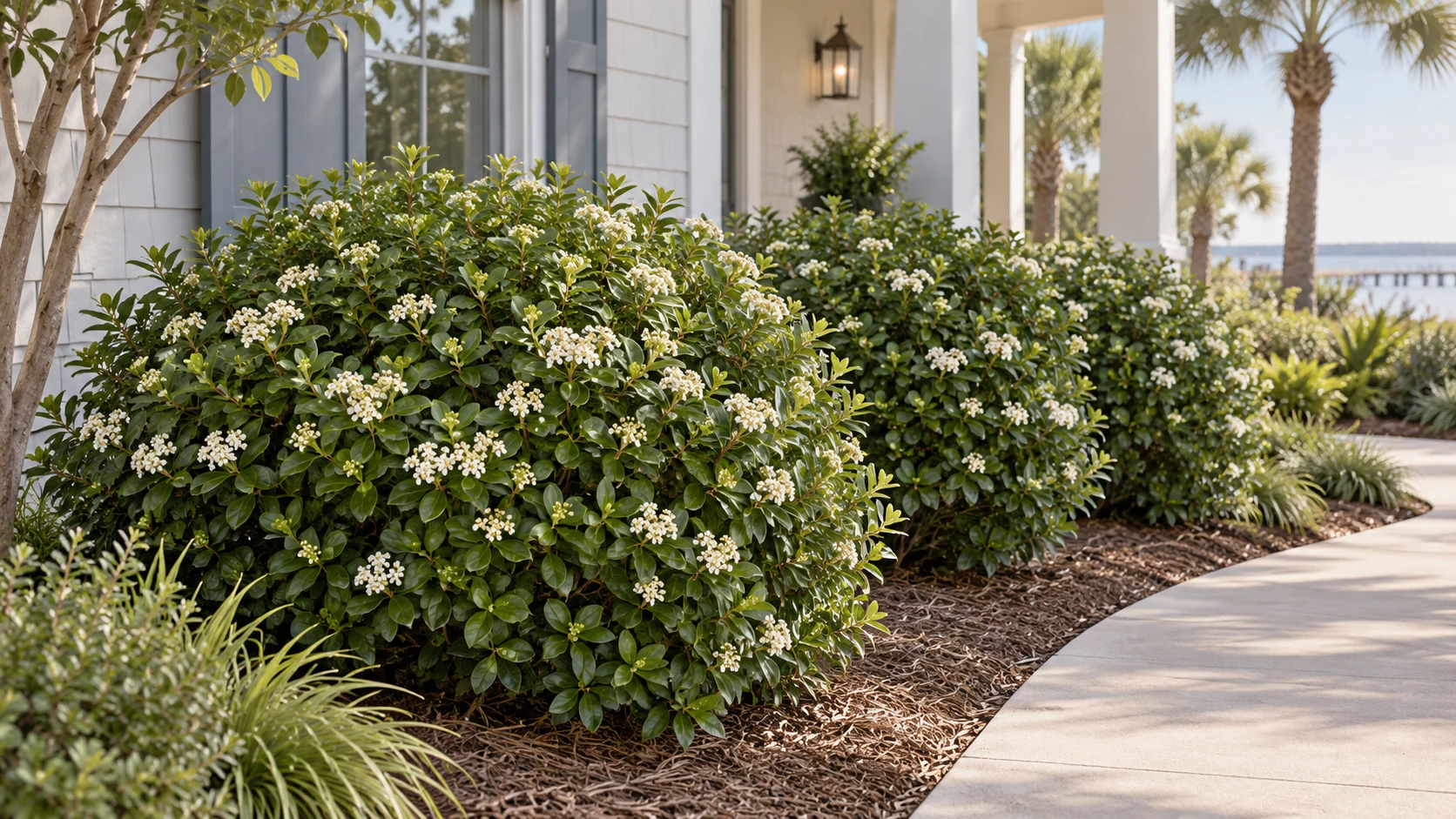
Small leaves and a naturally rounded form can bring repetition to a planting without making it feel rigid. This compact Walter’s viburnum is useful for a lower layer, provided its spreading growth has somewhere to go.
Illustrative planting concept
Size and space
Mature range: 2–5 ft high × 3–5 ft wide.
FNPS lists 2–5 ft high × 3–5 ft wide. Older plants can exceed compact nursery descriptions: Arkansas Extension notes dwarf selections may eventually double a stated 3 × 4 ft size. Spreading shoots can extend the planting beyond one crown.
Compare with a six-foot person: installed example 1.5 ft high by 1.5 ft wide. This example is not a fixed pot size or a growth timeline.
Sun to part sun · Acidic soil; avoid prolonged flooding and salty water · White late-winter to spring flowers · mostly evergreen, with seasonal leaf renewal
Where it works around Pensacola
Consider it in a sheltered inland coastal bed with room for natural growth. The cultivar is not a choice for direct salt spray or brackish flooding, and a compact plant still needs establishment water.
Native cultivar
Lower hedge
Rounded structure
White spring flowers
Repeated planting
Use repetition with breathing room.
Lay out the eventual rounded forms before deciding how many to buy. Filling every gap on installation day can create an overcrowded bed later.
Check the exact name.
Mrs. Schiller’s Delight is a viburnum. Schilling’s Dwarf Yaupon is a different plant, and ordinary Walter’s viburnum can be a much larger screen.
Decide how the edge will be managed.
Shoots can appear beyond the original shrub. Allow a naturalizing bed or include occasional removal where the planting meets a path.
Keep the site conditions honest.
Native ancestry does not make every coastal exposure suitable. Check sunlight, soil and salt exposure at the actual planting location.
Before it goes on the plan
Is it permanently a tiny shrub?
No. Compact describes its relationship to the larger species. Leave flexibility for older growth and decide how much shaping fits the maintenance plan.
Will it stay green all year?
It is often mostly evergreen locally, with a short leaf-renewal period and possible extra leaf loss in cold conditions. Do not rely on perfect screening every day.
Can it replace a full-sized Walter’s viburnum?
Only if the design needs a lower form. A compact cultivar and the full species solve different height and screening problems.
Pairing ideas
Walter’s Viburnum: Use the species guide when the goal is a taller screen. If combined in a large bed, keep the taller form from shading out the lower planting.
American Beautyberry: Beautyberry can contrast with the rounded viburnum in a suitably lit, roomy bed. Leave clearance for arching branches and expect winter leaf loss.
{"key":"schiller","id":"PLT-VIBU-OBOV-MRS-SCHILLER","slug":"mrs-schillers-delight-viburnum","name":"Mrs. Schiller’s Delight Viburnum","botanical":"Viburnum obovatum ‘Mrs. Schiller’s Delight’","eyebrow":"NATIVE CULTIVAR + SOFT STRUCTURE","benefit":"Give the bed a softer sense of order.","intro":"Small leaves and a naturally rounded form can bring repetition to a planting without making it feel rigid. This compact Walter’s viburnum is useful for a lower layer, provided its spreading growth has somewhere to go.","h":[2,5],"w":[3,5],"install":[1.5,1.5],"color":"#64784f","habit":"round","light":"Sun to part sun","lightTags":["sun","part"],"water":"Acidic soil; avoid prolonged flooding and salty water","season":"White late-winter to spring flowers · mostly evergreen, with seasonal leaf renewal","care":"Shape as needed; manage spreading shoots at bed edges","site":"Consider it in a sheltered inland coastal bed with room for natural growth. The cultivar is not a choice for direct salt spray or brackish flooding, and a compact plant still needs establishment water.","sizeNote":"FNPS lists 2–5 ft high × 3–5 ft wide. Older plants can exceed compact nursery descriptions: Arkansas Extension notes dwarf selections may eventually double a stated 3 × 4 ft size. Spreading shoots can extend the planting beyond one crown.","uses":["Native cultivar","Lower hedge","Rounded structure","White spring flowers","Repeated planting"],"checks":[["Use repetition with breathing room.","Lay out the eventual rounded forms before deciding how many to buy. Filling every gap on installation day can create an overcrowded bed later."],["Check the exact name.","Mrs. Schiller’s Delight is a viburnum. Schilling’s Dwarf Yaupon is a different plant, and ordinary Walter’s viburnum can be a much larger screen."],["Decide how the edge will be managed.","Shoots can appear beyond the original shrub. Allow a naturalizing bed or include occasional removal where the planting meets a path."],["Keep the site conditions honest.","Native ancestry does not make every coastal exposure suitable. Check sunlight, soil and salt exposure at the actual planting location."]],"faq":[["Is it permanently a tiny shrub?","No. Compact describes its relationship to the larger species. Leave flexibility for older growth and decide how much shaping fits the maintenance plan."],["Will it stay green all year?","It is often mostly evergreen locally, with a short leaf-renewal period and possible extra leaf loss in cold conditions. Do not rely on perfect screening every day."],["Can it replace a full-sized Walter’s viburnum?","Only if the design needs a lower form. A compact cultivar and the full species solve different height and screening problems."]],"sources":[["Florida Native Plant Society · cultivar size and site conditions","https://www.fnps.org/plant/viburnum-obovatum-schillers"],["University of Arkansas Extension · older growth and cultivar identity","https://www.uaex.uada.edu/yard-garden/resource-library/plant-week/Viburnum-obovatum-Mrs-Schillars-Delight-Walters-Viburnum-Small-Viburnum-09-28-2018.aspx"]],"companions":[{"slug":"walters-viburnum","name":"Walter’s Viburnum","title":"Compare the full-sized species.","reason":"Use the species guide when the goal is a taller screen. If combined in a large bed, keep the taller form from shading out the lower planting.","image":{"id":"6a9f5cd5ed7b89a06a969071","url":"https://cdn.prod.website-files.com/6a975baac0f352647862d847/6a9f5cd5ed7b89a06a969071_landova-walter-context-r05.webp","alt":"Illustrative planting concept with Walter’s Viburnum"}},{"slug":"american-beautyberry","name":"American Beautyberry","title":"Add a looser seasonal accent.","reason":"Beautyberry can contrast with the rounded viburnum in a suitably lit, roomy bed. Leave clearance for arching branches and expect winter leaf loss.","image":{"id":"6a9f5cd67400c99880f6f542","url":"https://cdn.prod.website-files.com/6a975baac0f352647862d847/6a9f5cd67400c99880f6f542_landova-beauty-context-r05.webp","alt":"Illustrative planting concept with American Beautyberry"}}],"wholeCaption":"Illustrative form · a compact selection with room to spread","detailCaption":"Illustrative detail · small leaves and white seasonal flower clusters","wholeFit":"contain","native":true,"guideKind":"Native cultivar guide","aliases":["Mrs Schillers Delight","Mrs. Schiller","dwarf Walters viburnum"],"images":{"context":{"id":"6a9f6fc66cfcb148fde9f1cb","url":"https://cdn.prod.website-files.com/6a975baac0f352647862d847/6a9f6fc66cfcb148fde9f1cb_landova-schiller-context-r06.webp","alt":"Illustrative planting concept with Mrs. Schiller’s Delight Viburnum"},"whole":{"id":"6a9f6fc8faf5016fe4821263","url":"https://cdn.prod.website-files.com/6a975baac0f352647862d847/6a9f6fc8faf5016fe4821263_landova-schiller-whole-r06.webp","alt":"Illustrative view of Mrs. Schiller’s Delight Viburnum overall form","fit":"contain"},"detail":{"id":"6a9f6fc9a02c6121fcb3d3a8","url":"https://cdn.prod.website-files.com/6a975baac0f352647862d847/6a9f6fc9a02c6121fcb3d3a8_landova-schiller-detail-r06.webp","alt":"Illustrative view of Mrs. Schiller’s Delight Viburnum foliage and seasonal detail"}},"caution":"Compact does not mean a fixed small size. Older growth and spreading shoots need room; avoid direct salt exposure."}
LANDOVA / PLANTING DECISIONS
Choose plants with the whole space in mind.
Explore a planting goal, then compare the growing needs and mature size of individual plants.
LANDOVA is in beta
Join the launch waitlist.
We are not accepting paying clients yet. We expect to launch around January 2027 and may open sooner. Explore our free tools now, and sign up for launch updates and educational planning emails.
Thank you. Your waitlist signup has been received. We will email you with launch updates. No purchase or project booking has been made.
We could not save your signup. Please try again or email info@landovadesign.com.