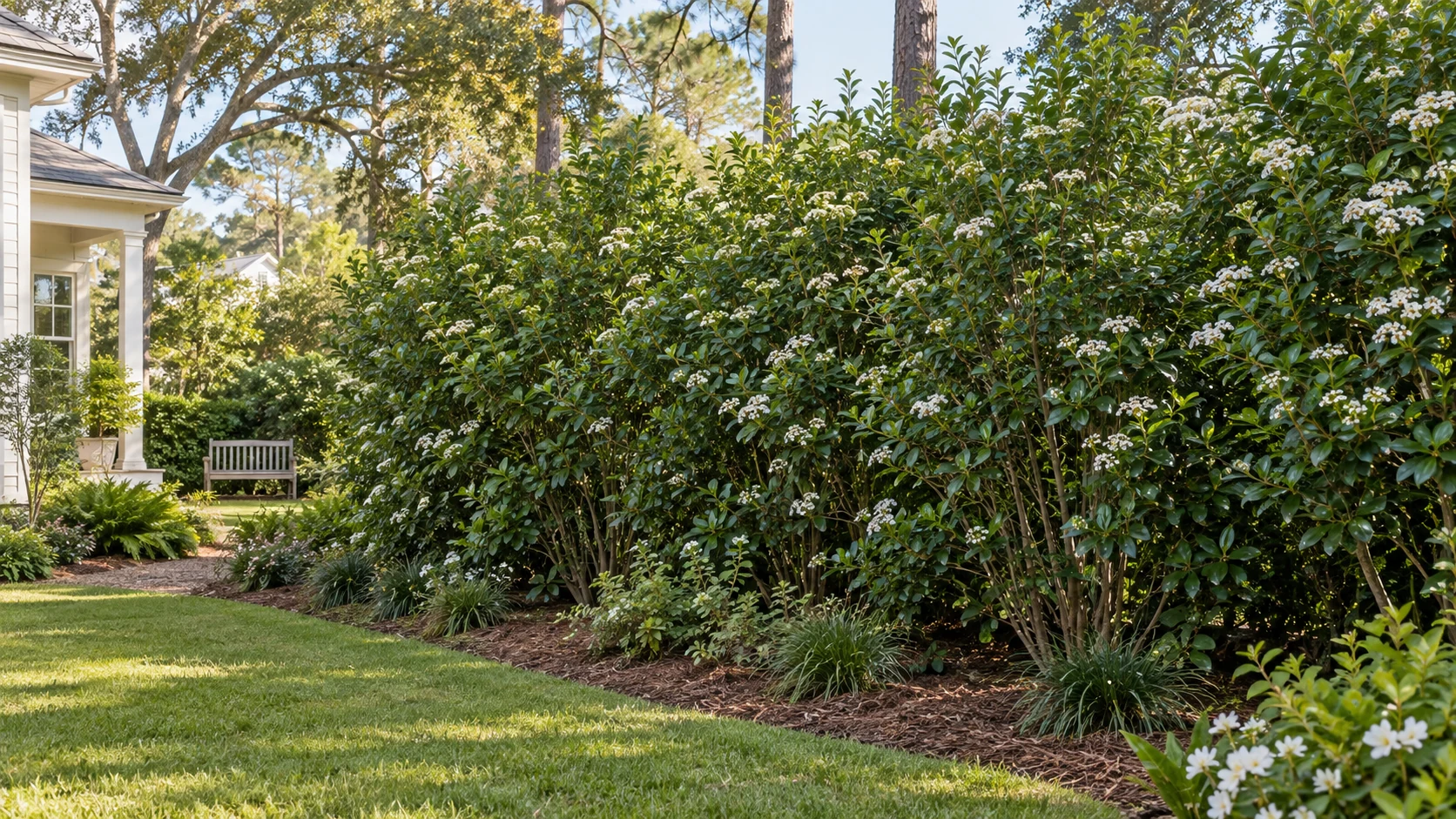
Fine foliage and small white flowers give this Florida native a lighter character than a solid wall. The full-sized species belongs in a generous screen or garden backdrop, with its future height considered from the start.
Illustrative planting concept
Size and space
Mature range: 10–20 ft high × 10–15 ft wide.
Plan approximately 10–20 ft high and 10–15 ft wide for this full-sized species. Some specimens reach about 30 ft, and spreading shoots can extend the planting. Compact named cultivars are different selections with different space needs.
Compare with a six-foot person: installed example 3 ft high by 2 ft wide. This example is not a fixed pot size or a growth timeline.
Sun to part shade · Water to establish; suited to moist planting areas · Evergreen to semi-evergreen · late-winter/spring flowers
Where it works around Pensacola
A native option for a sheltered Pensacola-area boundary where a large shrub can grow freely. Check the specific nursery form, soil and exposure; coastal location does not make direct salt spray a suitable condition.
A tall informal screen
A spring-flowering backdrop
A large native border
A transition toward a wooded edge
A multistem focal point in a roomy garden
Look up as well as across
Review rooflines, utility routes and the view from upstairs before locating a tall screen. Its mature outline should improve the property without creating a new access problem.
Keep the boundary workable
Leave space for fence repair and maintenance on your own property. Draw that access separately from the canopy so it does not disappear as the planting grows.
Choose natural or clipped
Repeated shearing changes the silhouette and can reduce the flower display. If a very low, formal hedge is essential, compare a correctly identified compact cultivar.
Think through seasonal changes
Small white blooms appear around late winter to spring; seasonal fruits attract wildlife. Leaf renewal or cold weather can briefly reduce the screen, so avoid promising an unchanging solid wall.
Before it goes on the plan
Is this a dwarf viburnum?
No. This guide covers the full-sized species. Confirm both the cultivar name and expected dimensions when a nursery offers a compact Walter’s viburnum.
Will it stay within the circle on my plan?
That circle is a planning aid. New shoots can extend the planting beyond one shrub’s canopy; leave room for a natural colony or plan their removal.
Could it work behind an outdoor kitchen?
Possibly, if the full mature size, service access, heat clearances and exposure are resolved. Place the kitchen and its operating space first, then test whether the planting still fits.
Pairing ideas
American Beautyberry: Give American beautyberry its own footprint in front of a roomy viburnum screen. Keep branches out of the circulation space.
Schilling’s Dwarf Yaupon Holly: Use Schilling’s Dwarf in a separate lower layer where light allows. Its broad base still needs several feet of room.
{"key":"walter","id":"PLT-VIBU-OBOVATUM","slug":"walters-viburnum","name":"Walter’s Viburnum","botanical":"Viburnum obovatum","eyebrow":"A living garden boundary","benefit":"A green screen with a spring moment.","intro":"Fine foliage and small white flowers give this Florida native a lighter character than a solid wall. The full-sized species belongs in a generous screen or garden backdrop, with its future height considered from the start.","h":[10,20],"w":[10,15],"install":[3,2],"color":"#536644","habit":"upright","light":"Sun to part shade","lightTags":["sun","part"],"water":"Water to establish; suited to moist planting areas","season":"Evergreen to semi-evergreen · late-winter/spring flowers","care":"Allow natural growth; manage spreading shoots","site":"A native option for a sheltered Pensacola-area boundary where a large shrub can grow freely. Check the specific nursery form, soil and exposure; coastal location does not make direct salt spray a suitable condition.","sizeNote":"Plan approximately 10–20 ft high and 10–15 ft wide for this full-sized species. Some specimens reach about 30 ft, and spreading shoots can extend the planting. Compact named cultivars are different selections with different space needs.","uses":["A tall informal screen","A spring-flowering backdrop","A large native border","A transition toward a wooded edge","A multistem focal point in a roomy garden"],"checks":[["Look up as well as across","Review rooflines, utility routes and the view from upstairs before locating a tall screen. Its mature outline should improve the property without creating a new access problem."],["Keep the boundary workable","Leave space for fence repair and maintenance on your own property. Draw that access separately from the canopy so it does not disappear as the planting grows."],["Choose natural or clipped","Repeated shearing changes the silhouette and can reduce the flower display. If a very low, formal hedge is essential, compare a correctly identified compact cultivar."],["Think through seasonal changes","Small white blooms appear around late winter to spring; seasonal fruits attract wildlife. Leaf renewal or cold weather can briefly reduce the screen, so avoid promising an unchanging solid wall."]],"faq":[["Is this a dwarf viburnum?","No. This guide covers the full-sized species. Confirm both the cultivar name and expected dimensions when a nursery offers a compact Walter’s viburnum."],["Will it stay within the circle on my plan?","That circle is a planning aid. New shoots can extend the planting beyond one shrub’s canopy; leave room for a natural colony or plan their removal."],["Could it work behind an outdoor kitchen?","Possibly, if the full mature size, service access, heat clearances and exposure are resolved. Place the kitchen and its operating space first, then test whether the planting still fits."]],"sources":[["Species dimensions + seasonal habit · Florida Native Plant Society","https://www.fnps.org/plant/viburnum-obovatum"],["Florida landscape use · UF/IFAS Gardening Solutions","https://gardeningsolutions.ifas.ufl.edu/plants/trees-and-shrubs/shrubs/walters-viburnum/"]],"companions":[{"slug":"american-beautyberry","name":"American Beautyberry","title":"Seasonal color at the edge","reason":"Give American beautyberry its own footprint in front of a roomy viburnum screen. Keep branches out of the circulation space.","image":{"id":"6a9f5cd67400c99880f6f542","url":"https://cdn.prod.website-files.com/6a975baac0f352647862d847/6a9f5cd67400c99880f6f542_landova-beauty-context-r05.webp","alt":"Illustrative planting concept with American Beautyberry"}},{"slug":"schillings-dwarf-yaupon-holly","name":"Schilling’s Dwarf Yaupon Holly","title":"A lower evergreen rhythm","reason":"Use Schilling’s Dwarf in a separate lower layer where light allows. Its broad base still needs several feet of room.","image":{"id":"6a9f5cd31fbbc23ce58d34ef","url":"https://cdn.prod.website-files.com/6a975baac0f352647862d847/6a9f5cd31fbbc23ce58d34ef_landova-schilling-context-r05.webp","alt":"Illustrative planting concept with Schilling’s Dwarf Yaupon Holly"}}],"wholeFit":"contain","wholeCaption":"Illustrative whole-plant study. Use the measured comparison for installed and mature size.","detailCaption":"Illustrative foliage and seasonal detail; appearance varies by season and growing conditions.","native":true,"guideKind":"Native species guide","aliases":["Walters Viburnum"],"images":{"context":{"id":"6a9f5cd5ed7b89a06a969071","url":"https://cdn.prod.website-files.com/6a975baac0f352647862d847/6a9f5cd5ed7b89a06a969071_landova-walter-context-r05.webp","alt":"Illustrative planting concept with Walter’s Viburnum"},"whole":{"id":"6a9f5cd5d45aa5619676be9e","url":"https://cdn.prod.website-files.com/6a975baac0f352647862d847/6a9f5cd5d45aa5619676be9e_landova-walter-whole-r05.webp","alt":"Illustrative view of Walter’s Viburnum overall form","fit":"contain"},"detail":{"id":"6a9f5cd62148e9081f04296c","url":"https://cdn.prod.website-files.com/6a975baac0f352647862d847/6a9ff509313f0a1ac0aaee9f_landova-walter-detail-restored-r08.webp","alt":"Illustrative view of Walter’s Viburnum foliage and seasonal detail"}},"caution":"Full-sized species, not a dwarf cultivar. Allow a tall, broad screen and room for spreading shoots."}
LANDOVA / PLANTING DECISIONS
Choose plants with the whole space in mind.
Explore a planting goal, then compare the growing needs and mature size of individual plants.
LANDOVA is in beta
Join the launch waitlist.
We are not accepting paying clients yet. We expect to launch around January 2027 and may open sooner. Explore our free tools now, and sign up for launch updates and educational planning emails.
Thank you. Your waitlist signup has been received. We will email you with launch updates. No purchase or project booking has been made.
We could not save your signup. Please try again or email info@landovadesign.com.