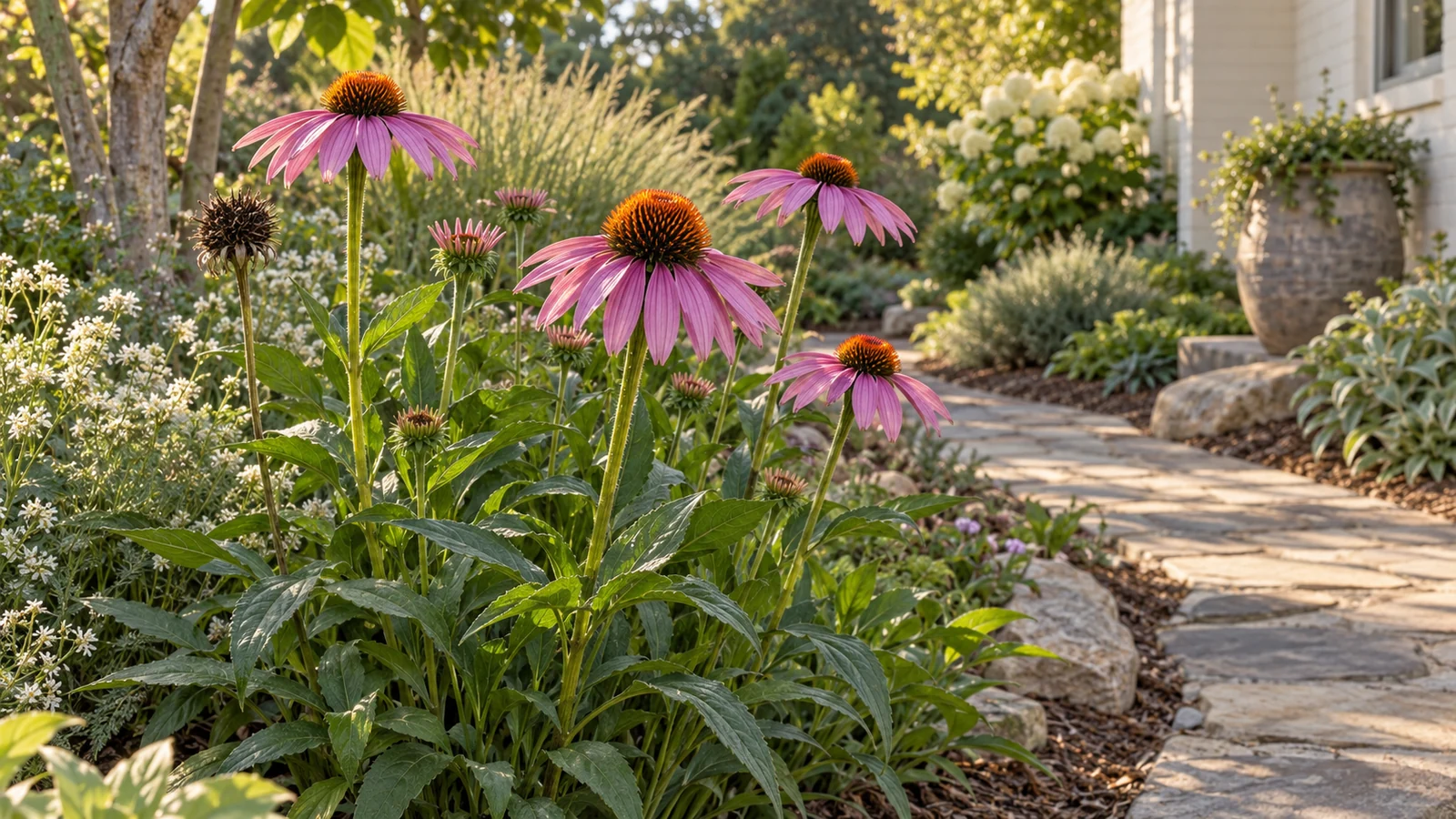
Add a clear purple flower shape above the planting.
Purple Coneflower carries pink-purple petals around raised, copper-brown cones on sturdy upright stems. The flowers stand well above the lower foliage, giving a border a clear vertical rhythm. A few plants can add purple without turning the whole bed into one color, while the seedheads offer another texture after the petals fade.
Before you choose: Treat this as a site-tested option in Pensacola, not a guaranteed long-lived perennial. FNPS notes that its natural Florida range is very limited and that a reliable cold period helps it persist. Heat, humidity and wet crowns can shorten its life. Buy nursery-grown plants and never collect from wild populations.
Illustrative planting concept
Size and space
Height in flower: 3–4 ft. Typical spread: 1–2 ft.
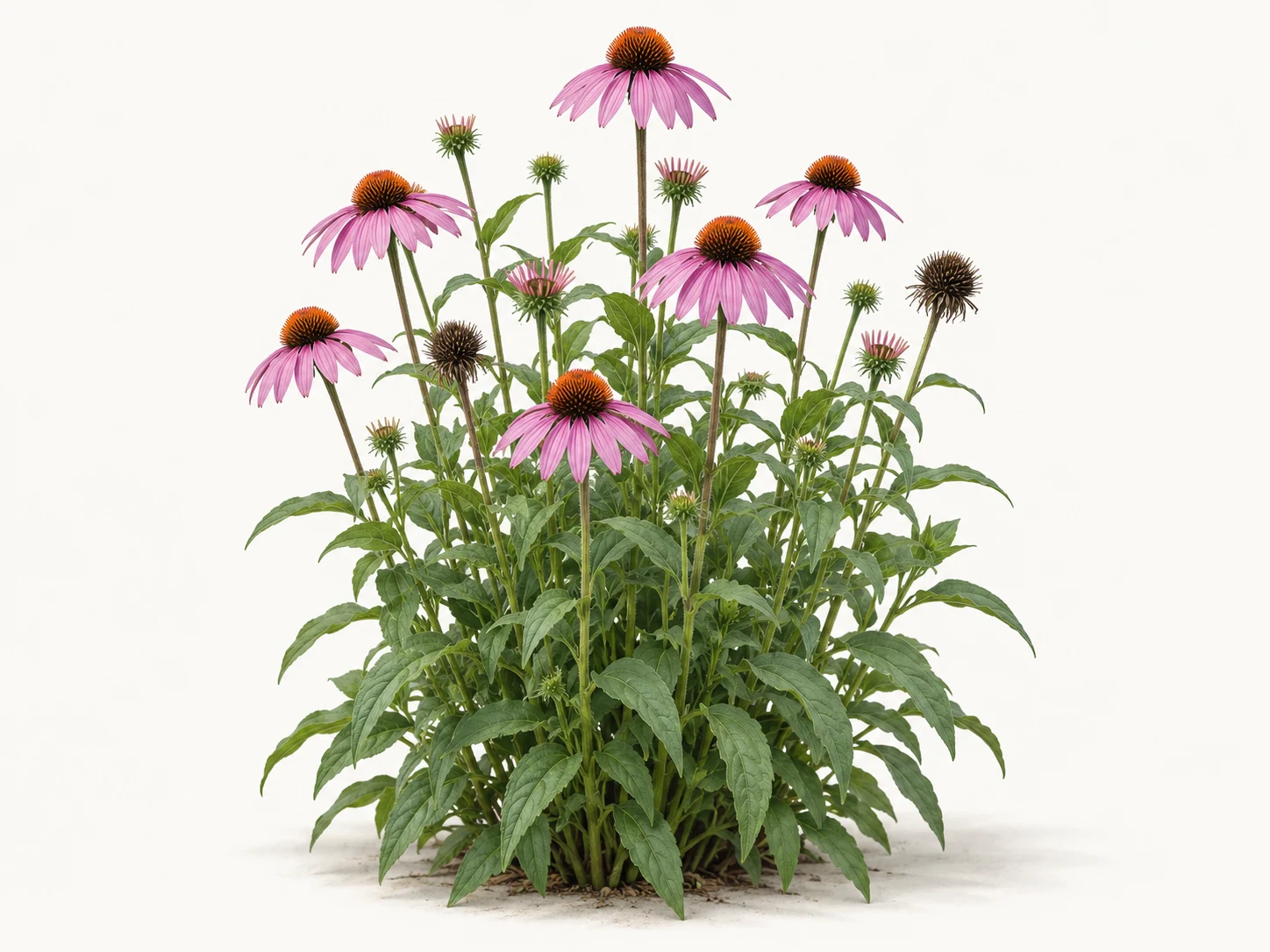
NC State describes the straight species at 3–4 ft high and 1–2 ft wide. The drawing includes full flower-stem height, not just the basal foliage. Compact cultivars and complex hybrids can differ considerably; ask for the named selection’s dimensions before placing it beneath a low window or along a narrow walk.
Installed example: 0.5 ft high × 0.5 ft wide. This is an illustrative size, not a pot-size or growth-timeline promise.
Full sun; some part shade with good light · Moist, well-drained soil; water through establishment and prolonged dry periods · Purple summer flowers and seedheads; winter dormancy
Care: Leave some seedheads if desired; monitor crowns and replace plants that decline
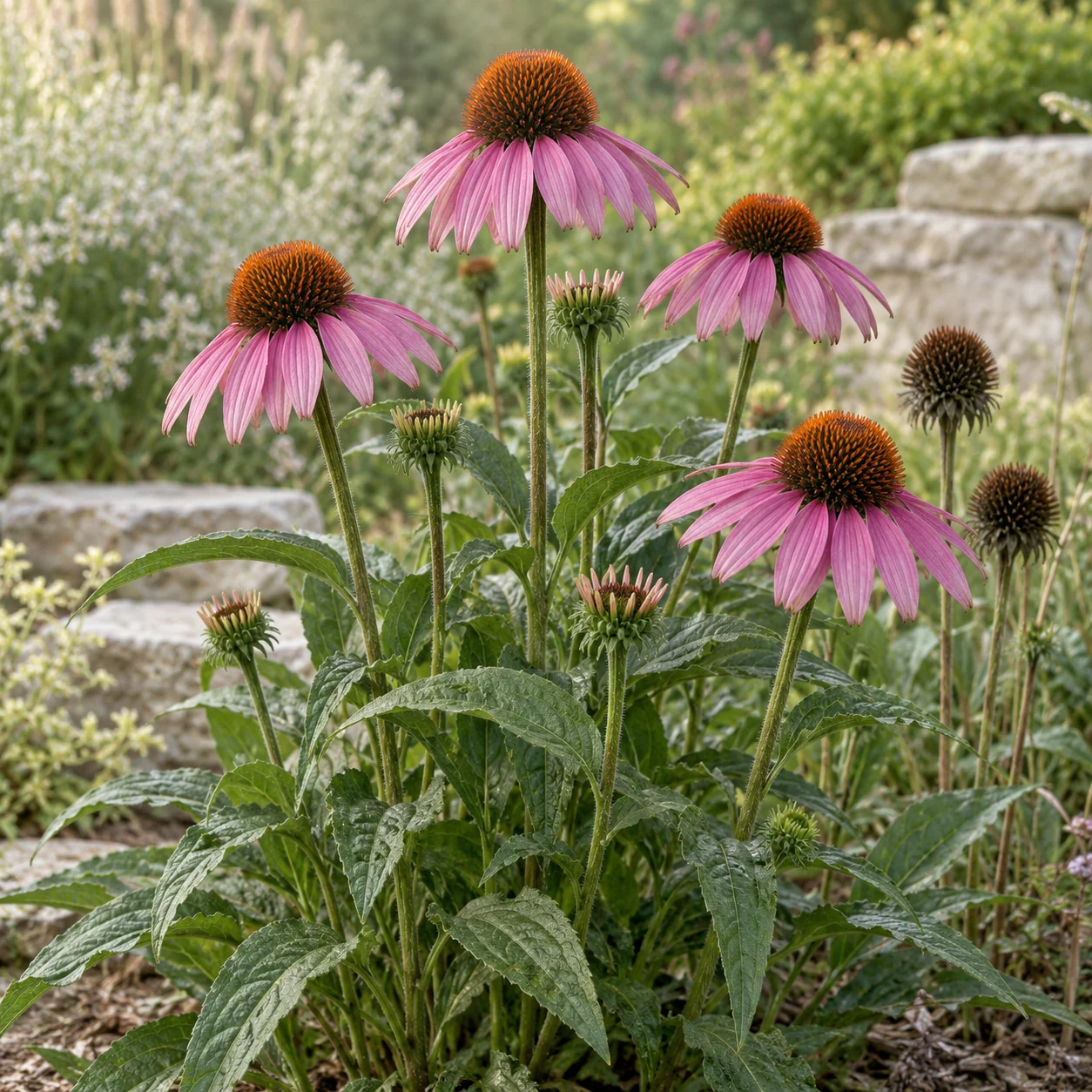
Know the whole plant
Illustrative overall form of Purple Coneflower. The nursery selection, season and site affect appearance.Illustrative foliage and seasonal detail of Purple Coneflower; confirm the botanical name and selection on the nursery label.
Where it works around Pensacola
Start with a small group in an airy Pensacola bed with good drainage and useful sunlight. Watch how it performs through a full year before repeating it widely. Keep irrigation from constantly soaking the crown and give neighboring plants room. The design can still work if a few seasonal flowers are renewed, provided permanent structure is supplied elsewhere.
A small purple accent in a sunny border
A trial planting for pollinator interest
A cut-flower garden with good drainage
A seasonal layer behind lower flowers
A seedhead accent in an informal bed
Can this be a trial before a large planting?
Local persistence varies. Test a few nursery-grown plants in the actual bed and observe their return before committing a large area.
Will the crown stay wet?
Check mulch depth, irrigation overlap and low spots. Good air movement and a draining root zone matter in a humid Gulf Coast garden.
Which form do you want?
The classic plant has single flowers with a raised cone and drooping rays. Double-flowered and dwarf selections look and grow differently.
Should seedheads stay through the quieter season?
Leave some where wildlife interest fits the design. Remove tired stems selectively while keeping the maintenance route clear.
Before it goes on the plan
Will it come back every year here?
It may, but long-term persistence is uncertain in a warm coastal site. FNPS specifically notes its need for a reliable cold period; plan for observation and possible replacement.
Does native mean suitable everywhere in Florida?
No. This species barely reaches Florida naturally and occupies specific habitats. A native-range label does not replace checking the conditions of a residential bed.
Can I use a smaller cultivar instead?
Yes, after checking that selection’s dimensions and local performance. Do not apply the straight species’ three-to-four-foot flowering height to every plant sold as a coneflower.
Pairing ideas
Pink Muhly Grass: Pink Muhly adds a different seasonal moment in its own sunny, draining space. Keep both crowns open.
Lanceleaf Coreopsis: Lanceleaf Coreopsis supplies an earlier yellow display. Leave individual plants room and avoid crowding the coneflower crown.
Schilling’s Dwarf Yaupon Holly: Dwarf Yaupon can anchor the bed from a separate larger footprint, leaving the coneflowers in sunlight.
{"key":"coneflower","name":"Purple Coneflower","botanical":"Echinacea purpurea","slug":"purple-coneflower","id":"PLT-ECHI-PURP","type":"accents","h":[3,4],"w":[1,2],"install":[0.5,0.5],"native":true,"accentGroup":"wildflower","accentForm":"daisy","light":"Full sun; some part shade with good light","lightTags":["sun","part"],"water":"Moist, well-drained soil; water through establishment and prolonged dry periods","season":"Purple summer flowers and seedheads; winter dormancy","care":"Leave some seedheads if desired; monitor crowns and replace plants that decline","benefit":"Add a clear purple flower shape above the planting.","intro":"Purple Coneflower carries pink-purple petals around raised, copper-brown cones on sturdy upright stems. The flowers stand well above the lower foliage, giving a border a clear vertical rhythm. A few plants can add purple without turning the whole bed into one color, while the seedheads offer another texture after the petals fade.","caution":"Treat this as a site-tested option in Pensacola, not a guaranteed long-lived perennial. FNPS notes that its natural Florida range is very limited and that a reliable cold period helps it persist. Heat, humidity and wet crowns can shorten its life. Buy nursery-grown plants and never collect from wild populations.","sizeNote":"NC State describes the straight species at 3–4 ft high and 1–2 ft wide. The drawing includes full flower-stem height, not just the basal foliage. Compact cultivars and complex hybrids can differ considerably; ask for the named selection’s dimensions before placing it beneath a low window or along a narrow walk.","site":"Start with a small group in an airy Pensacola bed with good drainage and useful sunlight. Watch how it performs through a full year before repeating it widely. Keep irrigation from constantly soaking the crown and give neighboring plants room. The design can still work if a few seasonal flowers are renewed, provided permanent structure is supplied elsewhere.","uses":["A small purple accent in a sunny border","A trial planting for pollinator interest","A cut-flower garden with good drainage","A seasonal layer behind lower flowers","A seedhead accent in an informal bed"],"checks":[["Can this be a trial before a large planting?","Local persistence varies. Test a few nursery-grown plants in the actual bed and observe their return before committing a large area."],["Will the crown stay wet?","Check mulch depth, irrigation overlap and low spots. Good air movement and a draining root zone matter in a humid Gulf Coast garden."],["Which form do you want?","The classic plant has single flowers with a raised cone and drooping rays. Double-flowered and dwarf selections look and grow differently."],["Should seedheads stay through the quieter season?","Leave some where wildlife interest fits the design. Remove tired stems selectively while keeping the maintenance route clear."]],"faq":[["Will it come back every year here?","It may, but long-term persistence is uncertain in a warm coastal site. FNPS specifically notes its need for a reliable cold period; plan for observation and possible replacement."],["Does native mean suitable everywhere in Florida?","No. This species barely reaches Florida naturally and occupies specific habitats. A native-range label does not replace checking the conditions of a residential bed."],["Can I use a smaller cultivar instead?","Yes, after checking that selection’s dimensions and local performance. Do not apply the straight species’ three-to-four-foot flowering height to every plant sold as a coneflower."]],"sources":[["NC State Extension: Purple Coneflower","https://plants.ces.ncsu.edu/plants/echinacea-purpurea/"],["Florida Native Plant Society: Purple Coneflower","https://www.fnps.org/plant/echinacea-purpurea"]],"unit":"ft","heightLabel":"Height in flower","spreadLabel":"Typical spread","heightText":"3–4 ft","spreadText":"1–2 ft","sizeSummary":"3–4 ft high × 1–2 ft wide","color":"#70815a","bloomColor":"#ae759e","guideKind":"Flowering perennial · site-tested choice","eyebrow":"FLOWERS + FOLIAGE / FORM + SEASON","aliases":["Purple Coneflower","Echinacea purpurea"],"goals":["color"],"wholeCaption":"Illustrative overall form of Purple Coneflower. The nursery selection, season and site affect appearance.","detailCaption":"Illustrative foliage and seasonal detail of Purple Coneflower; confirm the botanical name and selection on the nursery label.","images":{"context":{"id":"6aa093d71b77833b402344b2","url":"https://cdn.prod.website-files.com/6a975baac0f352647862d847/6aa093d71b77833b402344b2_landova-accent-coneflower-context.webp","alt":"Illustrative planting concept with Purple Coneflower","width":1600,"height":900},"whole":{"id":"6aa093d862e8d11122498aa9","url":"https://cdn.prod.website-files.com/6a975baac0f352647862d847/6aa093d862e8d11122498aa9_landova-accent-coneflower-whole.webp","alt":"Illustrative whole-plant form of Purple Coneflower","width":1448,"height":1086,"fit":"contain"},"detail":{"id":"6aa093d962e8d11122498b15","url":"https://cdn.prod.website-files.com/6a975baac0f352647862d847/6aa093d962e8d11122498b15_landova-accent-coneflower-detail.webp","alt":"Illustrative foliage and seasonal detail of Purple Coneflower","width":1254,"height":1254}},"companions":[{"slug":"pink-muhly-grass","name":"Pink Muhly Grass","title":"Follow summer flowers with autumn texture","reason":"Pink Muhly adds a different seasonal moment in its own sunny, draining space. Keep both crowns open.","image":{"id":"6aa00228430659e428d61061","url":"https://cdn.prod.website-files.com/6a975baac0f352647862d847/6aa00228430659e428d61061_landova-grass-muhly-context.webp","alt":"Illustrative planting concept with Pink Muhly Grass","width":1600,"height":900}},{"slug":"lanceleaf-coreopsis","name":"Lanceleaf Coreopsis","title":"Build a spring-to-summer sequence","reason":"Lanceleaf Coreopsis supplies an earlier yellow display. Leave individual plants room and avoid crowding the coneflower crown.","image":{"id":"6aa093d762e8d111224989d1","url":"https://cdn.prod.website-files.com/6a975baac0f352647862d847/6aa093d762e8d111224989d1_landova-accent-coreopsis-context.webp","alt":"Illustrative planting concept with Lanceleaf Coreopsis","width":1600,"height":900}},{"slug":"schillings-dwarf-yaupon-holly","name":"Schilling’s Dwarf Yaupon Holly","title":"Give the flowers a lasting backdrop","reason":"Dwarf Yaupon can anchor the bed from a separate larger footprint, leaving the coneflowers in sunlight.","image":{"id":"6a9f5cd31fbbc23ce58d34ef","url":"https://cdn.prod.website-files.com/6a975baac0f352647862d847/6a9f5cd31fbbc23ce58d34ef_landova-schilling-context-r05.webp","alt":"Illustrative planting concept with Schilling’s Dwarf Yaupon Holly"}}]}
LANDOVA / PLANTING DECISIONS
Choose plants with the whole space in mind.
Explore a planting goal, then compare the growing needs and mature size of individual plants.
LANDOVA is in beta
Join the launch waitlist.
We are not accepting paying clients yet. We expect to launch around January 2027 and may open sooner. Explore our free tools now, and sign up for launch updates and educational planning emails.
Thank you. Your waitlist signup has been received. We will email you with launch updates. No purchase or project booking has been made.
We could not save your signup. Please try again or email info@landovadesign.com.