Give a sheltered garden a spring moment to look forward to.
Red Buckeye offers a concentrated spring display rather than a year-round flower show. Its upright red blooms rise above large divided leaves, creating a strong accent in a quieter garden. Place it where the seasonal change can be enjoyed from a distance and where its broad, low branches have their own space.
Before you choose: All parts are poisonous to people and toxic to pets if eaten. Avoid placement where ingestion is likely. Red Buckeye can lose leaves early, especially under heat or drought stress, and should not carry the garden’s year-round privacy or summer-shade role.
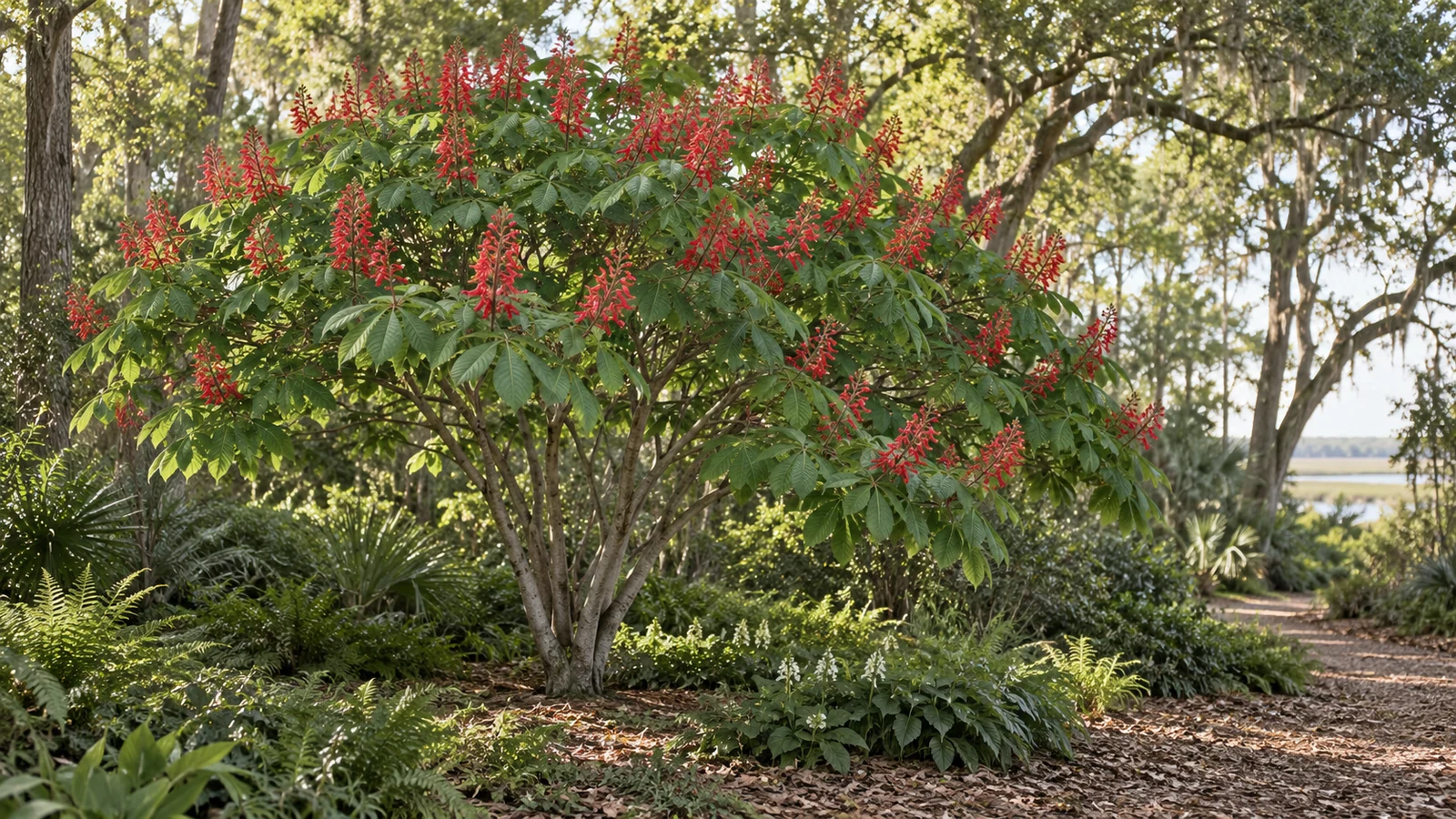
Illustrative planting concept
Size and space
Mature height: 15–20 ft. Mature spread: 15–25 ft.
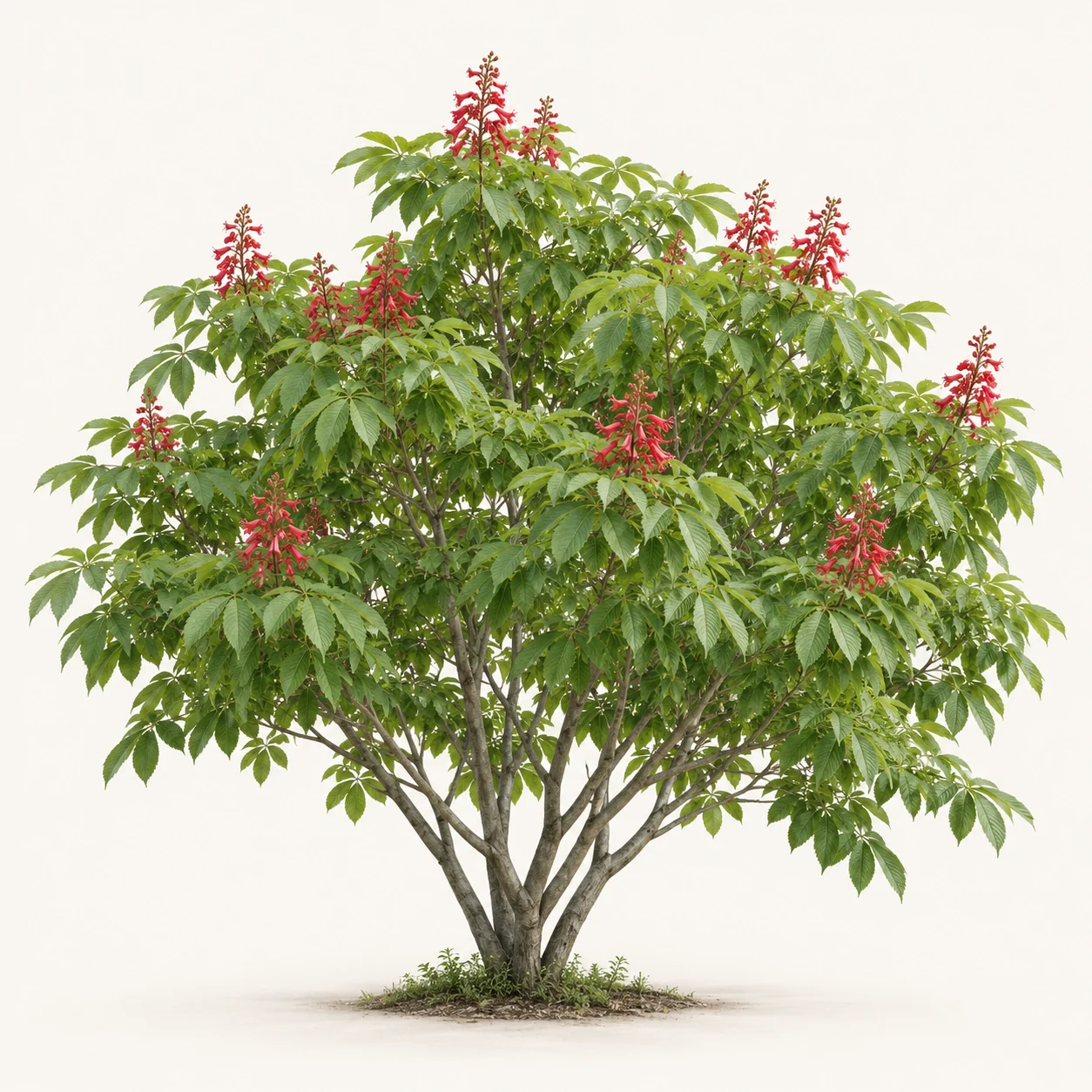
UF/IFAS lists 15–20 ft high and 15–25 ft wide for cultivated trees, with taller specimens possible in the wild. The broad spread and low branching are part of the planning decision. The illustration shows a leafy stage, not an assurance of a full crown through every summer.
Installed example: 5 ft high × 4 ft wide. This is an illustrative size, not a pot-size or growth-timeline promise.
Part shade; protect from hot afternoon sun · Prefer moist, well-drained soil; water during establishment and dry spells · Red tubular spring flowers · broad compound leaves · early leaf drop can occur
Care: Retain a natural low crown where practical and assess heat or drought stress before reacting to leaf loss
Know the whole plant
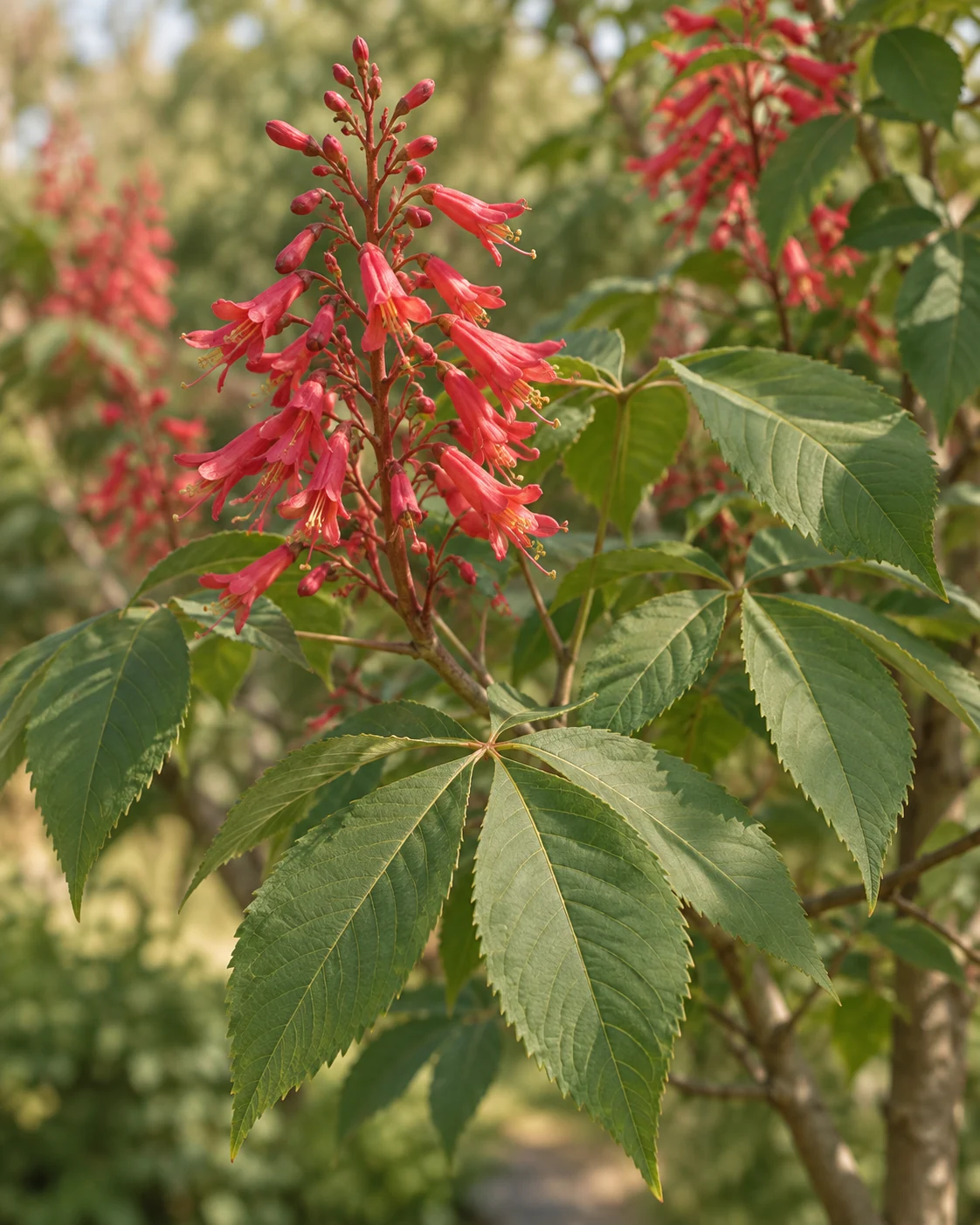
Illustrative Red Buckeye in a leafy spring stage; low branching and early seasonal leaf loss affect its year-round appearance.Illustrative red tubular flowers and palmately compound leaves; this is an ornamental plant with an ingestion caution.
Where it works around Pensacola
A sheltered Pensacola woodland edge or a garden with morning light and afternoon protection is a useful starting point. Treat Red Buckeye as a seasonal accent within a larger composition. Let nearby planting provide continuity when its leaves are sparse, and keep access and household use central to the placement decision.
A sheltered spring-flowering accent
A native woodland garden layer
A seasonal focal point viewed from the house
A nectar planting with considered access
A low branching tree in a generous mixed border
Is this an appropriate place for a toxic plant?
Consider children, pets and anyone likely to pick up seeds or chew foliage. If ingestion is a realistic concern, choose another tree for that part of the garden.
What will the garden look like after leaf drop?
Make the surrounding composition work when the buckeye is bare or sparse. A seasonal tree does not need to do every visual job in the landscape.
Can its low branches stay clear of movement?
Reserve width for the full crown and locate the walking route outside it. Choose the plant for its natural form rather than planning to remove most of the lower structure.
Will the site stay suitable in summer?
Review afternoon heat and soil moisture before planting. A sheltered-looking corner can still become hot and dry beside reflective walls or pavement.
Before it goes on the plan
Are buckeye seeds edible?
No. The plant is poisonous if ingested, including its seeds. It belongs in an ornamental decision with household use considered, not an edible landscape selection.
Why might it lose leaves before autumn?
Early leaf loss can occur, particularly with summer heat and drought. Check the tree and its site conditions rather than assuming leaf loss always means the plant has died.
Does it need full sun for flowers?
It can flower in shade, and afternoon protection is useful in hot settings. A suitable balance of light, moisture and shelter matters more than placing it in the hottest open spot.
Pairing ideas
American Fringetree: American Fringetree provides white spring flowers and a different leaf texture. Compare the two around site conditions and household needs before selecting the focal tree.
Florida Anise: Florida Anise can provide a separate green mass in a compatible moist, sheltered site. Leave room for both plants and remember that Florida Anise is not a culinary plant.
{"key":"redbuckeye","id":"PLT-AESC-PAVIA","slug":"red-buckeye","name":"Red Buckeye","botanical":"Aesculus pavia","h":[15,20],"w":[15,25],"install":[5,4],"treeForm":"rounded","color":"#738453","native":true,"type":"trees","categoryLabel":"Trees","reviewDate":"2026-09-08","guideKind":"Native sheltered flowering-tree guide","eyebrow":"RED SPRING FLOWERS + A LOW OPEN CROWN","benefit":"Give a sheltered garden a spring moment to look forward to.","intro":"Red Buckeye offers a concentrated spring display rather than a year-round flower show. Its upright red blooms rise above large divided leaves, creating a strong accent in a quieter garden. Place it where the seasonal change can be enjoyed from a distance and where its broad, low branches have their own space.","light":"Part shade; protect from hot afternoon sun","lightTags":["part","shade"],"water":"Prefer moist, well-drained soil; water during establishment and dry spells","season":"Red tubular spring flowers · broad compound leaves · early leaf drop can occur","care":"Retain a natural low crown where practical and assess heat or drought stress before reacting to leaf loss","caution":"All parts are poisonous to people and toxic to pets if eaten. Avoid placement where ingestion is likely. Red Buckeye can lose leaves early, especially under heat or drought stress, and should not carry the garden’s year-round privacy or summer-shade role.","site":"A sheltered Pensacola woodland edge or a garden with morning light and afternoon protection is a useful starting point. Treat Red Buckeye as a seasonal accent within a larger composition. Let nearby planting provide continuity when its leaves are sparse, and keep access and household use central to the placement decision.","sizeNote":"UF/IFAS lists 15–20 ft high and 15–25 ft wide for cultivated trees, with taller specimens possible in the wild. The broad spread and low branching are part of the planning decision. The illustration shows a leafy stage, not an assurance of a full crown through every summer.","uses":["A sheltered spring-flowering accent","A native woodland garden layer","A seasonal focal point viewed from the house","A nectar planting with considered access","A low branching tree in a generous mixed border"],"checks":[["Is this an appropriate place for a toxic plant?","Consider children, pets and anyone likely to pick up seeds or chew foliage. If ingestion is a realistic concern, choose another tree for that part of the garden."],["What will the garden look like after leaf drop?","Make the surrounding composition work when the buckeye is bare or sparse. A seasonal tree does not need to do every visual job in the landscape."],["Can its low branches stay clear of movement?","Reserve width for the full crown and locate the walking route outside it. Choose the plant for its natural form rather than planning to remove most of the lower structure."],["Will the site stay suitable in summer?","Review afternoon heat and soil moisture before planting. A sheltered-looking corner can still become hot and dry beside reflective walls or pavement."]],"faq":[["Are buckeye seeds edible?","No. The plant is poisonous if ingested, including its seeds. It belongs in an ornamental decision with household use considered, not an edible landscape selection."],["Why might it lose leaves before autumn?","Early leaf loss can occur, particularly with summer heat and drought. Check the tree and its site conditions rather than assuming leaf loss always means the plant has died."],["Does it need full sun for flowers?","It can flower in shade, and afternoon protection is useful in hot settings. A suitable balance of light, moisture and shelter matters more than placing it in the hottest open spot."]],"sources":[["UF/IFAS · Red Buckeye dimensions and landscape form","https://ask.ifas.ufl.edu/publication/ST064"],["UF/IFAS Gardening Solutions · Red Buckeye and ingestion caution","https://gardeningsolutions.ifas.ufl.edu/plants/trees-and-shrubs/trees/red-buckeye/"],["NC State Extension · Red Buckeye heat and early leaf drop","https://plants.ces.ncsu.edu/plants/aesculus-pavia/"]],"wholeCaption":"Illustrative Red Buckeye in a leafy spring stage; low branching and early seasonal leaf loss affect its year-round appearance.","detailCaption":"Illustrative red tubular flowers and palmately compound leaves; this is an ornamental plant with an ingestion caution.","aliases":["red buckeye","scarlet buckeye","aesculus pavia","red flowers","spring","shade","hummingbirds"],"goals":["color"],"images":{"context":{"id":"6aa0255cfb5859d9790cf56b","url":"https://cdn.prod.website-files.com/6a975baac0f352647862d847/6aa0255cfb5859d9790cf56b_landova-tree-redbuckeye-context.webp","alt":"Illustrative planting concept with Red Buckeye","width":1600,"height":900},"whole":{"id":"6aa0255c11322ec0db360c56","url":"https://cdn.prod.website-files.com/6a975baac0f352647862d847/6aa0255c11322ec0db360c56_landova-tree-redbuckeye-whole.webp","alt":"Illustrative whole-plant form of Red Buckeye","width":1254,"height":1254,"fit":"contain"},"detail":{"id":"6aa0255c87f75551d4f71aa0","url":"https://cdn.prod.website-files.com/6a975baac0f352647862d847/6aa0255c87f75551d4f71aa0_landova-tree-redbuckeye-detail.webp","alt":"Illustrative foliage and seasonal detail of Red Buckeye","width":1122,"height":1402}},"companions":[{"slug":"american-fringetree","name":"American Fringetree","title":"Compare a different spring flower","reason":"American Fringetree provides white spring flowers and a different leaf texture. Compare the two around site conditions and household needs before selecting the focal tree.","image":{"id":"6aa01713d9c686655a9ae785","url":"https://cdn.prod.website-files.com/6a975baac0f352647862d847/6aa01713d9c686655a9ae785_landova-tree-fringetree-context.webp","alt":"Illustrative planting concept with American Fringetree","width":1600,"height":900}},{"slug":"florida-anise","name":"Florida Anise","title":"Give the composition an evergreen neighbor","reason":"Florida Anise can provide a separate green mass in a compatible moist, sheltered site. Leave room for both plants and remember that Florida Anise is not a culinary plant.","image":{"id":"6a9f3484598f07756d53faf0","url":"https://cdn.prod.website-files.com/6a975baac0f352647862d847/6a9f3484598f07756d53faf0_landova-shrub-anise-context-r02.webp","alt":"Illustrative planting concept with Florida Anise"}}]}
LANDOVA / PLANTING DECISIONS
Choose plants with the whole space in mind.
Explore a planting goal, then compare the growing needs and mature size of individual plants.
LANDOVA is in beta
Join the launch waitlist.
We are not accepting paying clients yet. We expect to launch around January 2027 and may open sooner. Explore our free tools now, and sign up for launch updates and educational planning emails.
Thank you. Your waitlist signup has been received. We will email you with launch updates. No purchase or project booking has been made.
We could not save your signup. Please try again or email info@landovadesign.com.