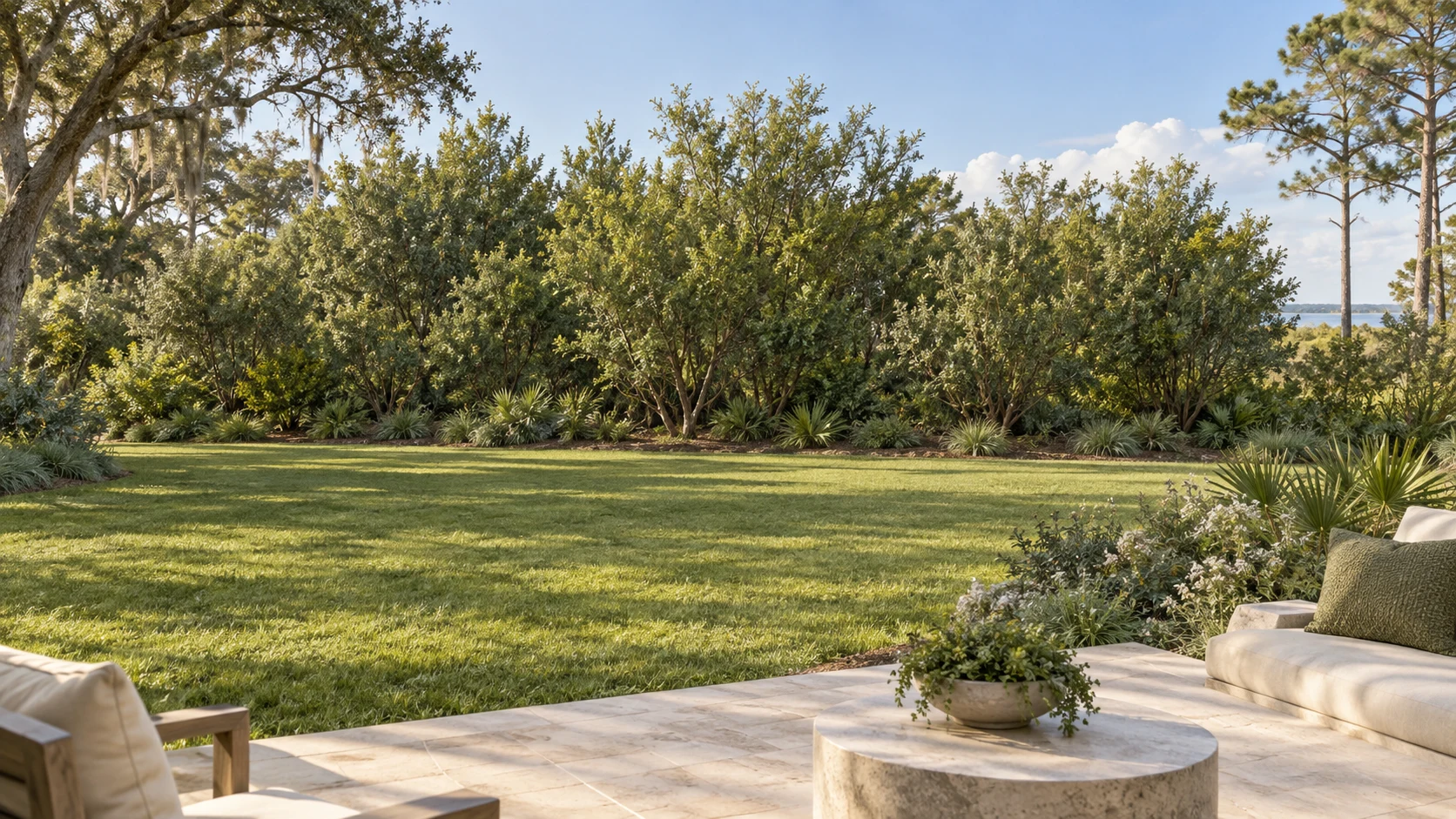
Wax myrtle can turn a generous property edge into an informal evergreen screen with wildlife value. Think of it as a large shrub that can become a small tree, and put the full canopy into the plan before filling a narrow gap.
Illustrative planting concept
Size and space
Mature range: 15–25 ft high × 8–10 ft wide.
Allow a substantial natural plant: roughly 15–25 ft high with an 8–10 ft spread is a useful published planning range. Many maintained plants are smaller, while old specimens can become much larger, including wider crowns. This is the species, not a dwarf cultivar or a guaranteed ten-foot-wide screen.
Compare with a six-foot person: installed example 4 ft high by 3 ft wide. This example is not a fixed pot size or a growth timeline.
Sun to part shade · Water to establish; adaptable once settled · Evergreen; small waxy fruit on female plants
Where it works around Pensacola
A native option for Pensacola-area screening and generous mixed borders. Sheltered coastal gardens and direct Gulf-front exposure are different: UF/IFAS Panhandle trials documented salt-spray damage in exposed dune locations. Place away from building walls and fire features because the foliage is flammable.
An informal property-edge screen
A wildlife-supporting mixed border
A natural backdrop beyond open lawn
A large garden with room for multiple stems
A sheltered coastal planting away from structures
Is the screen far enough from structures?
Use this plant at a generous garden edge rather than tight against building walls or an outdoor fire feature. Leave room to inspect, prune and clear dry material without working inside a crowded planting.
Will it block a view you want to keep?
A small installed shrub may grow above a fence and become tree-sized. Check the sightline from both standing and seated positions, and consider what shade the mature planting will cast on the rest of the garden.
Is this a sheltered yard or an exposed beachfront?
Do not use a general salt-tolerant label as a substitute for site assessment. Direct spray, wind and protective landforms change the conditions substantially, even within the same coastal neighborhood.
Can the natural edge be maintained?
Allow access to manage new shoots and unwanted expansion. An informal screen still needs observation, especially along a property line or future route for construction equipment.
Before it goes on the plan
Will every plant produce berries?
No. Male and female flowers occur on separate plants; fruit develops on female plants with suitable pollination. Ask the nursery about the stock if wildlife fruit is an important goal.
Is it a shrub or a tree?
It can function as either depending on age and training. This guide includes it with screening shrubs because of its landscape use, while showing the substantial size it can reach naturally.
Can it solve a drainage problem?
Plant tolerance does not fix the cause of unwanted water movement. Review grades, stormwater routes and neighboring properties first, then choose plants suited to the resulting conditions.
Pairing ideas
Pride of Houston Yaupon Holly: Pride of Houston yaupon can diversify a spacious native screen. Give each large shrub its own footprint and confirm light, access and the eventual canopy height.
Florida Anise: Florida anise can occupy a separate shaded, consistently moist area of the wider garden. It is a companion in the overall plan, not a recommendation to put both plants in identical exposure.
{"key":"wax","id":"PLT-MORE-CERIFERA","slug":"southern-wax-myrtle","name":"Southern Wax Myrtle","botanical":"Morella cerifera · synonym Myrica cerifera","eyebrow":"NATIVE SCREENING / ROOM FOR A NATURAL EDGE","benefit":"Build privacy with a softer native edge.","intro":"Wax myrtle can turn a generous property edge into an informal evergreen screen with wildlife value. Think of it as a large shrub that can become a small tree, and put the full canopy into the plan before filling a narrow gap.","h":[15,25],"w":[8,10],"install":[4,3],"color":"#65734B","habit":"Informal native evergreen shrub or small tree","light":"Sun to part shade","lightTags":["sun","part"],"water":"Water to establish; adaptable once settled","season":"Evergreen; small waxy fruit on female plants","care":"Selective pruning; manage unwanted shoots","site":"A native option for Pensacola-area screening and generous mixed borders. Sheltered coastal gardens and direct Gulf-front exposure are different: UF/IFAS Panhandle trials documented salt-spray damage in exposed dune locations. Place away from building walls and fire features because the foliage is flammable.","sizeNote":"Allow a substantial natural plant: roughly 15–25 ft high with an 8–10 ft spread is a useful published planning range. Many maintained plants are smaller, while old specimens can become much larger, including wider crowns. This is the species, not a dwarf cultivar or a guaranteed ten-foot-wide screen.","uses":["An informal property-edge screen","A wildlife-supporting mixed border","A natural backdrop beyond open lawn","A large garden with room for multiple stems","A sheltered coastal planting away from structures"],"checks":[["Is the screen far enough from structures?","Use this plant at a generous garden edge rather than tight against building walls or an outdoor fire feature. Leave room to inspect, prune and clear dry material without working inside a crowded planting."],["Will it block a view you want to keep?","A small installed shrub may grow above a fence and become tree-sized. Check the sightline from both standing and seated positions, and consider what shade the mature planting will cast on the rest of the garden."],["Is this a sheltered yard or an exposed beachfront?","Do not use a general salt-tolerant label as a substitute for site assessment. Direct spray, wind and protective landforms change the conditions substantially, even within the same coastal neighborhood."],["Can the natural edge be maintained?","Allow access to manage new shoots and unwanted expansion. An informal screen still needs observation, especially along a property line or future route for construction equipment."]],"faq":[["Will every plant produce berries?","No. Male and female flowers occur on separate plants; fruit develops on female plants with suitable pollination. Ask the nursery about the stock if wildlife fruit is an important goal."],["Is it a shrub or a tree?","It can function as either depending on age and training. This guide includes it with screening shrubs because of its landscape use, while showing the substantial size it can reach naturally."],["Can it solve a drainage problem?","Plant tolerance does not fix the cause of unwanted water movement. Review grades, stormwater routes and neighboring properties first, then choose plants suited to the resulting conditions."]],"sources":[["Escambia County Extension · local wax myrtle guidance","https://blogs.ifas.ufl.edu/escambiaco/2024/02/14/weekly-what-is-it-wax-myrtle/"],["UF/IFAS · Florida Panhandle dune and salt-spray research","https://ask.ifas.ufl.edu/publication/SG176"],["NC State Extension · wax myrtle habit and dimensions","https://plants.ces.ncsu.edu/plants/myrica-cerifera/"],["UF/IFAS · wax myrtle size and growth habit","https://ask.ifas.ufl.edu/publication/AG336"]],"companions":[{"slug":"yaupon-holly-pride-of-houston","name":"Pride of Houston Yaupon Holly","title":"A SECOND NATIVE SCREENING LAYER","reason":"Pride of Houston yaupon can diversify a spacious native screen. Give each large shrub its own footprint and confirm light, access and the eventual canopy height.","image":{"id":"6a9f29174f259866ad352562","url":"https://cdn.prod.website-files.com/6a975baac0f352647862d847/6a9f29174f259866ad352562_landova-shrub-yaupon-context.webp","alt":"Illustrative planting concept with Pride of Houston Yaupon Holly"}},{"slug":"florida-anise","name":"Florida Anise","title":"A SHELTERED, MOISTER POCKET","reason":"Florida anise can occupy a separate shaded, consistently moist area of the wider garden. It is a companion in the overall plan, not a recommendation to put both plants in identical exposure.","image":{"id":"6a9f3484598f07756d53faf0","url":"https://cdn.prod.website-files.com/6a975baac0f352647862d847/6a9f3484598f07756d53faf0_landova-shrub-anise-context-r02.webp","alt":"Illustrative planting concept with Florida Anise"}}],"wholeCaption":"Illustrative study of an informal, multi-stem wax myrtle. Natural growth and pruning can produce very different outlines.","detailCaption":"Illustration of narrow olive-green leaves and small waxy fruit on a female branch. Fruit production depends on plant sex and pollination.","wholeFit":"contain","images":{"context":{"id":"6a9f4a4c34e3816a79a3092a","url":"https://cdn.prod.website-files.com/6a975baac0f352647862d847/6a9f4a4c34e3816a79a3092a_landova-wax-context-r04.webp","alt":"Illustrative planting concept with Southern Wax Myrtle"},"whole":{"id":"6a9f4a4c08509c4e04d26c00","url":"https://cdn.prod.website-files.com/6a975baac0f352647862d847/6a9f4a4c08509c4e04d26c00_landova-wax-whole-r04.webp","alt":"Illustrative view of Southern Wax Myrtle overall form","fit":"contain"},"detail":{"id":"6a9f4a4ca2f1b48a17ba23c5","url":"https://cdn.prod.website-files.com/6a975baac0f352647862d847/6a9f4a4ca2f1b48a17ba23c5_landova-wax-detail-r04.webp","alt":"Illustrative view of Southern Wax Myrtle foliage and seasonal detail"}},"caution":"A large native screen; keep away from building walls and fire features. Older plants can grow larger."}
LANDOVA / PLANTING DECISIONS
Choose plants with the whole space in mind.
Explore a planting goal, then compare the growing needs and mature size of individual plants.
LANDOVA is in beta
Join the launch waitlist.
We are not accepting paying clients yet. We expect to launch around January 2027 and may open sooner. Explore our free tools now, and sign up for launch updates and educational planning emails.
Thank you. Your waitlist signup has been received. We will email you with launch updates. No purchase or project booking has been made.
We could not save your signup. Please try again or email info@landovadesign.com.